CBSE Class 12 Chemistry 2026 Solved Previous Year Paper
CBSEChemistry2026 Previous Year Paper
Paper code: 56/5/1 · 2026Practise with the full English-language 2026 CBSE Class 12 Chemistry main board paper (56/5/1), then use the worked explanations to review your reasoning. The paper gives you three hours to attempt 70 marks across five sections.
This set is one of the year's papers. See every set from 2026, grouped by series.
What the 2026 paper asks you to do
This year-wise resource presents one complete board paper rather than a collection of questions sorted by chapter. The question pages retain the English layout, options and diagrams, so you can practise reading the paper as printed. The cover index lets you jump to a question, and the worked solutions are set out with the formula, concept and explanation in steps. Keep the solutions closed during your first attempt if you want to see what you can do independently.
The paper has 33 compulsory questions. Section A contains 16 one-mark multiple-choice questions, including four assertion–reason items. Section B has five two-mark very short answers, and Section C has seven three-mark short answers. Section D contains two four-mark case-based questions, and Section E contains three five-mark long answers. There is no overall choice: where an internal OR is printed, attempt one alternative, not both. Some questions in Sections B through E offer internal choices; Section A does not. Calculators are not allowed.

Chemistry 2026 | Class 12 | Previous Year Paper | Code 56/5/1
In the StudentCurio app
A complete solved CBSE Class 12 Chemistry main examination paper for 2026, covering questions across multiple chapters with worked explanations. It helps students practise board-exam questions and review their solutions.
Physical chemistry: When the formula applies
The physical chemistry questions cover solutions, chemical kinetics and electrochemistry. In solutions, the paper moves between gas solubility, colligative properties, and ideal and non-ideal behaviour. Start by identifying the quantity the question asks for: molality measures moles of solute per kilogram of solvent, whereas molarity measures moles per litre of solution. Both can appear in the same chapter, but they are not interchangeable. When a question specifies complete dissociation, use that assumption in treating the number of dissolved particles rather than carrying it over to every solution problem.
In kinetics, distinguish a change in rate caused by changing a reactant concentration from a change in the rate constant with temperature. The half-life shortcut in this paper applies to a first-order reaction; do not treat it as a general rule for all reaction orders. For the cell-emf question, read the given concentrations before choosing your method. Standard electrode potentials provide a starting point, but they do not by themselves give the emf under the stated nonstandard conditions.
Organic chemistry: Use the conditions, not just the reagent name
Organic questions range from recognising named reactions and tests to planning conversions, comparing reactivity and explaining reaction outcomes. A useful way to review a conversion is to identify what changes between the starting material and the target: the functional group, the carbon skeleton or the atom through which a group is attached. Then check whether the reagent and conditions account for that change. This is more useful than memorising reagent names in isolation, particularly when a question combines familiar reactions in an unfamiliar sequence.
The ether case study makes substrate choice matter: the passage contrasts substitution in Williamson synthesis with elimination when a tertiary alkyl halide is used. The paper also tests acidity, basicity and aromatic substitution. When reviewing those questions, keep ring activation separate from directing effect. One describes how readily the ring reacts; the other describes where substitution is favoured. A statement about one does not automatically settle the other.
Inorganic chemistry and biomolecules: Keep related terms distinct
The inorganic questions cover coordination nomenclature, ligand types, isomerism, oxidation states, colour and magnetism. When reviewing a complex, separate the species inside the coordination sphere from ions outside it. The distinction matters both when naming the compound and when interpreting a precipitation observation. For a comparison of paramagnetism, check the electron configuration of the ion, not just that of the neutral atom. The number of unpaired electrons is the relevant comparison in the question.
The biomolecules questions ask you to distinguish carbohydrate classes, levels of protein structure and categories of vitamins and amino acids. One notation trap is worth watching for: D/L labels indicate relative configuration, while (+)/(−) indicate the direction of optical rotation. Do not infer one from the other. In an assertion–reason item, judge each statement on its own before deciding whether the reason actually explains the assertion.
Case-based questions: Separate the rule from the evidence
Section D pairs a passage on ethers with one on electrolysis. In the ether case, note which statements concern preparation, which concern bond cleavage and which concern substitution on an aromatic ring. They describe different processes, so the rule you use must match the subpart. In the electrolysis case, distinguish a question about which product forms from one about how much charge is transferred. Product prediction calls for attention to the species present and the electrodes; a charge calculation calls for tracking electrons. In either case, use the passage to locate the relevant principle, then check the particular conditions in the subpart.
Use the worked pages to find your first wrong step
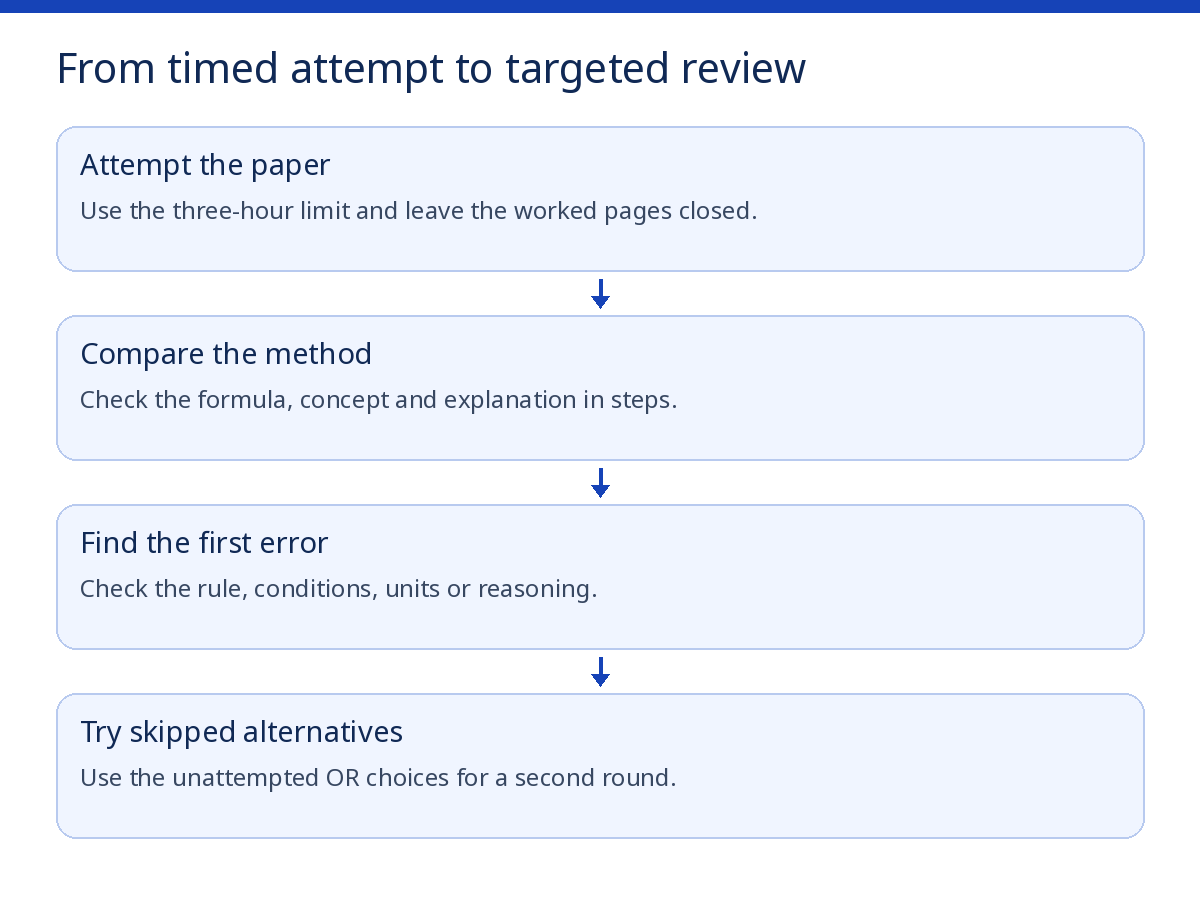
After a timed attempt, compare your work with the explanation from the point where you first diverged. If the formula differs, check the conditions for using it. If the formula matches but the calculation differs, look at units, signs or substitution before treating it as a gap in your understanding. For a written explanation, check whether you gave the chemical reason rather than merely restating the trend. Finally, try the internal alternatives you skipped. Those alternatives give you extra practice after the mock without changing what you were expected to attempt under exam conditions.
Spotted an error? Report a correction. Practise this in the app: notes, formula sheets and mind maps.















































































































































Loading comments…