Amines NCERT Solutions for CBSE Class 12 Chemistry
CBSEChemistryAmines
Use these worked NCERT in-text and exercise solutions to revise how amine structure affects basicity, chemical tests and reactions. The guide shows what to check when comparing compounds or planning a conversion.
Find the matching NCERT question
The file is organised into Intext Solutions and Exercise Solutions. The in-text questions move from classification and isomerism to preparations, aqueous basicity, ammonium salts and reactions of aniline. The exercises ask you to apply those ideas in naming questions, property comparisons, chemical tests and multi-step conversions. For example, after revising how to classify an amine in the in-text section, you can use the exercise section to practise classifying a structure and naming it correctly.
The file labels Amines as Chapter 9, while its edition note explains that another edition numbers it Chapter 13. Exercise 13.3 in that numbering corresponds to Exercise 9.3 in the file, and the in-text numbering follows the same pattern. If your textbook uses Chapter 13, match the question within the correct section rather than searching for the chapter number alone.

Amines | Class 12 | NCERT Solutions
In the StudentCurio app
Provides worked NCERT in-text and exercise solutions on amine properties and basicity, preparation and conversions, named reactions, chemical tests, aniline reactions and diazonium chemistry. Useful for Class 12 CBSE students practising and revising the Amines chapter.
Common mistake: classifying the carbon instead of nitrogen
To decide whether an amine is primary, secondary or tertiary, count the carbon groups bonded directly to nitrogen. Branching elsewhere does not change that count. An amine with an group is still primary if the carbon carrying that group is bonded to three other carbons. In names, an N- locant tells you that a substituent is attached to nitrogen rather than to a numbered carbon in the parent structure.
For isomerism questions, first make sure the structures have the same molecular formula, then identify what has changed. A different carbon skeleton is not the same as moving the nitrogen attachment along the same skeleton. The in-text solutions also illustrate metamerism by comparing how the same total number of carbons is distributed between the two groups on nitrogen in secondary amines.
Before ranking basicity, check the medium
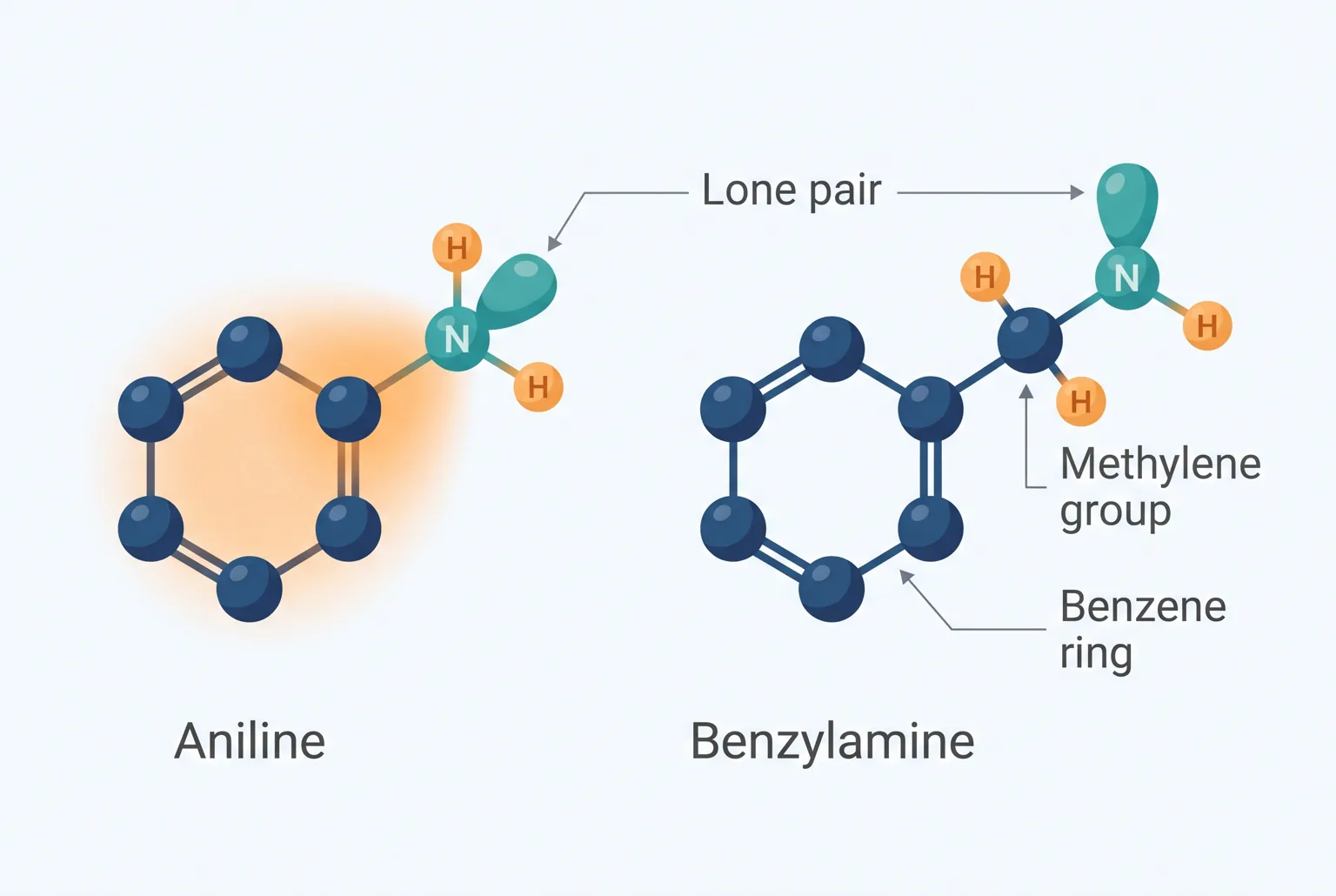
The basicity comparisons distinguish two questions: how available is the nitrogen lone pair for protonation, and how well is the resulting ammonium ion stabilised? In aniline, the lone pair is delocalised into the aromatic ring. In benzylamine, a methylene group separates nitrogen from the ring and interrupts that conjugation. Two compounds can therefore both contain a benzene ring without the ring affecting their lone pairs in the same way.
In water, hydration of the protonated amine matters alongside electron donation from alkyl groups. Hydration does not contribute in the gas phase, so do not carry an aqueous ranking into a gas-phase question. Also check whether the question asks for basic strength or for . Since , a stronger base has a larger but a smaller .
Connect chemical tests to observable changes
The solutions distinguish between naming a test and stating what it reveals. The carbylamine test detects primary aliphatic and aromatic amines through isocyanide formation; secondary and tertiary amines do not give that reaction. By contrast, Hinsberg’s test distinguishes classes by considering both the reaction with benzenesulphonyl chloride and the behaviour in alkali and after acidification.
When reading the Hinsberg solution, track which substance is present at each stage. The sulphonamide formed from a primary amine retains an N–H bond and can form a soluble conjugate base in alkali. The secondary amine derivative lacks that bond. A tertiary amine does not form a sulphonamide, but it can be protonated by dilute acid to form an ammonium salt. This distinction explains why an observation after acidification need not come from a sulphonamide at all.
A useful check for conversions: count the carbons
Before checking the reagents in a worked conversion, compare the carbon counts of the starting material and target. In the file’s chain-extension examples, substitution of a halide by cyanide introduces a carbon. That carbon stays in the chain when the nitrile is reduced to an amine. Hofmann bromamide degradation does the opposite: a primary amide gives a primary amine with one fewer carbon, because the carbonyl carbon is lost from the organic product.
Carbon count helps identify a suitable route, but the starting functional group still has to fit the reaction. Gabriel phthalimide synthesis uses substitution with a suitable unhindered alkyl halide. Ordinary aryl halides do not give primary arylamines by this route. Compare this with ammonolysis: excess ammonia favours primary amine formation, but further alkylation can still occur.
Track what reacts in aniline and diazonium chemistry
In the aromatic exercises, distinguish reaction at nitrogen from substitution on the ring. Free aniline directs electrophilic substitution to ortho and para positions. In the strongly acidic nitrating medium, however, protonation produces the anilinium ion, which directs substitution meta. The protection example illustrates a different strategy: acetylating nitrogen moderates ring activation before bromination. The form of the amino group at the ring-substitution step is therefore part of the explanation, not just a detail in the reaction sequence.
Cold acidic conditions at 273–278 K allow a primary aromatic amine to form an arenediazonium salt. Simple alkyldiazonium intermediates, by contrast, readily lose nitrogen. When using the aromatic conversions to revise, distinguish replacement, in which the diazonium group leaves and nitrogen gas is released, from azo coupling, in which the nitrogen atoms become part of the linkage between aromatic groups.
Spotted an error? Report a correction. Practise this in the app: notes, formula sheets and mind maps.















































































































































Loading comments…