CBSE Class 12 Chemistry 2022 Supplementary Paper Guide
CBSEChemistry2022 Previous Year Paper
Paper code: 56/6/2 · 2022Use this solved, year-wise paper to practise the 2022 CBSE Class 12 Chemistry supplementary examination in its original Term II format. The guide shows how to attempt paper 56/6/2 under timed conditions and use the worked solutions to diagnose mistakes across physical, inorganic and organic chemistry.
This set is one of the year's papers. See every set from 2022, grouped by series.
What the 2022 Term II paper looks like
This is the full English version of the CBSE Class 12 Chemistry theory supplementary paper for 2022, code 56/6/2. It is organised by year rather than by chapter. The original paper allows two hours for 35 marks, with a separate 15-minute reading period. Calculators and log tables are not allowed. Use these conditions to recreate this particular examination, not as a description of the current board-paper format.
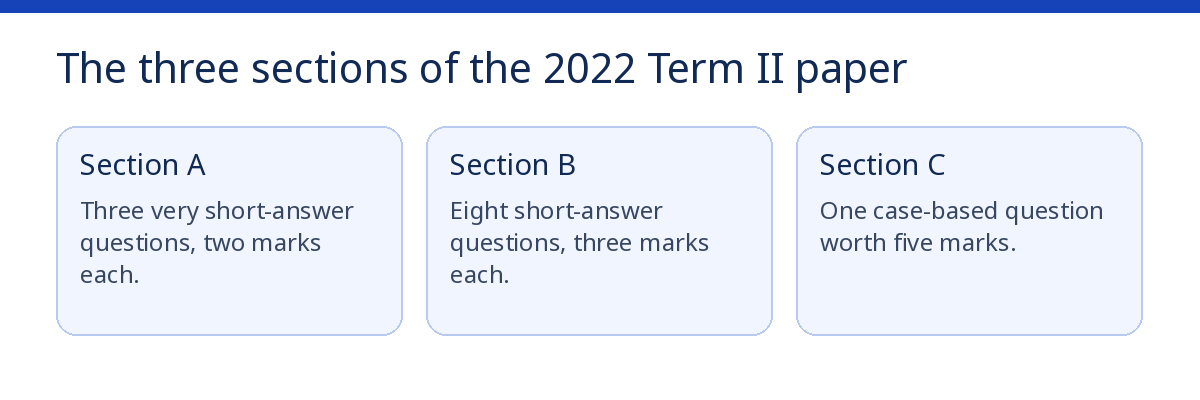
Section A has three very short-answer questions worth two marks each. Section B has eight short-answer questions worth three marks each. Section C has one five-mark case-based question. The paper lists 12 compulsory questions, but that does not mean every printed alternative is required: follow the directions within a question, including instructions to select subparts and any printed OR choices.

Chemistry Supplementary 2022 | Class 12 | Previous Year Paper | Code 56/6/2
In the StudentCurio app
Solved CBSE Class 12 Chemistry supplementary examination paper for 2022 (Term II, code 56/6/2), covering questions across physical, inorganic and organic chemistry. It helps students practise board-style questions and review worked solutions.
Plan a first attempt without the solutions
During the reading period, identify which questions ask for a definition, a calculation, a reason or a reaction. For questions with internal choice, read both branches before deciding. Check the subparts as well as the main topic: being comfortable with the first part of an option does not tell you whether you can complete the rest. In the writing period, label each subpart so you can match it easily to the corresponding worked solution.
The file preserves the original question layout, options and diagrams and provides question-number navigation. Stay in the question-paper pages for the first attempt. Save the unattempted alternatives for a later session; they let you practise concepts that your chosen branch did not test without repeating the entire paper.
When the physical chemistry rules apply
In chemical kinetics, the paper tests half-life, reaction order, and the interpretation of a concentration–time plot. Before using a graph, check the axes: taking the logarithm of concentration changes what a straight line means and how its slope relates to the rate constant. In a decomposition calculation, distinguish the fraction that has decomposed from the fraction of reactant that remains. Also keep reaction order, which comes from the rate law, separate from molecularity, which applies to an elementary step.
In electrochemistry, distinguish conductivity from molar conductivity. The factor of 1,000 in the paper’s molar-conductivity formula applies when conductivity is in siemens per centimetre and concentration is in moles per litre. The weak-electrolyte calculation additionally uses molar conductivity at infinite dilution as a reference. Write the units and identify the reference quantity before substituting numbers.
From colloid diagrams to inorganic explanations
The surface chemistry question contrasts interpreting a diagram with defining terms. On the diagram route, distinguish the motion of charged colloidal particles in an electric field from their aggregation when charge stabilisation is lost. On the definition route, distinguish adsorption, which concerns accumulation at a surface, from terms that describe a sol’s affinity for its medium or how its particles are constituted.
The inorganic questions ask you to connect electronic configuration to properties rather than simply recall a trend. For an ion, start with its configuration, not the neutral atom’s, when counting unpaired electrons. A spin-only magnetic moment is based on those unpaired electrons; it is not a claim that orbital contributions are always absent. For coordination-compound naming, distinguish ligands inside the coordination sphere from counter-ions outside it before assigning the metal’s oxidation state.
Common mistakes in structure and reaction questions
When naming an aldehyde, include the aldehyde carbon in the parent chain. When classifying an amine, count the carbon groups attached directly to nitrogen, not the total number of carbons in the molecule. For an amine basicity comparison in aqueous solution, do not rely on electron donation alone: stabilisation of the protonated amine by water also matters. For carboxylic acid strength, ask how the substituent affects the stability of the carboxylate ion, rather than looking only at the neutral acid.
The carbonyl case study moves between reaction eligibility, a distinguishing chemical test, a reagent choice and reaction writing. Read the requested task before using the passage: the presence of a carbonyl group alone does not establish eligibility for aldol condensation; an alpha hydrogen is required for the compound to act as the enolate donor.
Use the worked steps to find your first error
The solutions separate the formula or rule, the underlying concept and the explanation in steps. Compare your work with the reasoning before checking the final line. In a calculation, look for the first mismatch in the quantities, units or relationship you used. In a written explanation, check whether you connected the relevant chemical feature to the property being asked about. Then close the solution and rewrite the affected step in your own words or notation.
Before you move on: Can you explain why the units of a rate constant depend on reaction order, or why knowing a neutral metal atom’s configuration is not enough to predict an ion’s magnetic behaviour? Use those checks to decide what to revisit. The detailed reaction sequence in Q12(d)(i) is omitted from this guide because its prompt is incomplete in the supplied text transcription; consult the original PDF page before attempting that branch.
Spotted an error? Report a correction. Practise this in the app: notes, formula sheets and mind maps.















































































































































Loading comments…