CBSE Class 12 Chemistry 2023 Board Paper: Set 56/5/1
CBSEChemistry2023 Previous Year Paper
Paper code: 56/5/1 · 2023Practise with the full 2023 CBSE Class 12 Chemistry main-examination paper, Set 56/5/1. Use the English question paper for a timed attempt, then use the linked worked solutions to check your choice of method, assumptions and reasoning.
This set is one of the year's papers. See every set from 2023, grouped by series.
Know the format before you start
This is a year-wise previous paper for CBSE Class 12 Chemistry theory, not a chapter test. The 2023 set has 35 questions, carries 70 marks and allows three hours of writing time. The printed instructions also specify a separate 15-minute reading period and no calculators.
Section A has 18 one-mark multiple-choice questions, including assertion–reason items. Sections B and C contain two-mark very short answers and three-mark short answers respectively. Section D has two four-mark case-based questions, and Section E has three five-mark long answers. There is no overall choice: all numbered questions are compulsory, with alternatives only where the paper prints an internal choice. During the reading period, check exactly which part an OR applies to before committing to an option.

Chemistry 2023 | Class 12 | Previous Year Paper | Code 56/5/1
In the StudentCurio app
Complete regular CBSE Class 12 Chemistry board paper for 2023, Set 56/5/1, with worked solutions. It includes varied question formats and covers topics across chemical kinetics, coordination compounds, organic chemistry, electrochemistry, solutions and other chapters.
Chemical kinetics: choose the comparison before calculating
The kinetics questions move from reading initial-rate data to explaining the effect of temperature and working with a first-order relationship. In an initial-rate table taken at a fixed temperature, look for two trials in which only one reactant concentration changes. Comparing those trials isolates the effect of that reactant on the initial rate. Reading the order from a coefficient in the overall chemical equation is not a substitute for analysing the data.
A first-order derivation asks for a different kind of reasoning. Before using the integrated rate law, distinguish the fraction reacted from the fraction remaining: the concentration term in the law describes what is still present. Keeping that distinction clear helps you set up a derivation before you do any logarithmic algebra.
Physical chemistry: keep the quantities distinct
The electrochemistry questions range from voltaic cells and electrolysis to a case study on aqueous KCl. For a cell-potential calculation, first identify the oxidation and reduction half-cells. If both tabulated values are standard reduction potentials, use . Balancing electron transfer changes the coefficients in the reaction, not the electrode potentials. Check whether the question asks for a standard potential or an emf at the stated concentrations.
The KCl case moves from resistance measured with a conductivity cell and Wheatstone bridge to a table of conductivity and molar conductivity. Read each trend against its own column and units: conductivity characterises the solution, while molar conductivity relates conductivity to the amount concentration of electrolyte. Treating the names as interchangeable obscures what the table shows.
When a colligative-property formula applies
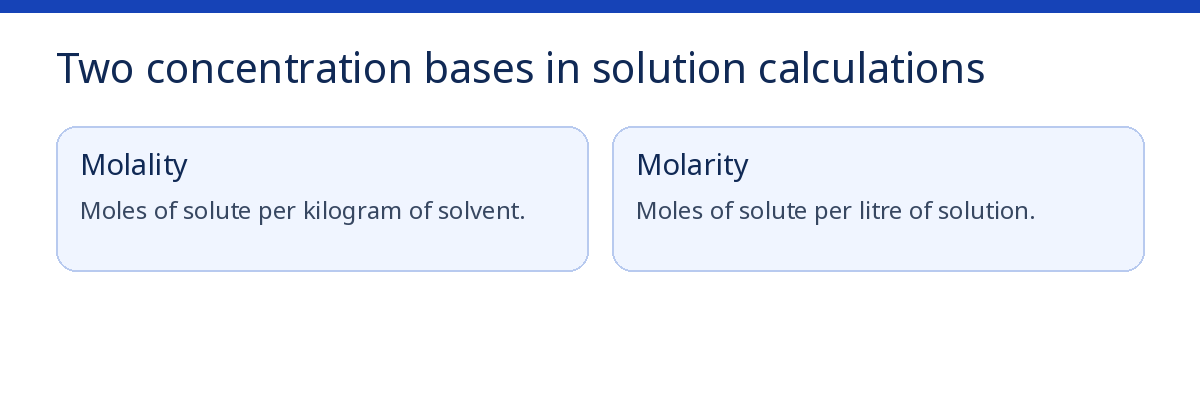
The long-answer alternatives on solutions cover vapour-pressure lowering, boiling-point elevation, freezing-point depression and osmotic pressure. They make useful follow-up practice because the concentration basis changes with the method. Molality uses kilograms of solvent; molarity uses litres of solution. Check the denominator before substituting a mass or volume into a formula.
For boiling-point elevation in the dilute-solution treatment, . Here belongs to the solvent, while the van’t Hoff factor accounts for a change in the effective number of solute particles through association or dissociation. If a problem specifies complete dissociation, state that assumption in your setup. Do not carry it over automatically to a different solute or solvent.
Structure and conditions in inorganic and organic chemistry
Coordination chemistry prompts cover ligand behaviour, linkage isomerism, crystal field theory, geometry and magnetism. For a crystal-field explanation, keep the metal’s oxidation state, its d-electron count and the electron arrangement in the split orbitals separate. Where a question gives the splitting relative to the pairing energy, use that condition rather than assuming an arrangement from the metal name alone. The paper also includes questions on transition metals, lanthanoids and actinoids.
In organic chemistry, the substitution case compares a two-step mechanism with a single-step mechanism. Read solvent effects alongside the substrate structure, leaving group and nucleophile rather than using polarity alone to choose a pathway. Elsewhere, the set asks for explanations of acidity and basicity, functional-group tests and conversions. Biomolecule questions add a different task: using a structural feature to explain a chemical observation.
Quick self-check before opening the worked solutions
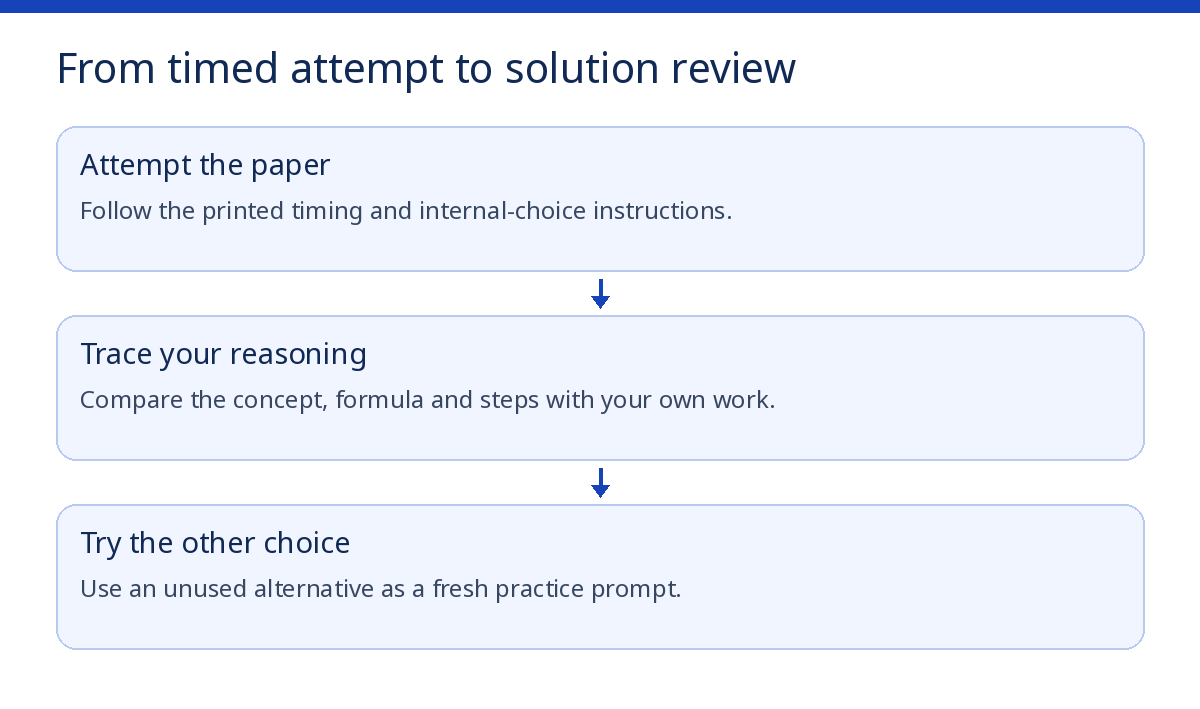
Use the question paper alone for your first attempt. For an assertion–reason item, can you judge each statement independently and then decide whether the reason actually explains the assertion? For a case-based item, can you identify which part of the passage, table or diagram supports your reasoning? For a multipart answer, have you supplied what each prompt asks for, whether that is a reason, equation or calculation?
After the attempt, use the question-number links to compare your work with the resource’s formula, concept and worked steps. If the final result differs, find the first point where your method diverged rather than just replacing the final line. You can then attempt the unused internal alternative separately to see whether you can apply the underlying concept in a different prompt.
Scope of the examples in this guide
Paper details here come from the readable English instructions. The guide leaves out isolated wording, notation or interpretation issues in Q4, Q26(a), Q30(b)(i), Q31, Q32(b), Q34(b)(i) and Q35(c). Those passages are not used as reference examples; the surrounding topics are covered through independently supported parts of the paper.
Spotted an error? Report a correction. Practise this in the app: notes, formula sheets and mind maps.















































































































































Loading comments…