CBSE Class 12 Biomolecules: Case-Based Assessment Guide
CBSEChemistryBiomolecules
This CBSE Class 12 Chemistry assessment gives you 12 cases on carbohydrates, vitamins, amino acids, proteins and nucleic acids. Use the passages and diagrams to practise deciding which chemical concept applies before you open the linked worked solutions.
How to use the assessment PDF
The PDF contains 46 numbered questions and 10 OR alternatives across its 12 case studies. The clickable index points separately to questions and solutions, so you can go straight to a topic without opening its answers. The file includes multiple-choice, short-answer and assertion–reason formats. It is a case-based assessment, not a file with an additional chapter-practice section.
On a first attempt, identify whether you need to interpret a passage, read a structure or apply a rule to numerical data. For a short answer, write down the observation and explain what it supports; for a calculation, state the assumption before doing the arithmetic. Then open the linked solution and use the return link to revisit the exact wording or diagram that informed your answer.

Biomolecules | Class 12 Chemistry | CBSE Case-based Assessment
In the StudentCurio app
Presents CBSE-style case-based questions and worked solutions on carbohydrates, amino acids and proteins, vitamins, and nucleic acids. Helps Class 12 students practise applying Biomolecules concepts in assessment-style questions.
Polysaccharides: connect chain structure with function
The opening case compares starch, glycogen and cellulose. All three are built from glucose, which makes them useful for seeing why the identity of the monomer does not tell you everything about a polymer. The pattern of connections between glucose units, the presence or absence of branches and the way chains pack all help distinguish these materials.
Starch is a plant storage material containing linear amylose and branched amylopectin. Glycogen is another storage polysaccharide, structurally similar to amylopectin. Cellulose plays a different role: its extended chains pack closely and provide support in plant cell walls. When comparing the examples, keep chain architecture separate from biological role. A description such as ‘linear’ is about structure, not a synonym for either storage or support.
Good to remember: D/L and α/β describe different features
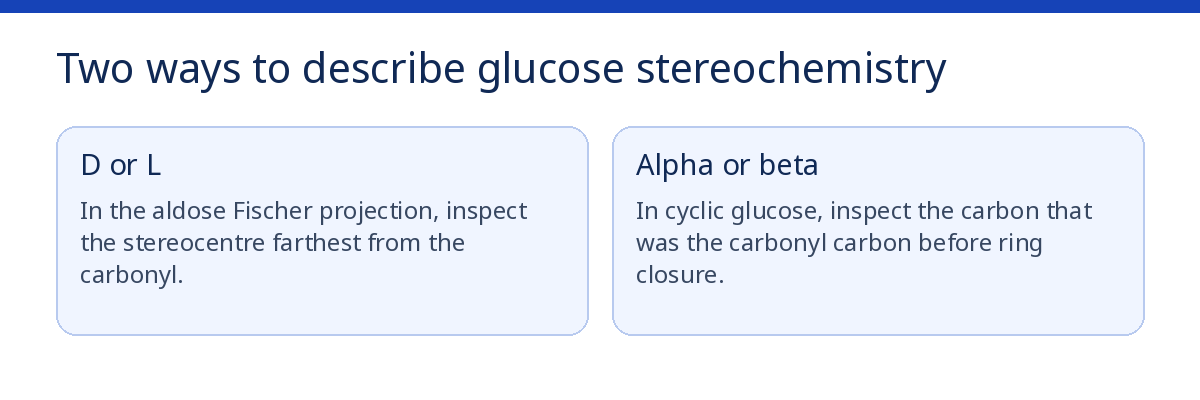
In the Fischer projections of aldoses used in the assessment, D/L configuration is assigned from the hydroxyl group on the stereocentre farthest from the carbonyl group. Read the projection as drawn: horizontal bonds point toward you and vertical bonds point away. The D or L label describes configuration; it does not tell you the direction in which the sugar rotates plane-polarised light.
The Haworth diagrams ask you to look at a different feature. When open-chain glucose cyclises, its aldehyde carbon becomes the anomeric carbon. The two cyclic anomers differ in configuration at that carbon while retaining the same configuration at the other stereocentres. Mutarotation links these drawings to what happens in solution: the anomers interconvert through the open-chain form, and the observed optical rotation changes until equilibrium is reached.
Glucose reactions and vitamins: reason from properties
The glucose cases use reactions alongside structural drawings. When reading a chemical test, first identify what the reagent probes and then ask whether the relevant group is available in the form being tested. A question about a glucose derivative is not necessarily asking what unmodified glucose does under the same conditions. Likewise, a carbohydrate that is drawn as a ring should not automatically be treated as non-reducing: what matters is whether it can access an open-chain form that reacts under the test conditions.
The mixed-topic case also brings in vitamins. Here the reasoning shifts from functional groups and test observations to a relationship between solubility and storage. Read that prompt as a request to explain a property, rather than to list deficiency diseases.
Amino acids: track charge before predicting movement
The ionisation case shows how an amino acid can gain or lose protons as the pH changes. In the structures shown, the amino and carboxyl groups can carry opposite charges at the same time. A zwitterion therefore has charged groups even though its net charge is zero. The isoelectric point concerns the amino acid’s average net charge in solution: at that pH there is no net migration in an electric field. It is not necessarily pH 7.
Peptide sequence is a different kind of question. Instead of tracking protonation, read the fragments as ordered pieces of a chain. When partial hydrolysis produces overlapping fragments, their shared residue can help you work out how the pieces fit. Preserve the order within each fragment rather than treating it as a list of ingredients.
Protein denaturation: distinguish folding from sequence
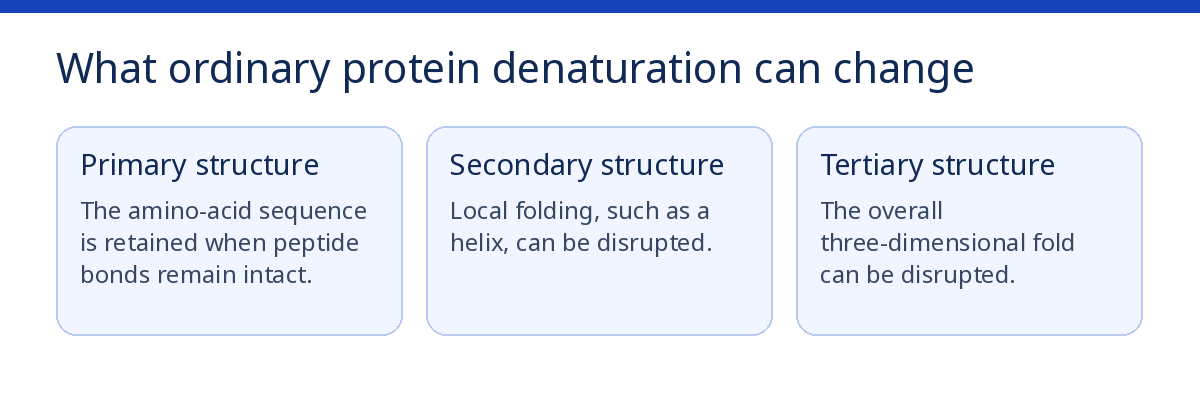
Changes in temperature or pH can disturb a protein’s native folding and reduce or eliminate its biological activity. The protein case connects that change to levels of structure. Primary structure is the amino-acid sequence held together by peptide bonds. Secondary and tertiary structure concern folding: local arrangements such as helices and the overall three-dimensional shape, respectively.
The important distinction is that ordinary denaturation can disrupt secondary and tertiary structure without breaking the peptide bonds that preserve the primary sequence. A protein can therefore lose its function even though its amino acids remain in the same order. This guide omits Case Study 9(i) and its linked answer because the printed single-choice question is ambiguous.
Before a DNA calculation, check what is being counted
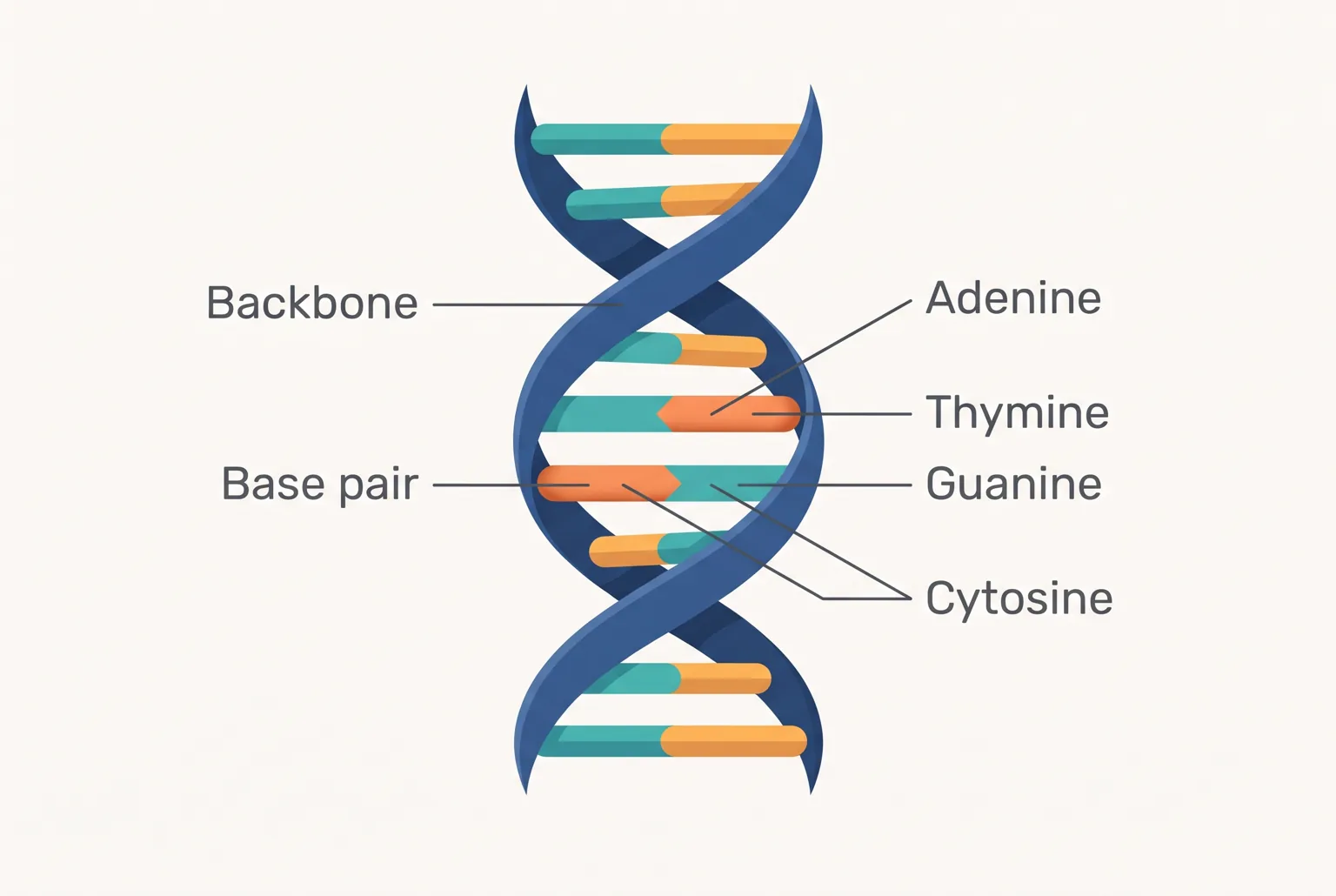
The DNA cases separate the repeating sugar–phosphate backbone from the sequence of bases attached to the sugars. The backbone describes how nucleotides are joined along a strand; complementary base pairing describes the relationship between strands. Keeping these two ideas separate helps when moving from a structural diagram to a composition question.
For Chargaff calculations, check that the counts or percentages describe both strands of standard double-stranded DNA. Complementary pairing then accounts for the matching totals of adenine and thymine, and of guanine and cytosine. These equalities should not be assumed for a single strand. Conversely, matching percentages alone do not establish that a sample is double-stranded. Identify whether the question gives you a structural assumption or asks you to evaluate what the data support.
Spotted an error? Report a correction. Practise this in the app: notes, formula sheets and mind maps.















































































































































Loading comments…