Amines: CBSE Class 12 NCERT Chemistry Chapter Guide
CBSEChemistryAmines
This CBSE Class 12 NCERT textbook chapter connects the structure of amines to their preparation, physical properties, basicity and reactions. Use its comparison tables and review questions to practise explaining why a trend holds, when it changes and which reaction suits a particular conversion.
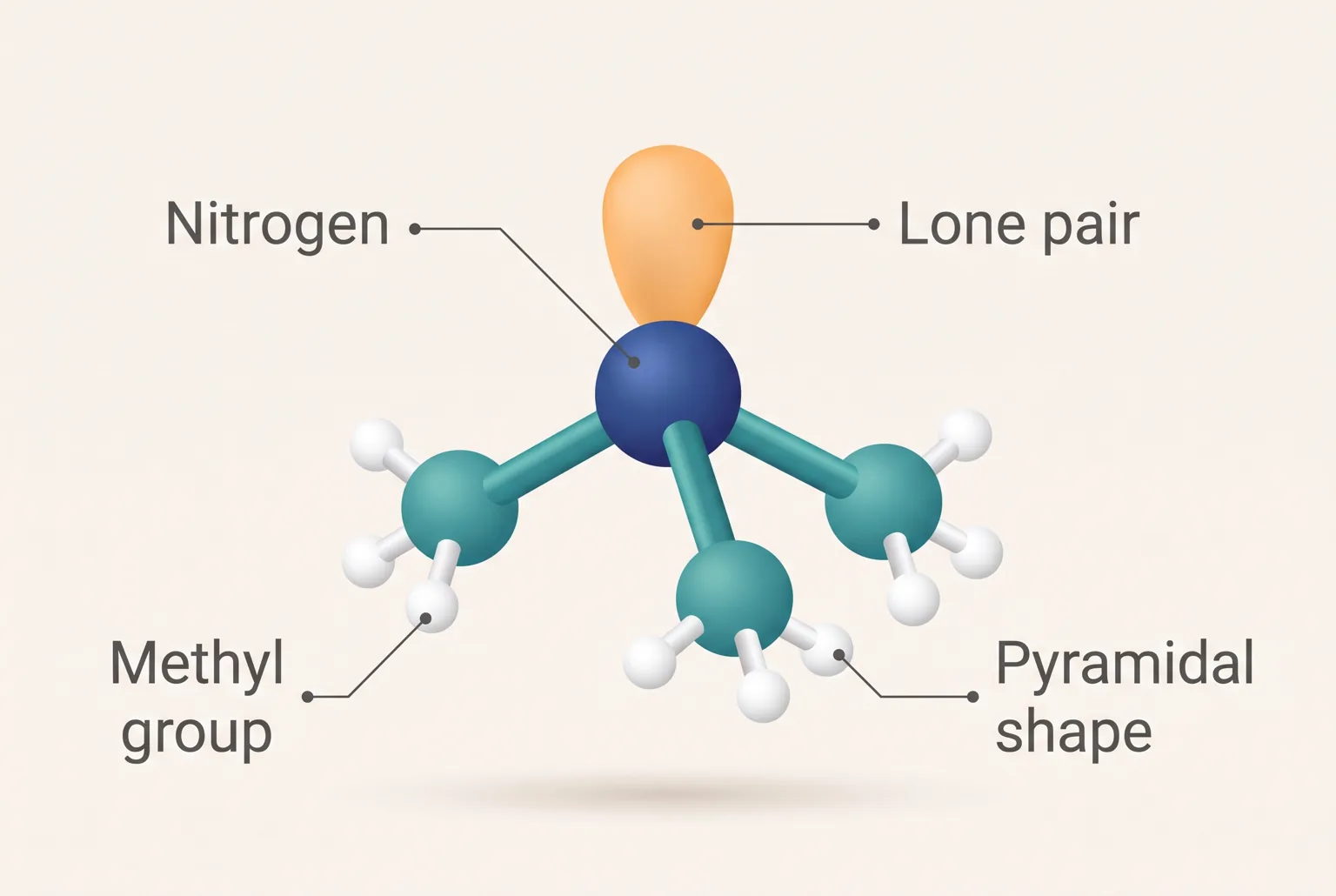
Classify and name an amine from its nitrogen
Think of an amine as a derivative of ammonia: replacing one, two or three of ammonia’s hydrogen atoms with alkyl or aryl groups gives a primary, secondary or tertiary amine, respectively. Count the organic groups bonded directly to nitrogen, not the carbons in the molecule. Aniline is a primary amine because nitrogen is bonded to one phenyl group. The chapter uses trimethylamine to illustrate the pyramidal arrangement around nitrogen, with three bonds and an unshared electron pair.
The nomenclature table pairs common names with IUPAC names so you can read the same structure in either system. In propan-2-amine, the numeral identifies the carbon bearing the amino group. In N-methylethanamine, the locant N shows that the methyl group is attached to nitrogen rather than to the parent carbon chain. The chapter also distinguishes an arylamine such as aniline, where nitrogen is bonded directly to the ring, from a compound such as phenylmethanamine, where a carbon separates nitrogen from the ring.

Amines | Class 12 | NCERT Textbook
In the StudentCurio app
This textbook chapter covers amine classification, preparation, physical properties and basicity, along with reactions of aniline and the preparation and reactions of diazonium salts. It also includes review questions to help Class 12 students study amine chemistry and practise key reactions.
Choose a preparation route by tracking carbon
Start with the functional group you need to convert. The chapter describes reduction of nitro compounds to amines, reduction of nitriles to primary amines, and reduction of amides with lithium aluminium hydride. In a route that first replaces a halogen with a cyano group, the nitrile carbon becomes part of the product’s carbon chain when the nitrile is reduced. By contrast, Hoffmann bromamide degradation gives a primary amine with one carbon fewer than the starting amide. Distinguish this degradation from amide reduction before choosing a reagent.
Product selectivity also matters. In ammonolysis, the amine formed can react further with the alkyl halide, so the reaction can yield a mixture of amine classes and a quaternary ammonium salt. A large excess of ammonia favours the primary amine as the major product; it does not mean that only that product forms. Gabriel phthalimide synthesis offers a route to primary alkylamines, but not to primary arylamines: aryl halides do not undergo the required nucleophilic substitution with the phthalimide anion.
Hydrogen bonding: compare like with like
Primary and secondary amines can form hydrogen bonds with one another because they contain both a nitrogen lone pair and at least one N–H bond. Tertiary amines have no N–H bond and cannot donate that kind of hydrogen bond to another amine molecule. The chapter’s boiling-point table illustrates the order primary > secondary > tertiary for its set of isomeric amines. Use this as a comparison between isomers, not as a rule for ranking amines with very different molar masses.
Water solubility asks a different question: can the amine interact with water? A tertiary amine can still accept a hydrogen bond from water through its nitrogen lone pair. For lower aliphatic amines, hydrogen bonding helps explain water solubility; as the hydrophobic alkyl portion grows, solubility falls.
Basicity: check the phase before ranking
An amine acts as a base when its nitrogen lone pair accepts a proton. When reading the chapter’s aqueous data, remember that a larger corresponds to a smaller and a stronger base. In the gas phase, the electron-releasing effect of alkyl groups supports the textbook order: tertiary amine, then secondary, then primary, then ammonia, from strongest to weakest.
In water, the stability of the protonated amine also depends on solvation. Steric hindrance can affect how readily water molecules interact with the ion, so the inductive effect alone does not determine the order. Compare the methyl- and ethyl-substituted entries in the table: the relative positions of the primary and tertiary amines change between the two series. Aniline illustrates a different effect. Its lone pair is conjugated with the benzene ring and is less available for protonation, making aniline a weaker base than ammonia.
What the carbylamine and Hinsberg tests distinguish
The carbylamine reaction distinguishes primary amines from the other two classes. On heating with chloroform and ethanolic potassium hydroxide, primary aliphatic and primary aromatic amines form isocyanides; secondary and tertiary amines do not give this reaction.
The Hinsberg test makes a finer distinction. Primary and secondary amines both react with benzenesulphonyl chloride, but the primary amine’s sulphonamide retains an acidic N–H bond and dissolves in alkali. The secondary amine’s sulphonamide has no N–H bond and is insoluble in alkali. Tertiary amines do not form a sulphonamide in this test. When comparing the first two cases, check the structure of the product rather than counting the N–H bonds of the starting amine.
Aniline and diazonium salts: two reaction pathways
In aniline, the same lone-pair donation that makes nitrogen less ready to accept a proton increases electron density at the ortho and para positions of the ring. This explains why bromination with bromine water at room temperature gives 2,4,6-tribromoaniline. When monosubstitution is the aim, the chapter describes acetylating the amino group first to reduce ring activation, then carrying out substitution and hydrolysing the resulting amide.
With nitrous acid, the distinction is between primary aliphatic and primary aromatic amines. The former give unstable diazonium salts that release nitrogen, whereas primary aromatic amines form diazonium salts at –. The chapter treats aromatic diazonium salts as intermediates for making other aromatic compounds, including azo dyes. Use the in-text conversion questions to practise identifying which functional group changes and whether the carbon count must change along the way.
Spotted an error? Report a correction. Practise this in the app: notes, formula sheets and mind maps.















































































































































Loading comments…