CBSE Class 12 Chemistry 2026: Main Board Paper with Solutions
CBSEChemistry2026 Previous Year Paper
Paper code: 56/1/1 · 2026Practise with the full English-language 2026 CBSE Class 12 Chemistry main examination paper, code 56/1/1. Use the worked solutions after your attempt to check not just your answers, but also your choice of method and the conditions under which it applies.
This set is one of the year's papers. See every set from 2026, grouped by series.
What the five sections ask you to do
This year-wise paper carries 70 marks and allows three hours, without a calculator. Its 33 questions are divided into five sections: Section A has 16 one-mark multiple-choice questions, including assertion–reason items; Section B has five two-mark very short answers; and Section C has seven three-mark short answers. Section D has two four-mark case-based questions, and Section E has three five-mark long answers.
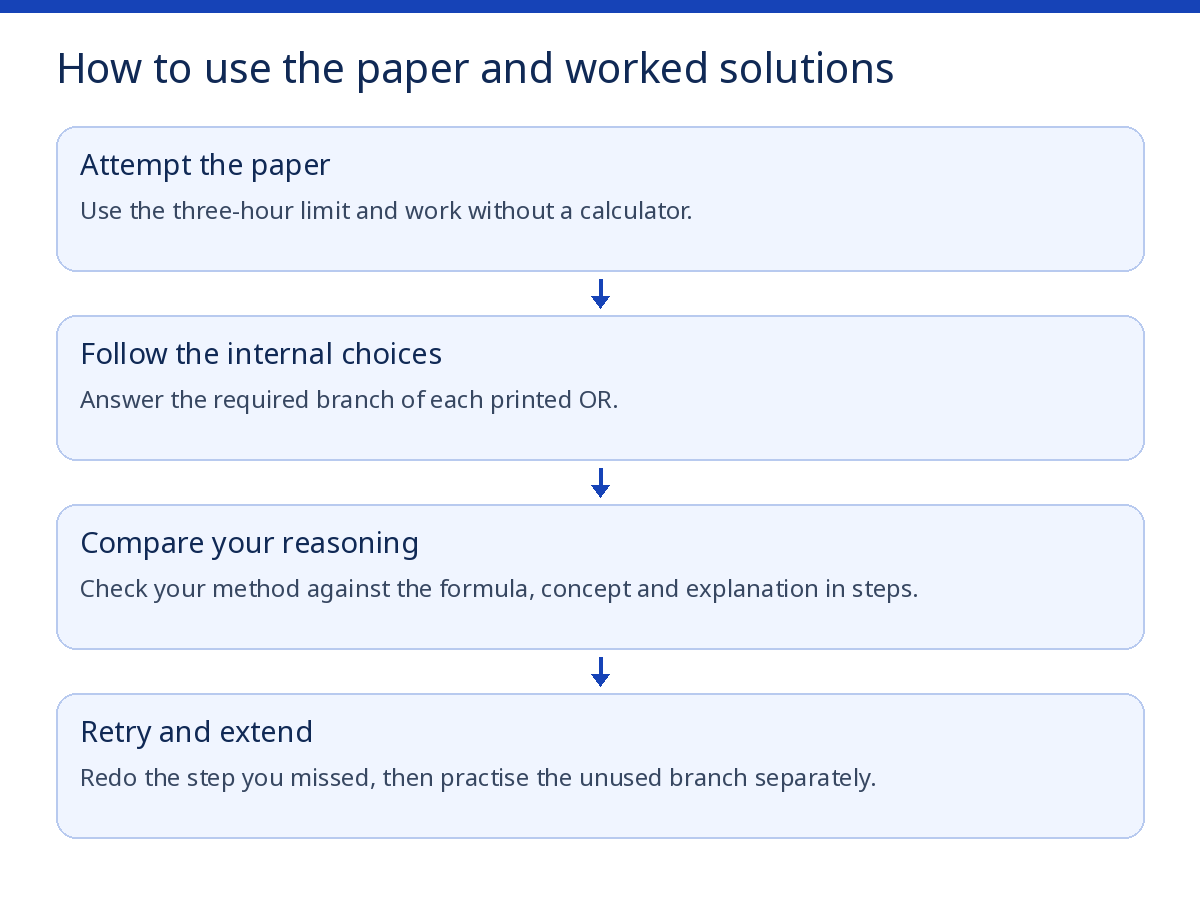
There is no overall choice. All questions are compulsory, but some questions in Sections B through E offer an internal choice. On a timed attempt, answer only the required branch of a printed OR. During review, try the other branch separately: a choice can test different material, as in Section B, where coordination nomenclature appears opposite a branch on ionisation isomerism and the chelate effect.

Chemistry 2026 | Class 12 | Previous Year Paper | Code 56/1/1
In the StudentCurio app
A complete 2026 CBSE Class 12 Chemistry main examination paper with worked solutions, covering questions across physical, inorganic and organic chemistry. It helps students practise the board-paper format and review solution methods across the syllabus.
When a kinetics shortcut applies
The kinetics questions ask you to interpret graphs, reason about a one-step reaction and use pressure data for a first-order decomposition. These are different tasks. For an elementary step, the reactant coefficients determine the powers in its rate law. Do not transfer that shortcut to an overall reaction whose mechanism is unknown: the balanced equation alone does not generally establish the order.
For the pressure-based calculation, distinguish total pressure from the reactant’s partial pressure before using an integrated rate equation. The total includes the gases formed during decomposition, so it is not a direct measure of how much reactant remains. In your review, check how the reaction stoichiometry connects the measured quantity to the quantity the rate law needs.
Solutions: identify what changes and why
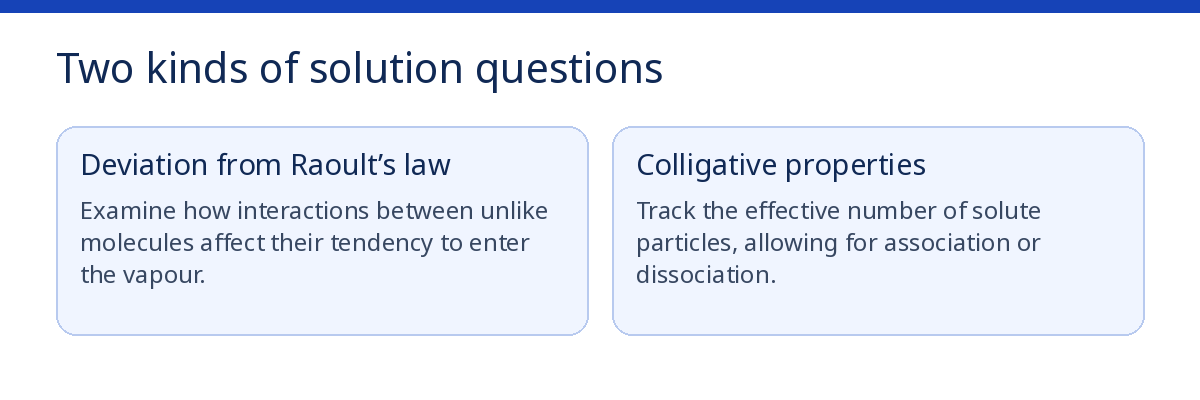
The paper tests both deviations from Raoult’s law and colligative properties. For deviations, focus on how interactions between unlike molecules affect the tendency of molecules to escape into the vapour. For boiling-point elevation and freezing-point depression, focus instead on the effective number of dissolved particles. Association reduces that number; dissociation increases it. Keeping these explanations separate prevents you from using an intermolecular-force argument where the calculation needs a particle-count correction.
Check the concentration measure as well. In the boiling-point elevation relation , is molality, in moles of solute per kilogram of solvent, not molarity. The relation is used for dilute solutions, with the van’t Hoff factor accounting for changes in effective particle count.
Electrochemistry: label the conditions first
The electrochemistry questions move between electrode processes, battery reactions and calculations of cell emf and Gibbs energy change. Before choosing a formula, label each potential standard or under the stated conditions. The equilibrium constant is linked to standard cell emf through the standard Gibbs energy change. For emf at a specified composition, the Nernst equation instead uses the reaction quotient for the reaction as written.
In the long-answer calculations, check that the reaction quotient and the number of electrons transferred refer to the same balanced reaction. Pure solids do not contribute a variable term to the quotient. For the battery questions, note whether the prompt asks about charging or discharging before writing the reaction: reversing the operating process changes the direction of the reaction.
Coordination chemistry: separate counting from explanation
Coordination chemistry appears in several formats, from short questions on names and isomerism to a case passage on valence bond theory and crystal field theory. When reading a complex formula, record the metal’s oxidation state and coordination number separately. The former comes from charge accounting; the latter counts donor atoms bound to the metal, so a ligand that binds through more than one donor atom contributes more than one to the count.
For a magnetic-behaviour question, geometry is not enough on its own. The case study asks you to consider electronic arrangement as well. In crystal field reasoning, the metal ion’s electron count and the splitting of its d orbitals help you decide how electrons occupy those orbitals. It is the resulting presence or absence of unpaired electrons that matters for the magnetic classification.
Organic chemistry: let the evidence narrow the possibilities
The organic questions mix reaction writing with structure identification. The amines case study brings together basicity in aqueous solution, identification tests and conversions. Elsewhere, the paper uses substitution kinetics and stereochemistry as clues, and asks you to connect carbonyl structures to chemical tests and reaction behaviour. A molecular formula limits the possibilities, but it does not by itself identify a functional group or distinguish structural isomers.
For a structure prompt with several clues, check your candidate against each condition, including negative test results. For a conversion, keep the reagent and reaction conditions attached to the step they govern. The biomolecules questions require a different kind of precision: when comparing peptide and glycosidic linkages, distinguish the units each linkage connects rather than treating both merely as bonds between biological molecules.
Quick self-check before opening a worked solution
Use the original question layout for your timed attempt, then use the question-number index to navigate the worked solutions. The solution format separates the formula, the concept and the explanation in steps. Read those parts against your own working: a correct formula can still be applied to the wrong quantity, and a correct conclusion does not always show the reasoning a prompt requests.
For an assertion–reason item, can you judge each statement separately and then decide whether the reason actually explains the assertion? For a calculation, can you name the condition that makes your chosen relation applicable? After checking the solution, retry the specific step where your reasoning diverged before attempting the unused OR branch.
Spotted an error? Report a correction. Practise this in the app: notes, formula sheets and mind maps.















































































































































Loading comments…