Alcohols, Phenols and Ethers: CBSE Class 12 PYQs and Solutions
CBSEChemistryAlcohols, Phenols and Ethers
Practise CBSE Class 12 Chemistry chapter-wise PYQs with worked solutions covering acidity, physical properties, reaction conditions and organic products.
Eight topic groups that map Chapter 7
The collection gathers 154 CBSE questions. Q1–Q103 are single-answer MCQs and Q104–Q154 are subjective questions. They carry the exam-year labels 2021 (Term 1), 2023, 2024, 2025 and 2026.
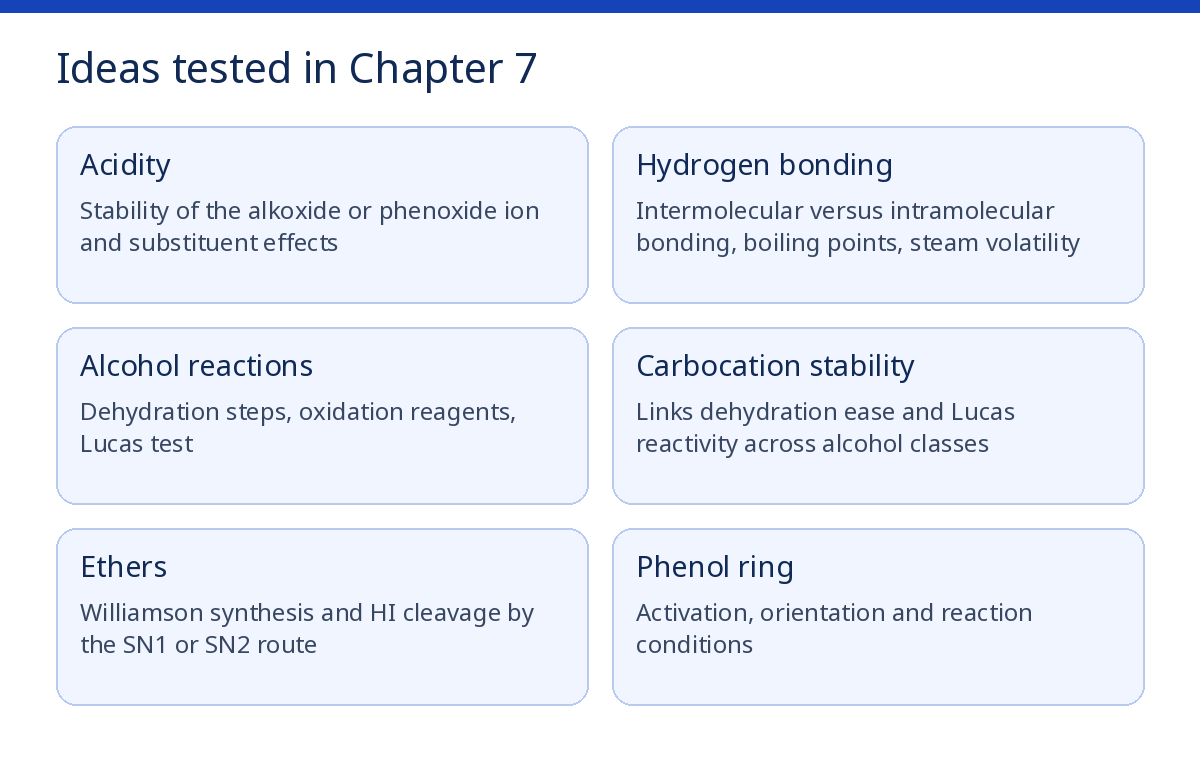
A topic finder sorts the questions into eight groups, which also work as a revision map:
- Nomenclature, classification and structures
- Physical properties, acidity and hydrogen bonding
- Preparation of alcohols and carbonyl conversions
- Reactions, oxidation and dehydration of alcohols
- Reaction mechanisms, kinetics and stereochemistry
- Phenols and electrophilic aromatic substitution
- Ethers, Williamson synthesis and cleavage
- Conversions, identification tests and reaction sequences
One question can appear in several groups. The phenol and ether lists are among the longest. This is Chapter 7 in the current CBSE sequence. Older NCERT editions number it Chapter 11.

Alcohols, Phenols and Ethers | Class 12 | Previous Year Paper
In the StudentCurio app
A comprehensive 147-page collection of solved previous year questions for CBSE Class 12 Chemistry, covering reaction mechanisms like dehydration, phenol acidity, and named reactions such as Reimer–Tiemann and Kolbe–Schmitt.
Judging acidity by the stability of the anion
Many items compare acid strength. Typical pairs are phenol against water and alcohols, phenol against 4-methylphenol, and p-nitrophenol against phenol or p-methoxyphenol.
One method handles all of these comparisons. When the O–H group loses a proton, it leaves an alkoxide or a phenoxide ion. The more stable this conjugate base is, the stronger the acid. Ask two questions:
- Can the negative charge on oxygen spread into a benzene ring, or does it stay on oxygen?
- Does a substituent withdraw electron density and disperse the charge, or release it and concentrate the charge?
Keep inductive effects (−I, +I) separate from resonance effects. One assertion–reason item depends on naming correctly the effect shown by the methoxy and nitro groups.
Alcohols are also tested as both Brønsted acids and Brønsted bases. Link this to the polar O–H bond and the unshared electron pairs on oxygen. One stem uses the reaction of an alcohol with sodium, which gives and hydrogen gas.
Hydrogen bonding, boiling points and steam distillation
Three recurring patterns depend on hydrogen bonding:
- boiling points of alcohols against ethers, such as ethanol versus methoxymethane
- boiling-point orders among alcohols that differ in chain length and branching
- separation of o-nitrophenol from p-nitrophenol by steam distillation
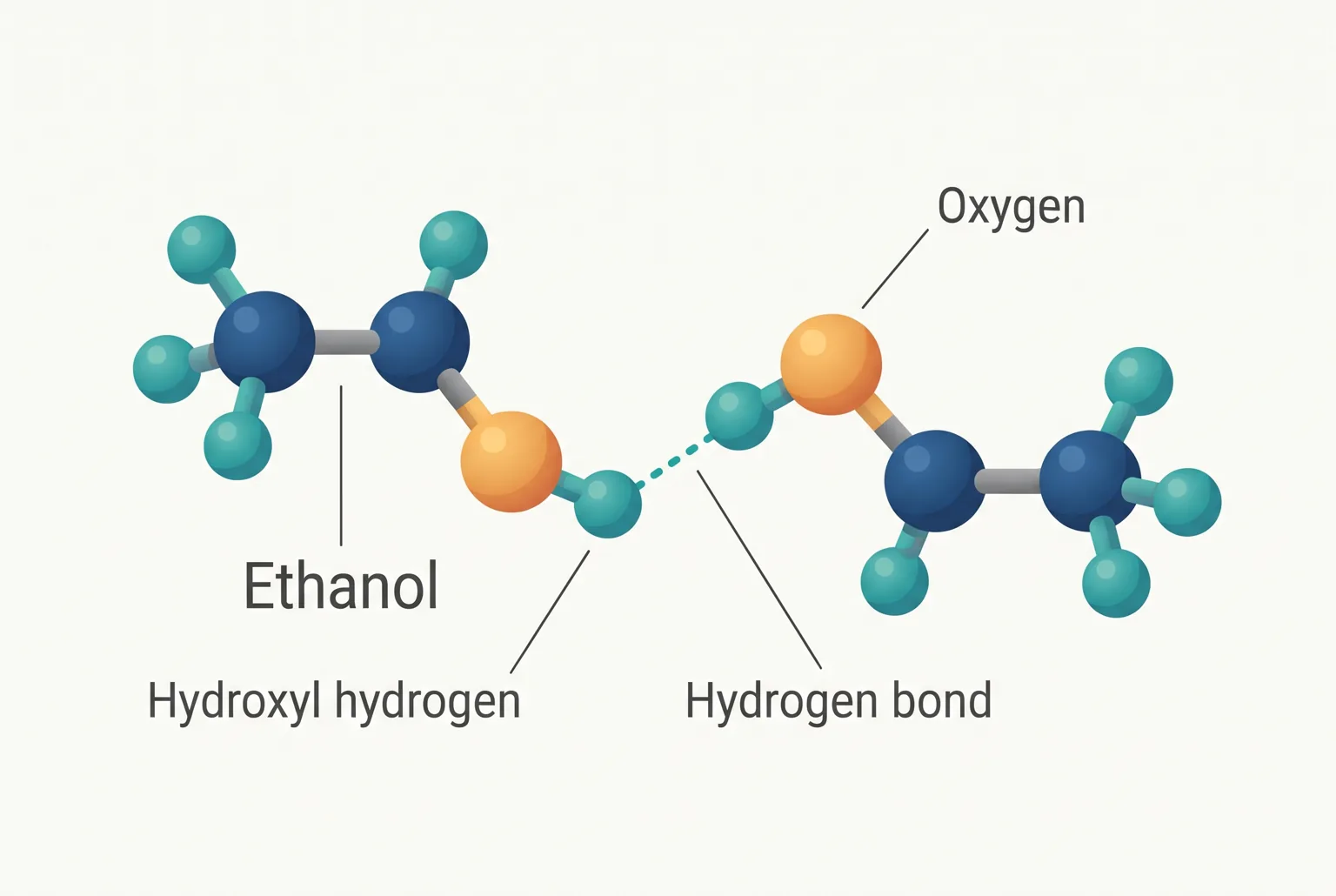
The key distinction is between two kinds of hydrogen bond. An intermolecular hydrogen bond links separate molecules, so more energy is needed to boil the liquid. An intramolecular hydrogen bond forms within one molecule, so that molecule associates less with its neighbours.
For boiling-point orders among alcohols, weigh two factors separately. Larger molecular size raises the boiling point, and branching lowers it.
Dehydration, oxidation and the Lucas test
Acid-catalysed dehydration with conc. is examined step by step. One question asks for the initiation step. Another asks for the intermediate formed in the slowest step. These are different points in the mechanism, so write out the whole sequence before choosing an option.
Two question types share one explanation: the ease of dehydration of , and alcohols, and their reactivity with Lucas reagent. Both depend on the stability of the carbocation each class can form. Lucas-test items ask either for a reactivity order or for the alcohol that gives cloudiness immediately.
Oxidation stems ask what a secondary alcohol gives with chromic anhydride (). They also ask which reagent converts to . For that conversion, you need a reagent that stops at the aldehyde stage.
Ethers: Williamson synthesis and cleavage by HI
For Williamson synthesis, CBSE asks you to classify the reaction type. Identify which species attacks and what it replaces.
Cleavage questions with HI ask which fragments form. The stems vary the group attached to oxygen: methyl or ethyl, tertiary butyl, or phenyl. Before predicting products, settle two points:
- Can one group leave as a stable carbocation? That points to an path.
- Which carbon is least hindered for attack by iodide? That points to an path.
Also check whether a carbon–oxygen bond belongs to an aromatic ring.
Structure items compare the C–O–C bond angle in ethers with the tetrahedral angle. They also ask you to judge a reason based on repulsion between alkyl groups.
Phenol ring substitution: activation versus orientation
The −OH group has two separate properties that CBSE tests. The first is how reactive it makes the ring towards electrophiles. The second is which positions it directs incoming groups to. Several assertion–reason items pair these two properties and change one of them between sets, so judge each property on its own.
Reaction conditions decide the product. Stems contrast dilute nitric acid at low temperature with concentrated nitric acid. Others use bromine in at low temperature. Note the reagent strength, solvent and temperature in every stem.
Other recurring stems ask about the by-product of making phenol from cumene and the conversion of phenol to salicylic acid. They also cover acetylation of salicylic acid with to form aspirin.
Common mistakes in assertion–reason pairs
The paired statements across sets are designed to catch specific slips:
- Swapping "intermolecular" and "intramolecular". A reason can be false because of this one word, even when the assertion is true.
- Judging the pair as a whole. Mark each statement true or false first. Only then decide whether the reason explains the assertion.
- Reversing a comparison. Some sets print "more acidic" and "less acidic" versions of the same pair, so read the direction carefully.
- Mislabelling electronic effects. Decide whether a group is electron releasing or withdrawing before giving any acidity verdict.
- Merging steps. The initiation step and the slowest step of dehydration have separate answers.
Practice order for Q1–Q154
The original material contained only answer keys and online links. Every full solution here is labelled Added solution, and every subpart and alternative is answered. Apparent source errors are kept in the questions and explained in the solutions. Marks appear only where they were printed.
A workable order:
- Take one topic group at a time from the topic finder, starting with acidity and hydrogen bonding.
- Attempt that group's MCQs and assertion–reason items before opening any solution.
- Move to the subjective questions (from p. 38). Write full reaction sequences, then compare them with the subjective solutions (from p. 99).
- Check the source notes (p. 146) whenever a solution flags a printed error.
Frequently asked questions
Which exam years are included?
The questions carry the labels 2021 (Term 1), 2023, 2024, 2025 and 2026. The 2021–22 Term 1 papers are dated by their examination year, 2021.
Are the solutions official CBSE answers?
No. The source material had only answer keys and links. The full worked solutions were added for this edition and are labelled Added solution.
Why might my textbook call this Chapter 11?
Chapter 7 follows the current CBSE sequence. Older NCERT editions may number Alcohols, Phenols and Ethers as Chapter 11.
Spotted an error? Report a correction. Practise this in the app: notes, formula sheets and mind maps.















































































































































Loading comments…