2024 CBSE Class 12 Chemistry Previous Year Paper (56/1/1)
CBSEChemistry2024 Previous Year Paper
Paper code: 56/1/1 · 2024Use the full 2024 CBSE Class 12 Chemistry main board paper, code 56/1/1, as a timed mock. Then use the worked solutions to check whether you chose the right principle, applied it under the right conditions and showed enough reasoning.
This set is one of the year's papers. See every set from 2024, grouped by series.
Know the format before you start
This year-wise resource pairs the English version of the 2024 theory paper with worked solutions. The paper has 33 questions for 70 marks, with three hours of writing time and a separate 15-minute reading period. Calculators are not allowed.
Section A has sixteen one-mark multiple-choice questions, including assertion–reason items. Section B has five two-mark very short answers, and Section C has seven three-mark short answers. Section D has two four-mark case-based questions, while Section E has three five-mark long answers.
There is no overall choice. Where the paper offers an internal choice, select one branch during the mock. Also check instructions within individual questions: a question can be compulsory without requiring every listed subpart.

Chemistry 2024 | Class 12 | Previous Year Paper | Code 56/1/1
In the StudentCurio app
Complete solved CBSE Class 12 Chemistry main examination paper 56/1/1 from 2024, with questions across multiple chapters and worked solutions. It helps students practise board-exam questions and review solution methods.
Physical chemistry: identify what the data can tell you
The paper moves between solution properties, electrode potentials, conductivity and reaction kinetics. These topics reward different first steps. For a conductivity problem involving the same cell, the reference solution allows you to establish the cell constant before using the other solution’s resistance. Keep conductivity distinct from molar conductivity: the latter relates conductivity to amount concentration, so the units used for concentration matter.
In the initial-rate table, look for pairs of trials in which one reactant concentration stays fixed. That comparison isolates how changing the other concentration affects the measured rate. Establish the concentration dependence before finding the rate constant, whose units depend on the overall order. The coloured or familiar appearance of a formula is less useful than checking what the given data actually justify.
Do not confuse stoichiometry with kinetic order
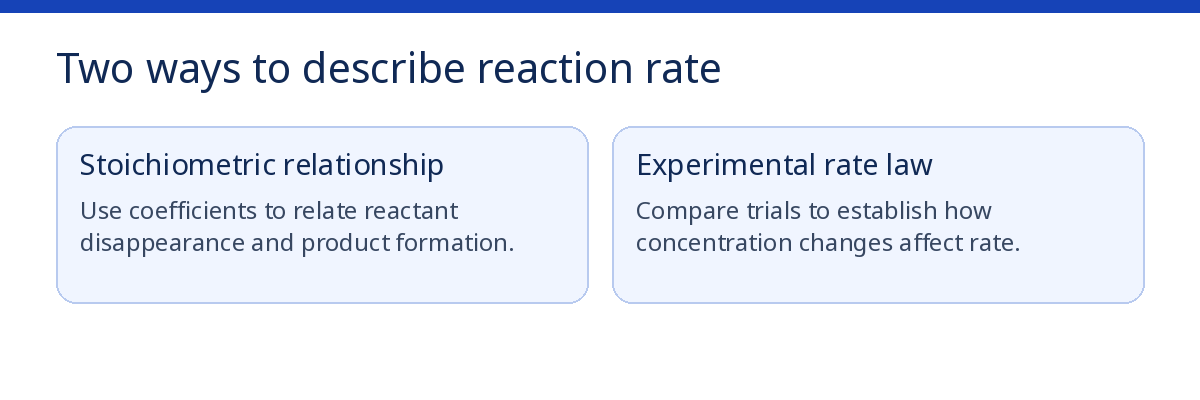
A stoichiometric rate relationship connects the disappearance of reactants with the formation of products. For a reaction proceeding as written, divide each species’ concentration change per unit time by its stoichiometric coefficient, using a minus sign for reactant disappearance. An experimental rate law, by contrast, describes how rate depends on concentration. For an overall reaction, you cannot generally read its orders from the balanced equation.
The paper also asks about molecularity. Keep its scope separate: molecularity applies to an elementary step, whereas an observed order describes the concentration dependence under the measurement conditions. The guide omits option-level discussion of the stoichiometric-rate and Arrhenius-plot items because signs in the supplied question transcription are unclear.
Organic chemistry: start with the structure and conditions
The paper asks for reaction products, mechanisms, reasons, chemical tests and conversions. Those tasks require different kinds of evidence. A product prediction needs a structure consistent with the starting compound and reagents; a mechanism must show how bonds change; a chemical test needs a distinguishing observation, not just the name of a reagent.
When practising haloalkane reactions, write down whether the medium is aqueous or alcoholic rather than reading only the reagent name. When working on alcohols, classify the hydroxyl-bearing carbon before deciding which rule is relevant to the stated conditions. For a multi-step identification problem, mark which pieces of evidence constrain the carbon skeleton and which constrain the functional group. Check each proposed structure against the whole sequence, not just the last clue.
Case passages: separate the context from the task
The two case-based questions concern galvanic cells and coordination compounds. The battery passage supplies context, but the subparts ask for different responses: a comparison, a reason, and, depending on the branch chosen, equations or advantages. If a subpart asks for equations, a prose description of what the battery does is not a substitute for writing the reactions.
For the coordination case, valence bond theory and crystal field theory give different ways to discuss complexes. Crystal field theory uses the splitting of metal d-orbital energies to describe electronic arrangements and explain colour in appropriate complexes. For a magnetic-behaviour comparison, work out the metal ion’s electron count and consider the ligand field and geometry before deciding how to account for unpaired electrons.
Switch between definitions and explanations
The biomolecules questions range from short prompts on peptide linkage, DNA, carbohydrates and vitamin solubility to questions on glucose structure and reactions. Practise telling a structural feature apart from a property or a reaction. A definition needs the feature that identifies the term; a reaction prompt needs you to track what changes under the stated treatment.
A similar distinction helps with the transition-metal questions. An electronic configuration is a starting point, not a complete explanation of colour, oxidation-state behaviour or catalysis. When a prompt names an ion, start from that ion rather than the neutral atom. Then connect the relevant electronic feature to the property being asked about instead of relying on a broad trend alone.
Quick self-check after the mock
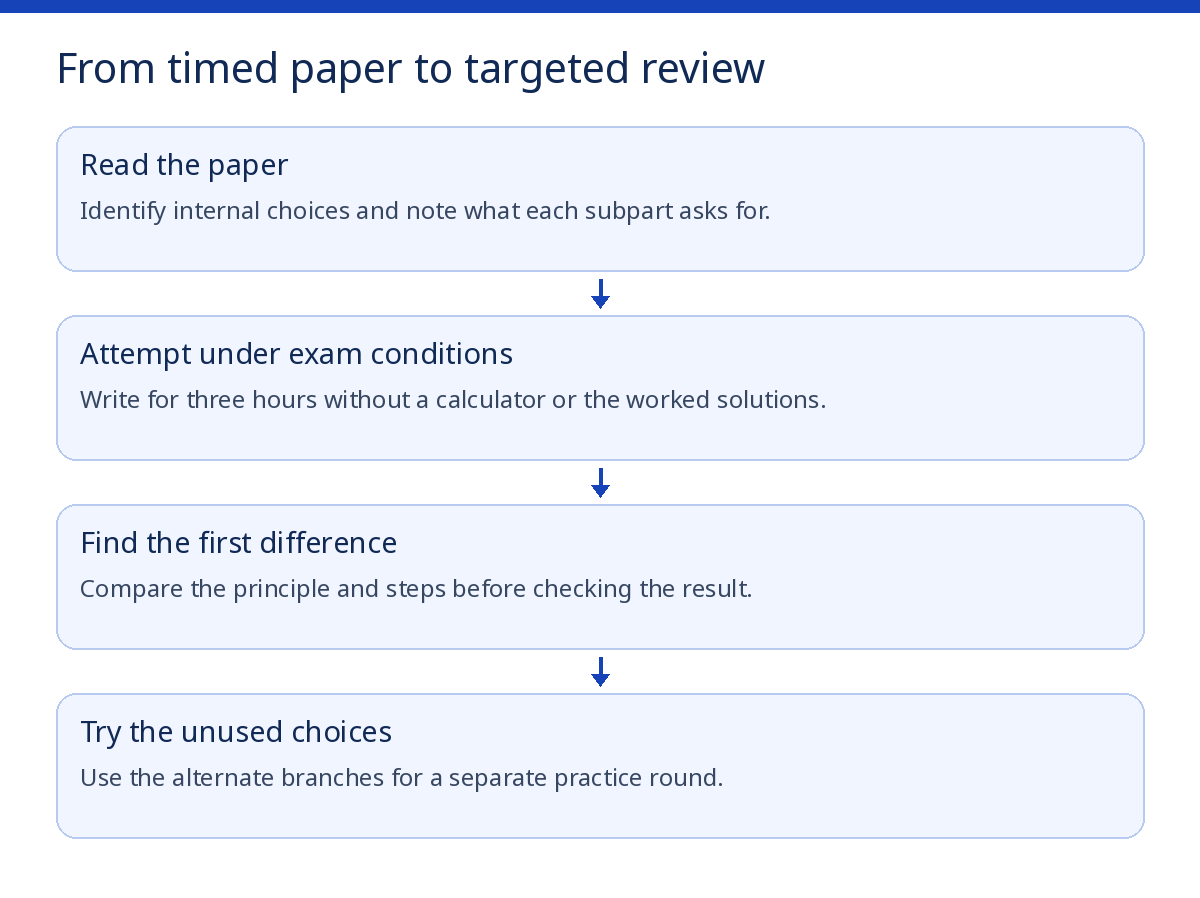
During the reading period, note the internal choices and the subparts that ask for a reason rather than a result. Keep the solutions closed while you write. In assertion–reason items, decide whether each statement is true before asking whether the reason actually explains the assertion.
The file links question numbers to worked solutions, which separate the formula, concept and explanation steps. On review, look for the first point where your reasoning diverged: did you misread the task, choose an inapplicable rule or lose a unit or sign during calculation? Try the unused internal choices separately. Before moving on, see whether you can state why the method applies without looking at the final line.
Spotted an error? Report a correction. Practise this in the app: notes, formula sheets and mind maps.















































































































































Loading comments…