CBSE Class 12 Chemistry 2022 Term II Paper With Solutions
CBSEChemistry2022 Previous Year Paper
Paper code: 56/5/1 · 2022Practise with the complete 2022 CBSE Class 12 Chemistry Term II main-examination paper, then use the worked solutions to check not just your final answers but the reasoning behind them.
This set is one of the year's papers. See every set from 2022, grouped by series.
Know the format before you start
This year-wise resource contains the English version of paper 56/5/1, with a printed duration of 2 hours and a maximum of 35 marks. It preserves the original question layout, options and diagrams and includes worked solutions for the subparts and both sides of the printed OR choices. These details describe the 2022 Term II paper, not necessarily the format of a later CBSE examination.
For a timed attempt, work from the question pages first and treat each printed OR as a choice. Afterwards, use the unattempted alternatives as separate revision tasks. The solutions distinguish the formula used, the concept behind it and the steps in the explanation. That structure helps you tell whether you missed a fact, chose the wrong method or left a gap in your reasoning.

Chemistry 2022 | Class 12 | Previous Year Paper | Code 56/5/1
In the StudentCurio app
Complete CBSE Class 12 Chemistry Term II main-examination paper from 2022, with worked solutions to questions across multiple chapters, including organic chemistry, electrochemistry, kinetics and coordination compounds. Helps students practise the board-paper format and review solution methods.
Kinetics: identify the model before using an equation
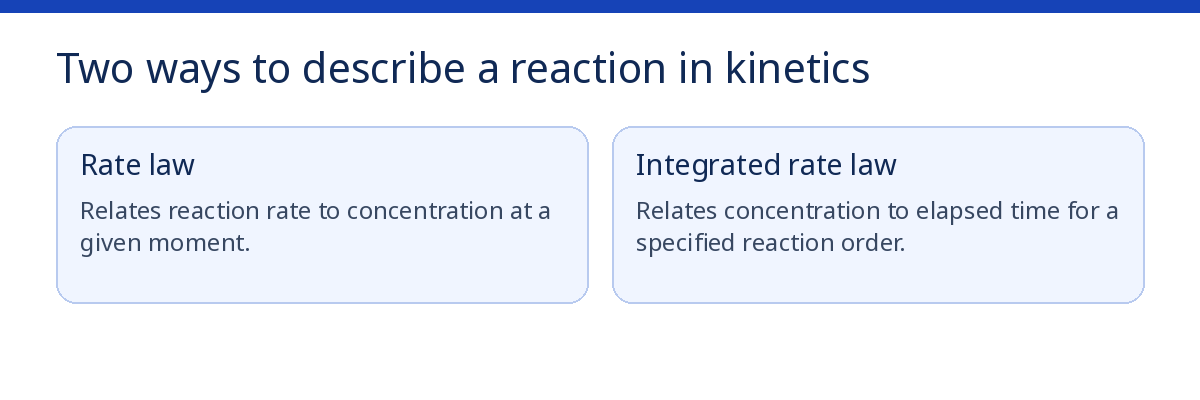
The kinetics material asks you to move between rate-constant units, concentration dependence, integrated rate laws and graph interpretation. These are related, but they answer different questions. A rate law tells you how the rate depends on concentration at a given moment. An integrated rate law describes how concentration changes with time. Choose the relationship that matches what the question actually gives you.
When a graph is supplied, read both axes before interpreting the straight line. A plot of concentration against time is not the same as a plot of a logarithmic concentration ratio against time. The ratio must be dimensionless, and the logarithm base matters when relating the slope to the rate constant. In your review, check whether you identified the plotted quantity before interpreting the slope or using a half-life relationship.
Organic chemistry: explain trends and track transformations
The organic questions range from carbonyl reactivity and carboxylic acid strength to amine properties, named reactions and multistep conversions. For a comparison, identify the property before choosing an explanation. Crowding around a carbonyl matters when a nucleophile approaches it; stabilization of a conjugate base matters when judging acidity. An electronic effect should be tied to the species it acts on, rather than cited as a catch-all explanation.
For reaction sequences, mark the functional group at each stage and ask what the reagent and conditions allow it to become. Keep intermediate structures visible so you can check the next step without guessing from the starting material. For a distinguishing test, review the link between the chemical property being tested and the observation you would actually record.
Coordination and transition metals: follow the evidence
The coordination questions connect nomenclature, ligand identity, denticity and crystal-field splitting. Keep ligand type and denticity separate: one describes which ligands are present, while the other counts how many donor atoms from an individual ligand bind to the metal. Likewise, for naming and electronic configuration, establish the metal's oxidation state from the complex charge and ligand charges before reasoning about its d-electron count.
For spin questions, use the geometry and the stated relationship between splitting and pairing energy. In an octahedral complex, pairing within the lower set is favoured when the splitting exceeds the pairing energy, but the electron count still determines the occupancy. The transition-metal questions also practise reasoning from electronic structure to magnetic behaviour or oxidation states, while the lanthanoid material connects shielding to trends in ionic size.
Surface chemistry: distinguish processes, not just terms
The surface chemistry material covers colloid behaviour and the comparison between physical and chemical adsorption. When reviewing colloids, separate a question about particle motion in an electric field from one about loss of dispersion stability. Both involve charged particles, but one concerns their movement and the other their aggregation. For the Hardy–Schulze rule, first identify the ion whose charge is opposite to that of the sol before comparing coagulating power.
For adsorption, compare physical and chemical adsorption on the same basis in each sentence. The nature of the adsorbent–adsorbate interaction, the relative adsorption enthalpy and the possibility of forming multiple layers are distinct criteria. A paired comparison makes it easier to see whether you have actually contrasted the two processes.
Electrochemistry: check what the cell and the units tell you
The electrochemistry material links electrode reactions, the salt bridge, an opposing voltage and equilibrium. In a cell diagram, trace electron transfer in the external circuit separately from ion movement within the cell. That distinction lets you explain how charge balance is maintained instead of giving the salt bridge a vague role in completing the circuit. When discussing an external voltage, account for its direction as well as its magnitude.
Good to remember: Conductivity and molar conductivity describe different quantities, so do not use their names or units interchangeably. In , use concentration in moles per litre and conductivity in siemens per centimetre to obtain molar conductivity in siemens square centimetres per mole. The factor of 1000 belongs to that unit convention.
Quick self-check before you open a solution
Pick one numerical or graph-based item and one descriptive item from your attempt. For the first, can you name the measured or plotted quantity and justify the equation without relying on its familiar appearance? For the second, can you connect the stated condition to the property or process you used as evidence? Mark the first point where you cannot explain your reasoning. Then open the worked solution and compare that specific step, rather than judging your attempt only by whether the final line matches.
Spotted an error? Report a correction. Practise this in the app: notes, formula sheets and mind maps.















































































































































Loading comments…