CBSE Class 12 Chemistry 2024 Previous Year Paper
CBSEChemistry2024 Previous Year Paper
Paper code: 56/5/1 · 2024Practise with the full English-language 2024 CBSE Class 12 Chemistry main board paper (56/5/1). Use the worked solutions after your attempt to identify which concepts, conditions or reasoning steps you missed.
This set is one of the year's papers. See every set from 2024, grouped by series.
Know which paper you’re attempting
This is a year-wise previous year paper, not a chapter worksheet. The 2024 main examination had a time limit of 3 hours and a maximum of 70 marks. The file preserves the original English question layout, options and diagrams, so you can practise reading the paper as it was presented rather than working from a list of extracted questions.
For a timed attempt, start with the question paper and leave the solutions closed. Follow the printed instructions, including where you need to choose between alternatives. Use the full paper to see how readily you can move between physical, inorganic and organic chemistry without a chapter heading to tell you which idea to apply. Save practice on the unattempted alternatives for your review.

Chemistry 2024 | Class 12 | Previous Year Paper | Code 56/5/1
In the StudentCurio app
The 2024 CBSE Class 12 Chemistry main examination paper (Q.P. Code 56/5/1) with worked solutions, covering physical, inorganic and organic chemistry. It helps students practise the board-paper format and review step-by-step answers across chapters.
Use the worked steps to diagnose an error
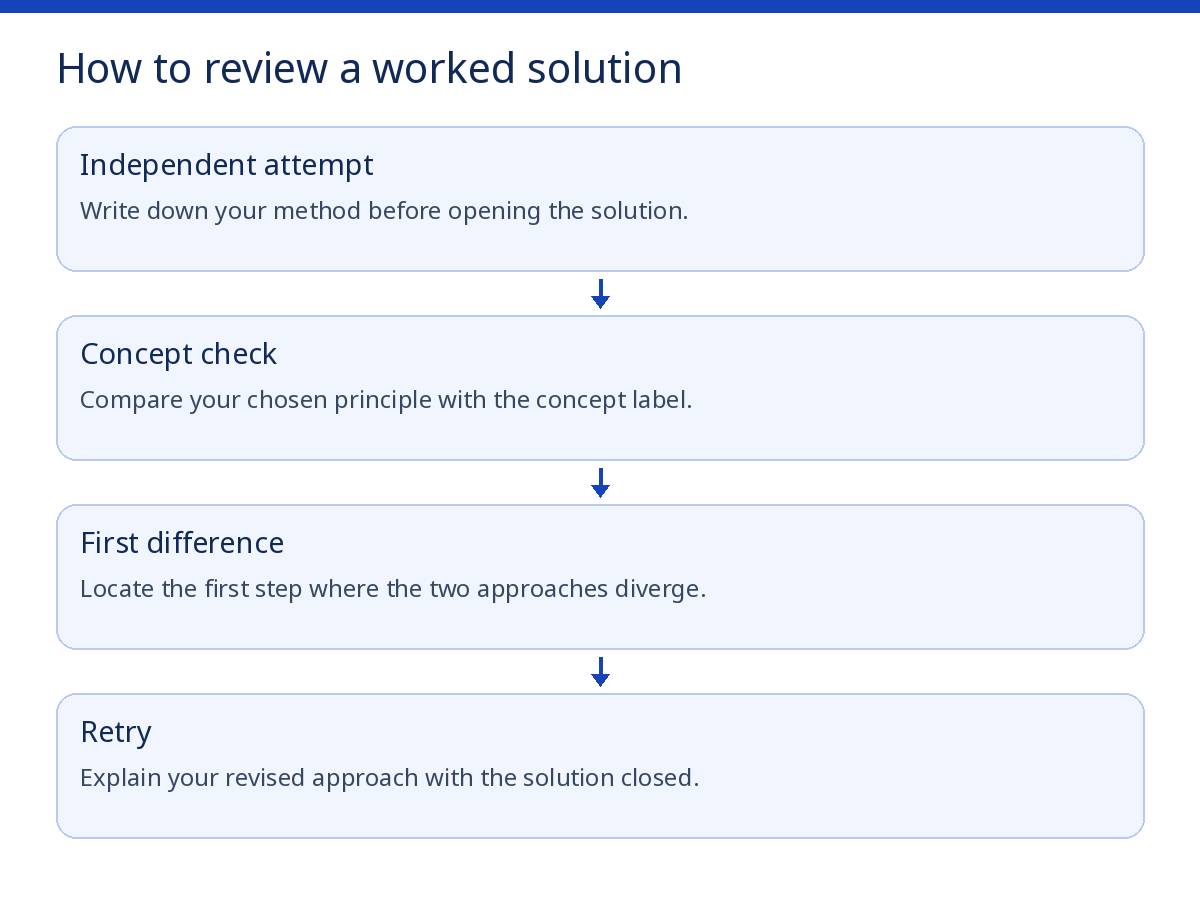
The cover provides question-number links, and the worked solutions separate Formula Used, Concept Used and Explanation in Steps. Both printed OR choices are covered. That structure makes it possible to check more than whether your final response matches: you can compare the principle you selected and the point at which you applied it.
Start with the concept label. If it differs from the idea you used, go back to the question and identify the wording that should have guided your choice. If you selected the right principle, find the first step where your reasoning diverged instead of copying the whole solution. On conceptual questions, the formula field may contain a short rule or relationship rather than an equation to substitute into.
Physical chemistry: check what each quantity measures
The solutions and electrochemistry material rewards careful reading of the quantity named in the question. In an osmotic-pressure comparison, check the temperature as well as the property being compared. If a question concerns dissolved particles, distinguish solute species from water that becomes part of the solvent. For a hydrate, the written formula alone is not a count of separate solute particles in the resulting solution.
In electrochemistry, conductivity and molar conductivity describe different things. Conductivity characterises how well the solution conducts; molar conductivity relates that behaviour to the amount of electrolyte. Before explaining a dilution trend, name the quantity you are discussing. Then distinguish a change in the number of charge carriers per unit volume from changes in ionic interactions or, for a weak electrolyte, in the extent of dissociation.
When a rate comparison isolates reaction order
In the kinetics material, comparing two rates can reveal how the rate depends on the concentration of a reactant. This comparison isolates that reactant’s exponent only if the rate constant and the other concentration terms in the rate law are unchanged. Before taking a ratio, identify what was varied and what was held fixed. A rate change alone does not tell you which concentration term caused it.
The units give you a separate check. The rate has units of concentration per time, but the rate constant does not automatically have those same units. They coincide for a zero-order rate law because there is no remaining concentration factor. In review, use the rate law to justify the units rather than treating them as a separate fact to memorise.
Inorganic chemistry: explain the link to the property
The inorganic questions include interstitial compounds and lanthanoid contraction. Both reward an explanation that connects a structural idea to an observable property. For interstitial compounds, locate the small atoms in gaps in the metal lattice, then consider how their presence affects the movement of metal layers. This gives a reason for a change in hardness instead of leaving it as an isolated trend.
For lanthanoid contraction, follow the reasoning from poor shielding by 4f electrons to changes in size, then to similarities in chemical behaviour. Keep those steps distinct: shielding accounts for the size trend, while similar sizes help explain why some elements behave similarly. This distinction is useful when an assertion–reason item asks whether a statement actually explains a property, not merely whether the statements concern the same topic.
Common mix-ups in organic reasoning
The organic material includes reaction mechanisms, stereochemistry and electronic effects. When checking a substitution mechanism, distinguish an intermediate from a transition state. A concerted substitution has no free carbocation intermediate; the proposed mechanism must be consistent with any stereochemical change you describe. When assessing a tetrahedral carbon as a possible stereocentre, inspect all four attached groups. The presence of an isotope label does not remove a duplication elsewhere among the substituents.
Keep inductive effects separate from resonance effects when explaining acidity or basicity. A substituent can withdraw electron density inductively and donate by resonance, so a single label such as “electron-donating” may not explain the comparison. This guide omits the disputed assertion–reason item on phenol substituents: the worked notes flag that the printed wording does not match any offered choice.
Quick self-check before you revisit the paper
Pick one response you hesitated over and explain, without opening the solution, which feature of the question led you to the concept you chose. Then ask what would have to change in the question for that concept or rule not to apply. If you can name a formula but cannot explain its conditions, you have identified a more useful revision task than simply redoing the arithmetic.
For a question with a printed OR choice, try the alternative independently after reviewing your first attempt. Notice whether you can select and justify the approach without seeing the solution’s concept label first. That is a better check of your reasoning than recognising a method once the worked steps are already in front of you.
Spotted an error? Report a correction. Practise this in the app: notes, formula sheets and mind maps.















































































































































Loading comments…