CBSE Class 12 Chemistry 2024 Solved Board Paper
CBSEChemistry2024 Previous Year Paper
Paper code: 56/4/2 · 2024Use the full 2024 CBSE Class 12 Chemistry main examination paper for a three-hour practice attempt. Then use its worked solutions to find where your reasoning, choice of method or written explanation needs work.
This set is one of the year's papers. See every set from 2024, grouped by series.
What is in the 2024 paper file?
This year-wise resource contains the English version of the CBSE Class 12 Chemistry main examination paper, code 56/4/2, followed by worked solutions. The paper allows 3 hours and carries 70 marks. The file preserves the question layout, options and diagrams, so you can practise reading the paper as printed rather than working from a list of questions grouped by chapter.
The cover provides a question-number index, and solution pages link back to the corresponding questions. The worked material covers subparts and both printed OR choices. That distinction is useful: for a timed attempt, follow the printed choice instructions; for revision afterwards, you can return to the alternative you did not attempt. The paper is organised by examination year, so use it to see how topics appear together in a board paper rather than as a checklist of everything in the syllabus.

Chemistry 2024 | Class 12 | Previous Year Paper | Code 56/4/2
In the StudentCurio app
A complete solved CBSE Class 12 Chemistry main examination paper from 2024, with questions and worked answers spanning multiple chapters. It helps students practise the board-paper format and review solution methods.
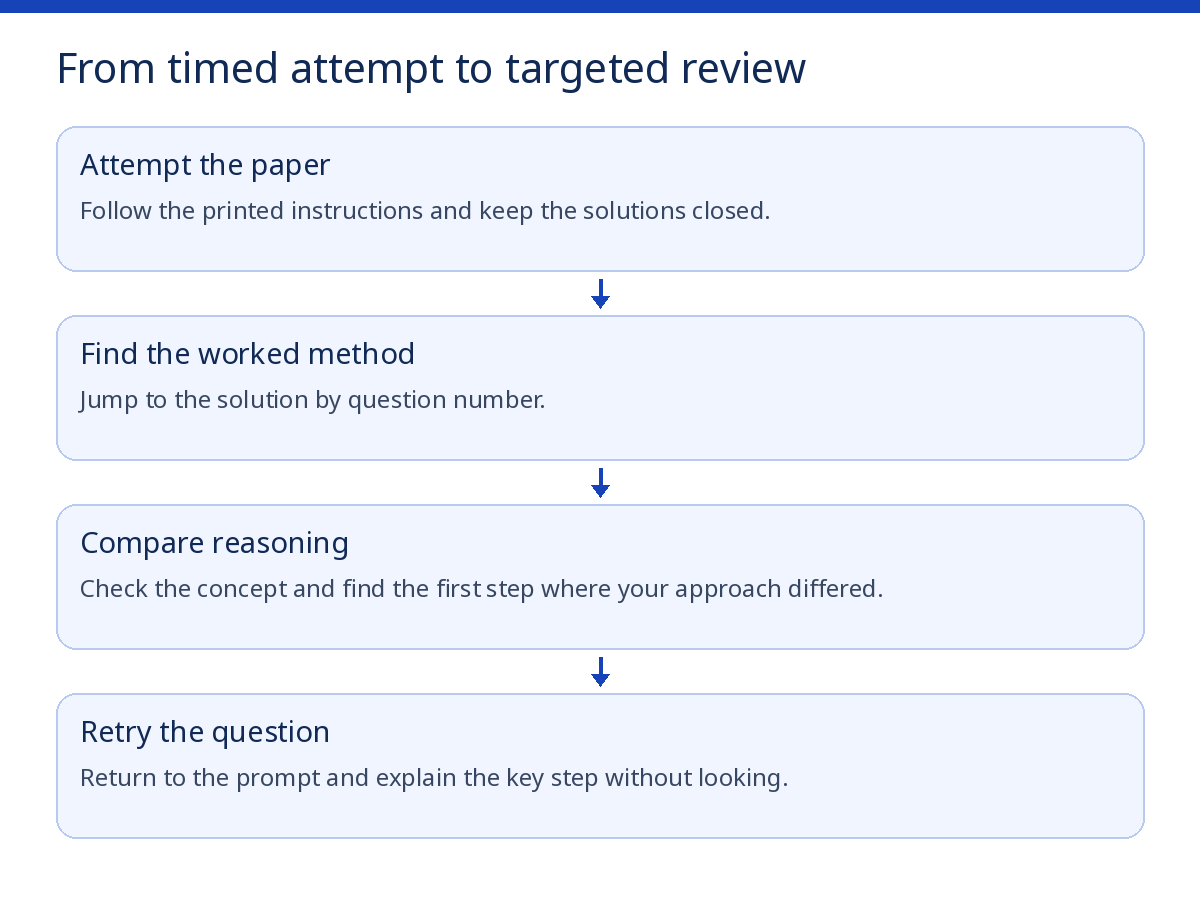
Make the timed attempt useful for revision
Start in the question-paper portion of the file and leave the worked pages closed. Read the printed instructions before starting the clock. Follow the full three-hour limit if you want to see what you can complete in one sitting. Keep your first responses, even where you later change your mind: they make it easier to distinguish a reading slip from a gap in your chemistry.
For an option-based item, jot down the deciding reason if you are unsure. For an assertion–reason item, judge the two statements separately before deciding whether the reason actually explains the assertion. In a written response, show the relevant step or give the reason the prompt asks for. These small traces of your thinking make the solution review more useful than a comparison of final answers alone.
Physical chemistry: identify what the rule describes
The paper includes electrochemistry and chemical kinetics. In electrochemistry, distinguish a conductivity calculation from a question about the direction of a cell process. At infinite dilution, ionic contributions to limiting molar conductivity are weighted by the stoichiometric numbers of the ions in the electrolyte formula. For a cell opposed by an external voltage, the applied voltage must exceed the cell voltage to drive the process in reverse. Read the stated conditions before deciding which ideas apply.
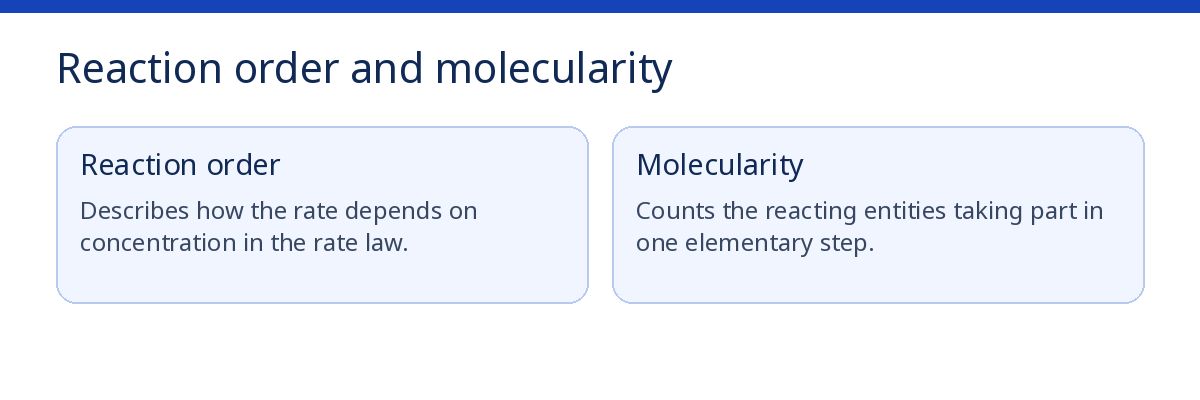
In kinetics, a concentration–time graph is not interchangeable with a rate–concentration graph. Read the axes before interpreting the line. Also separate reaction order, which describes concentration dependence in the rate law, from molecularity, which counts reacting entities in one elementary step. A multistep reaction does not have a single elementary molecularity assigned from its overall equation.
Use structure and conditions to explain chemical behaviour
The worked material also draws on d-block chemistry, biomolecules and several areas of organic chemistry, including substitution, amines and carbonyl reactions. In d-block questions, notice whether the prompt asks about electronic configuration or oxidation states. The two ideas are related, but a response needs to address the property actually requested.
For organic transformations, read the starting functional group and the reagent conditions together. A reagent name on its own does not explain why a reaction stops at a particular functional group or why a separate work-up is needed. In substitution reasoning, connect carbocation stability to the ionisation step when the mechanism is , rather than treating the same argument as a rule for every substitution. In biomolecule questions about chemical tests, pay attention to the test medium: behaviour under alkaline conditions need not be explained from the starting structure alone.
Two details worth checking before you move on
- Ionic charge and stoichiometric coefficient are different. In a limiting molar conductivity sum, the coefficient counts how many ions of a given kind the electrolyte formula yields. Do not use the magnitude of the ion’s charge as that multiplier.
- Branching does not determine the class of an amine. For the amines covered here, classify the group by counting the carbon groups bonded directly to nitrogen, not by inspecting how branched the carbon chain looks.
Both checks are about identifying what a quantity or label refers to. If you spot either mix-up in your attempt, write one sentence naming what you counted and what you should have counted. That makes the correction specific enough to use on a different question.
Read the worked method before the final answer
The solution pages separate Formula used, Concept used and Explanation in steps. Open the solution for an attempted question and pause at the concept label. Ask whether you used the same principle and whether you checked the condition that makes it relevant. Then read the steps only as far as you need to locate the first difference from your response. A correct option chosen for the wrong reason still deserves a second look.
Use the return link to try the question again without the explanation in view. For a printed OR pair, attempt the unused choice separately before opening its worked solution. When you finish, keep a short record of the cause of each error, such as reading the wrong graph axis, overlooking the reaction medium or leaving a reasoning link unstated. Those notes tell you what to revisit after this paper.
Spotted an error? Report a correction. Practise this in the app: notes, formula sheets and mind maps.















































































































































Loading comments…