CBSE Class 12 Chemistry 2023 Solved Paper: 56/3/1
CBSEChemistry2023 Previous Year Paper
Paper code: 56/3/1 · 2023Practise the full 2023 CBSE Class 12 Chemistry main board paper (56/3/1), then use the worked solutions to see whether you chose the right principle, set up the calculation correctly or gave enough reasoning.
This set is one of the year's papers. See every set from 2023, grouped by series.
What this 2023 paper contains
This year-wise resource pairs the English version of the 2023 CBSE Class 12 Chemistry theory paper with worked solutions. The paper allows three hours, carries 70 marks and contains 35 questions. Section A has one-mark multiple-choice questions, including assertion–reason items. Sections B and C have two-mark very short answers and three-mark short answers, respectively. Section D has four-mark case-based questions, and Section E has five-mark long answers.
There is no overall choice. Internal choices appear at specified points in Sections B through E; an OR does not make the entire question optional. During a timed attempt, answer only the required branch. When you return to the file for revision, you can practise the alternatives too: the solution set covers both printed choices.

Chemistry 2023 | Class 12 | Previous Year Paper | Code 56/3/1
In the StudentCurio app
Complete solved CBSE Class 12 Chemistry main examination paper for 2023 (code 56/3/1), with questions and worked answers across physical, inorganic and organic chemistry. Useful for practising board-exam questions and reviewing solution methods.
Physical chemistry: identify the quantity first
The paper brings together calculations from Solutions, Chemical Kinetics and Electrochemistry. The tasks include finding the extent of association from freezing-point depression, working with changes in concentration over time, estimating activation energy from a temperature change and calculating cell emf. These questions ask for different quantities even when they share familiar inputs such as concentration or temperature.
Start your working by naming what the question asks for. In kinetics, a species’ rate of formation or consumption is not automatically the same as the stoichiometrically normalised rate of reaction. In electrochemistry, conductivity describes how well the solution conducts, whereas molar conductivity also accounts for the electrolyte concentration. Naming the quantity before choosing an equation makes it easier to spot a wrong coefficient or a mix-up between two similarly named properties.
Before substituting, check what the equation assumes
For a dilute solution, freezing-point depression depends on the concentration of dissolved particles. If solute molecules associate, the effective particle count changes. The van ’t Hoff factor accounts for that change; an association calculation also needs the assumed association pattern. In this paper, the question specifies dimer formation, so the model is not something you have to guess.
The activation-energy task uses a different kind of assumption. The Arrhenius equation relates the rate constant to absolute temperature, so use kelvin. If the question gives a ratio of reaction rates rather than rate constants, that ratio can stand in for the rate-constant ratio only when the concentration-dependent part of the rate law is unchanged. Check that condition before substituting.
Inorganic chemistry: separate structure from stability
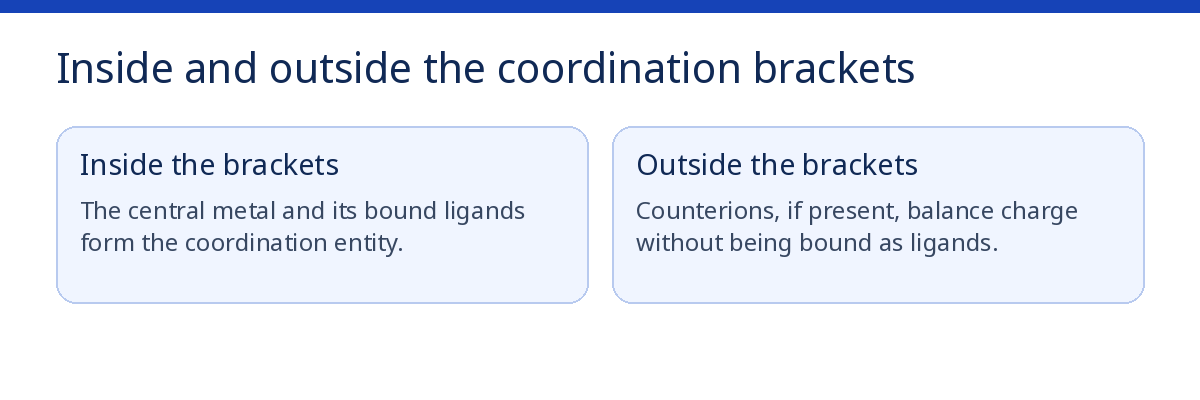
Coordination chemistry appears in both objective and case-based questions. Begin with the brackets in a coordination formula: distinguish the ligands bound to the metal from counterions outside the coordination sphere. That distinction matters when interpreting ions in solution. For questions about geometry and magnetism, keep the metal’s oxidation state, its electron configuration and the presence or absence of unpaired electrons distinct in your reasoning.
The paper’s comparison of which complex is most stable is omitted here because the accompanying solution notes that the options do not establish an unconditional thermodynamic ranking. Denticity tells you how many donor atoms of a ligand bind to a metal centre; denticity alone cannot rank unlike complexes without a defined equilibrium and conditions. The paper also provides separate practice on transition-metal oxidation states and on writing balanced inorganic equations.
Organic chemistry: match your working to the prompt
The organic questions move between predicting products, naming compounds, planning conversions, explaining reactivity and writing a mechanism. For a conversion, show which reagent belongs to each step so that the route can be checked. For a mechanism, a correct overall equation is not enough: the answer needs to show how the transformation proceeds. When the prompt asks for a reason, connect a structural feature to the property rather than simply restating the order or trend.
The biomolecules questions call for a different kind of precision. They ask about carbohydrate structures, glucose reactions and distinctions such as nucleoside versus nucleotide. When reviewing a comparison, check that you have named the structural difference itself, rather than only listing examples or recalling where each substance occurs.
How to read the two case-based questions
One case deals with halo compounds and nucleophilic substitution; the other deals with coordination compounds. Read the subparts after the passage and identify the output each requests: an equation, a comparison, a name or a prediction with reasoning. The passage sets the context, but it does not replace the chemical reasoning needed in the answer.
In the halo-compound case, the named substitution pathway matters: a comparison for one mechanism should not be treated as a rule for the other. In the coordination case, distinguish what information can be inferred from a precipitation observation from what must be predicted using a bonding model. These are different tasks even when they refer to the same chapter.
Use the worked solutions to find your first wrong step
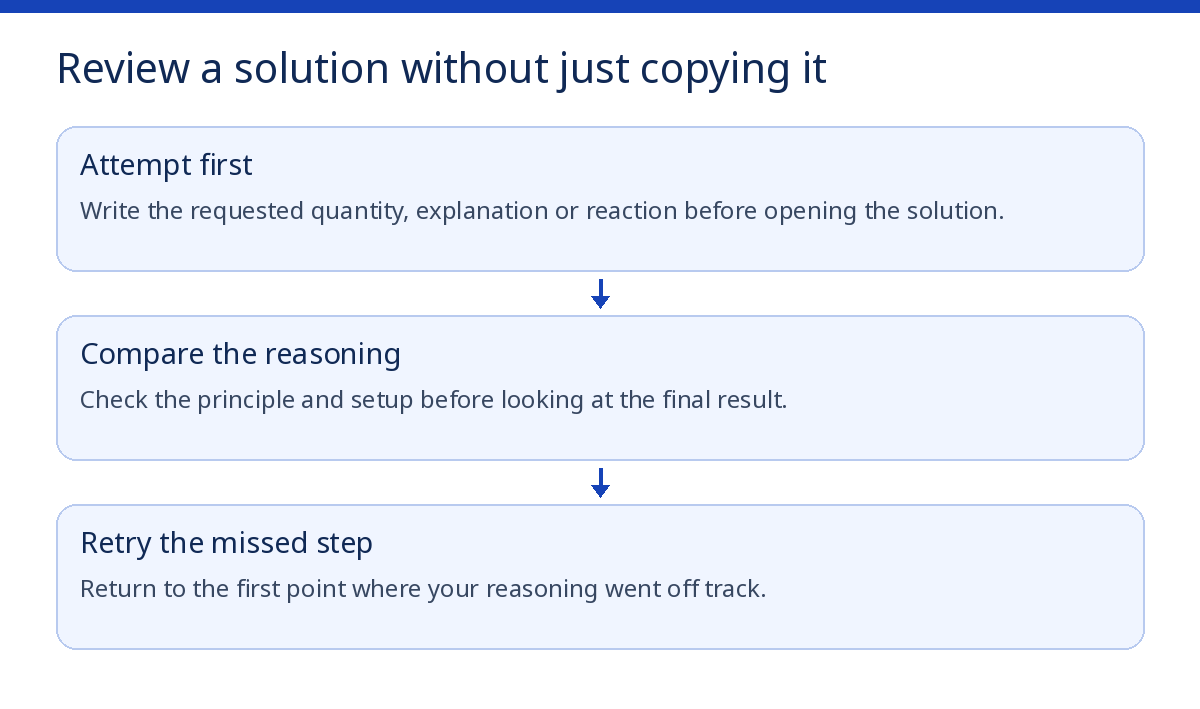
For a mock attempt, use the paper’s 15-minute read-only period before the three-hour writing session and work without a calculator. Keep the worked answers closed until you finish. Afterwards, use the question-number links to go straight to the solutions you need. The entries separate the formula or relation, the concept and the explanation in steps, so you can compare your reasoning before checking the final result.
For an assertion–reason item, review three decisions separately: whether the assertion is true, whether the reason is true and, if both are true, whether the reason actually explains the assertion. For a written answer, mark the first place your working diverged: the interpretation of the prompt, the choice of principle, or its application. That tells you what to retry without rereading every solution.
Spotted an error? Report a correction. Practise this in the app: notes, formula sheets and mind maps.















































































































































Loading comments…