CBSE Class 12 Chemistry 2024 Question Paper with Solutions
CBSEChemistry2024 Previous Year Paper
Paper code: 56/5/3 · 2024Practise with the full English version of the 2024 CBSE Class 12 Chemistry main board paper, set 56/5/3. Use the worked solutions to identify the first step that went wrong, whether it was choosing a formula, recalling a reaction condition or explaining a trend.
This set is one of the year's papers. See every set from 2024, grouped by series.
What this 2024 paper includes
This is a full year-wise previous paper, not a chapter worksheet. The paper is worth 70 marks and has a three-hour time limit. The file preserves the English question layout, including the printed options and diagrams, and its cover provides an index for navigating by question number. The solution pages separate the formula or rule from the underlying concept and the explanation in steps.
That structure gives you two ways to use the file. For a full rehearsal, read the question paper in order without opening the solutions. For a focused review, go straight to the questions you have already attempted and compare your reasoning with the relevant steps. The full-paper format lets you practise moving between physical, inorganic and organic chemistry rather than staying with one familiar topic.

Chemistry 2024 | Class 12 | Previous Year Paper | Code 56/5/3
In the StudentCurio app
A complete CBSE Class 12 Chemistry 2024 main examination paper with worked answers, covering questions across physical, inorganic and organic chemistry. Useful for board-exam practice and reviewing solution methods.
Physical chemistry: distinguish the quantities first
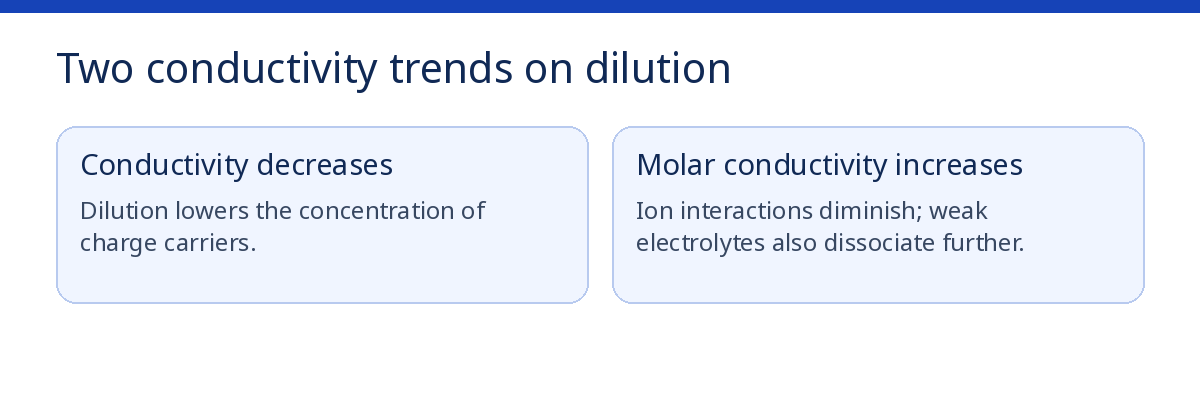
In the electrochemistry questions, conductivity and molar conductivity describe different things. Conductivity describes how well the solution conducts, while molar conductivity relates that behaviour to the amount of electrolyte. On dilution, the concentration of charge carriers falls, so conductivity decreases. Molar conductivity increases as interactions between ions diminish; for a weak electrolyte, increased dissociation also contributes. The distinction matters because an explanation that refers only to the number of ions per unit volume does not explain both trends.
The solutions material also tests whether you know what is being compared. Isotonic solutions have the same osmotic pressure at the same temperature. That does not require them to have the same density or volume. In problems involving the van ’t Hoff factor, check whether complete dissociation is assumed before treating the number of ions per formula unit as the factor.
When a rate-ratio shortcut applies
A rate comparison can reveal the exponent of a reactant concentration in a rate law, but the comparison has to isolate that concentration. For a law of the form , at fixed temperature and with any other relevant reactant concentrations unchanged, dividing two rates cancels the common rate constant. The rate ratio then equals the concentration ratio raised to the power . If other concentrations change as well, that shortcut cannot by itself identify the order with respect to the chosen reactant.
Zero order is a useful check on what the exponent means. For a reaction that obeys an overall zero-order law under the conditions considered, the rate equals the rate constant. The two therefore have the same units: concentration per unit time. When reviewing a kinetics answer, check the link between the rate law and the units rather than memorising the units in isolation.
Inorganic chemistry: connect structure to properties
The paper draws on two different kinds of structural explanation. In interstitial compounds, small atoms occupy gaps in a metal lattice. Their presence restricts movement within the lattice, which helps explain why such compounds are generally harder than the parent metal. A useful explanation connects the occupied gaps to resistance to deformation rather than merely naming the type of compound.
Lanthanoid contraction calls for a different chain of reasoning. Poor shielding by 4f electrons contributes to contraction across the lanthanoids, helping explain why corresponding zirconium and hafnium ions are close in size. That similarity helps account for their similar chemistry. When you review an assertion–reason item, check not only whether each statement is true, but also whether the reason actually explains the assertion. A related fact is not necessarily an explanation.
Organic chemistry: track the conditions and the change
The organic chemistry solutions include reaction sequences involving aromatic amines and diazonium salts, as well as questions that depend on electronic effects. For a conversion, mark the functional group that changes at each step and write the condition next to the step it controls. Diazotisation and a subsequent transformation of the diazonium salt are distinct stages. Recognising the intermediate is useful because it lets you see where separate routes diverge rather than remembering an entire conversion as one line.
For acidity and basicity, identify the species being stabilised before deciding which effect matters. Stabilising a conjugate base favours acidity of the corresponding acid and weakens the conjugate base. In comparisons involving substituted phenols, also check where the substituent sits: a resonance interaction available from an ortho or para position need not operate in the same way from a meta position.
Stereochemistry check: geometry is not configuration
Before labelling a tetrahedral carbon a stereocentre, compare all four attached groups. Hydrogen and deuterium count as different, but a pair of identical groups still rules out four distinct substituents. Checking the groups individually is more reliable than judging chirality from the way bonds are drawn on the page.
Keep that check separate from the mechanism of an reaction. Backside attack describes the geometry of bond formation and bond breaking. It does not by itself mean that an observable change of configuration can be assigned to a reacting carbon with two identical substituents. The worked solution flags a wording ambiguity about observed inversion; this guide leaves out the item’s option verdict and retains the distinction between mechanism and observable stereochemistry.
Use the worked solutions to diagnose errors
During a timed attempt, follow the printed directions for internal choices and note where you had to guess or leave a step incomplete. Afterwards, review the alternative you did not choose separately. The worked solutions cover both printed OR choices, so the unused branch can become a fresh practice task without changing how you attempted the paper.
Start your review at the first point where your reasoning differs from the explanation. If you wrote the right relationship but compared the wrong quantities, revisit their definitions. If a conversion stalled, find the missing intermediate or condition. If you reached a conclusion without explaining it, practise adding the chemical link that justifies it. Then close the solution and rewrite the reasoning from that point.
Spotted an error? Report a correction. Practise this in the app: notes, formula sheets and mind maps.















































































































































Loading comments…