CBSE Class 12 Chemistry 2024 Paper with Worked Solutions
CBSEChemistry2024 Previous Year Paper
Paper code: 56/4/1 · 2024Practise the full 2024 CBSE Class 12 Chemistry main board paper, Q.P. Code 56/4/1, in its original English layout. Then use the worked solutions to check not just your final answers, but the chemical reasoning behind them.
This set is one of the year's papers. See every set from 2024, grouped by series.
What this year-wise paper contains
This file brings together the full Chemistry main examination paper and its worked solutions. The paper allows three hours and carries 70 marks. It preserves the original English question layout, options and diagrams, so you can practise reading the paper as set rather than working from questions regrouped by chapter. The cover links question numbers to the worked solutions, which cover the subparts and both printed alternatives where an OR choice appears.
The paper draws on electrochemistry, chemical kinetics, solutions, organic chemistry, biomolecules and coordination compounds, with questions also drawing on d-block chemistry. Its value as a year-wise resource is that these topics appear together: you have to recognise which concept a question calls for without a chapter heading giving it away.

Chemistry 2024 | Class 12 | Previous Year Paper | Code 56/4/1
In the StudentCurio app
The complete 2024 CBSE Class 12 Chemistry main examination paper (Q.P. Code 56/4/1) with worked solutions. It covers questions from multiple chapters, including electrochemistry, chemical kinetics, solutions, organic chemistry, biomolecules and coordination compounds, helping students practise the full board-paper format and review answer methods.
Attempt the paper before opening the solutions
For a full practice attempt, set aside the printed three hours and keep the worked solutions closed. Follow the instructions on the question paper, including those for internal choices. Where an OR choice is provided, make your selection during the attempt; save the other alternative for review. The file gives you access to both worked methods, but that is a review feature, not a reason to attempt both in a timed sitting.
Keep enough of your reasoning on the page to diagnose a mistake later. For a choice-based question, a short note about the deciding fact can distinguish a reasoned choice from a guess. For a calculation, retain the equation and quantities you used. In an assertion–reason item, assess each statement before deciding whether the reason explains the assertion.
When the physical chemistry rule applies
In electrochemistry, distinguish a limiting conductivity calculation from a question about how a cell operates. Kohlrausch’s law of independent ionic migration concerns limiting molar conductivity: each ion’s contribution is weighted by the number of those ions represented in a formula unit of the electrolyte. In a cell question involving an external voltage, identify whether it opposes the cell voltage before comparing their magnitudes. The size of a voltage on its own does not tell you which way it acts.
In chemical kinetics, start by identifying what changes and what is held fixed. A concentration–time graph tracks the progress of a reaction, whereas the Arrhenius relation describes how the rate constant depends on temperature. Use the graph axes or the quantities named in the question to decide which relationship is relevant before you substitute values.
Organic chemistry: start with the structure
The organic questions give you practice moving between structures, reagents and reaction types. Start by locating the functional group that changes. Then identify what the reagent does under the stated conditions and check whether the proposed product reflects that change. When reviewing a reagent-matching item, test each pairing on its own rather than treating the whole set as one fact to memorise.
- Do not count the wrong carbon groups. For amine classification, count carbon groups bonded directly to nitrogen, not the total number of carbon atoms in the molecule.
- Do not turn a mechanism trend into a universal ranking. When a comparison is specifically about , look at the ionisation step and the stability of the carbocation that can form. That reasoning is tied to the stated mechanism.
Use the worked explanations to locate the first error
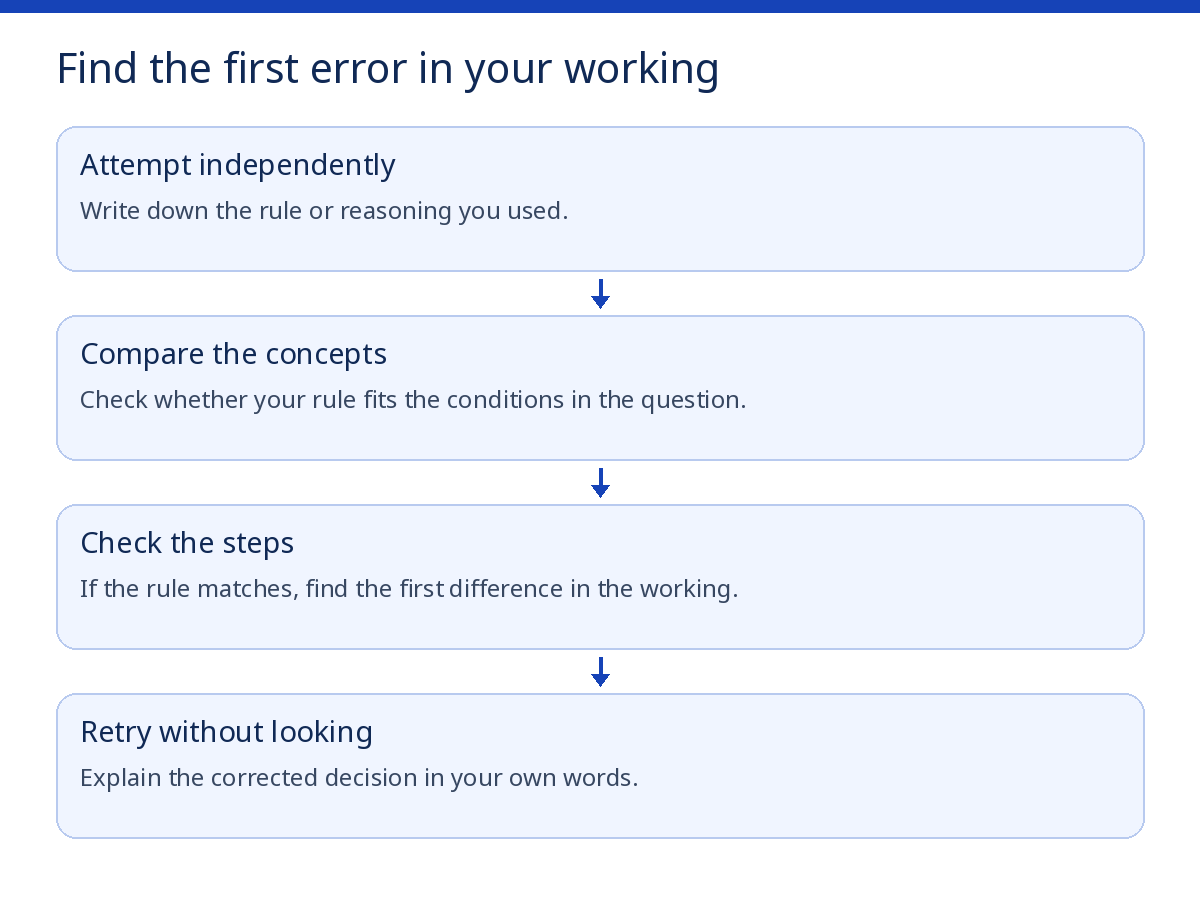
The solution entries separate the formula used, concept used and explanation in steps. Read the concept first and compare it with the principle you chose. If those differ, reread the question and find the condition or wording that selects the relevant rule. If the principle is the same, compare your working line by line until you reach the first difference. That is more useful than copying the explanation from the beginning.
For a numerical response, check whether you kept the quantities and units consistent and carried the correct signs through the calculation. For a structural or reasoning response, check whether you identified the relevant atom, group or condition. Review correct guesses too: an option can match the worked answer even when the reasoning that led you there does not.
Quick self-check before a second pass
After reviewing the paper, return to a few questions without opening their solutions. Choose them for different reasons: one where you chose the wrong principle, one where the principle was right but a step went wrong, and one where you were right but unsure. Check whether you can now explain the decision that caused trouble rather than simply remembering the final answer.
- Can you tell from the quantities in a kinetics question whether it asks about reaction order, concentration over time or the temperature dependence of the rate constant?
- In a reaction question, can you name the functional group and explain why the stated reagent or condition matters before considering a product?
Try the unused OR alternatives independently as well. They offer a fresh chance to apply a method without relying on your memory of the response you already wrote.
Spotted an error? Report a correction. Practise this in the app: notes, formula sheets and mind maps.















































































































































Loading comments…