2025 CBSE Class 12 Chemistry Paper 56/7/2: A Study Guide
CBSEChemistry2025 Previous Year Paper
Paper code: 56/7/2 · 2025Use the full 2025 CBSE Class 12 Chemistry main board paper for a three-hour theory practice session, then review your reasoning with the worked solutions. The guide explains what each section asks you to do and which distinctions matter when checking your work.
This set is one of the year's papers. See every set from 2025, grouped by series.
The paper at a glance
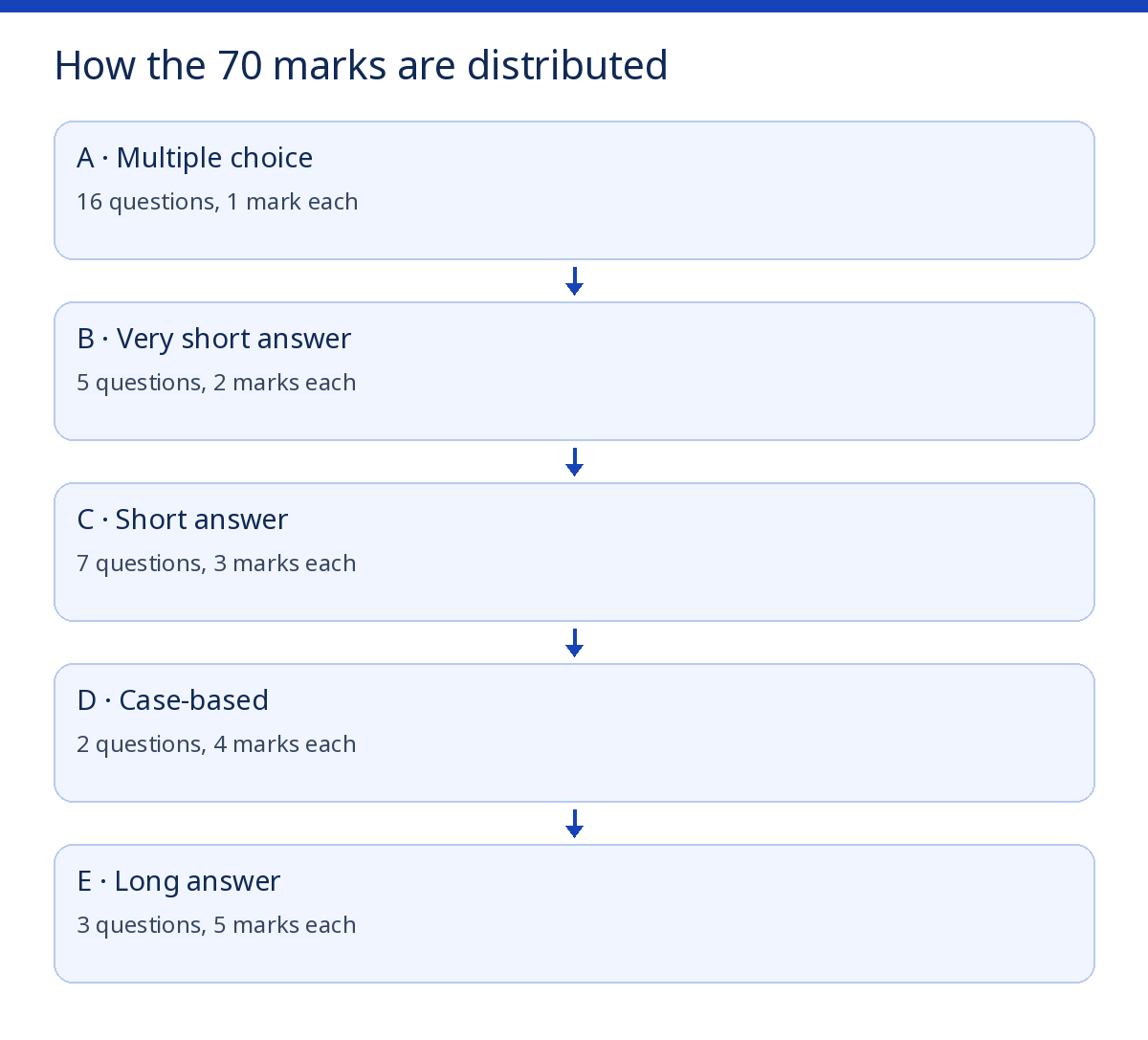
This year-wise resource contains the English version of the 2025 CBSE Class 12 Chemistry main examination, paper code 56/7/2. The theory paper carries 70 marks and allows three hours of writing time. The printed instructions also specify a separate 15-minute reading period during which candidates do not write answers. Calculators are not allowed.
The paper has 33 questions across five sections. Section A has 16 one-mark multiple-choice questions, including assertion–reason items. Section B has five two-mark questions, and Section C has seven three-mark questions. Section D contains two four-mark case-based questions, while Section E has three five-mark long-answer questions. There is no overall choice: all question numbers are compulsory, with internal choices in some questions outside Section A. For a timed attempt, answer only the required branch of a printed OR; save the other branch for revision.

Chemistry 2025 | Class 12 | Previous Year Paper | Code 56/7/2
In the StudentCurio app
Complete CBSE Class 12 Chemistry main examination paper for 2025 (code 56/7/2), with worked solutions. It covers questions across the syllabus, including organic chemistry, electrochemistry, chemical kinetics, solutions, coordination compounds and biomolecules.
Physical chemistry: Identify what the data represent
The physical chemistry questions move between short concept checks and calculations that require you to interpret the data first. The solutions chapter includes deviation from Raoult’s law and freezing-point depression in a system where the solute associates. Keep these ideas separate: deviation from Raoult’s law concerns vapour pressure, while a freezing-point calculation depends on how many dissolved particles are present. When solute molecules associate, the number of particles decreases relative to the number expected without association.
In kinetics, the paper tests both rate-law concepts and a first-order calculation using pressure data. A table headed total pressure does not automatically give the pressure of the reacting gas. When a decomposition produces gaseous products, the total includes their contributions. Before choosing a rate equation, identify the quantity it needs and use the balanced reaction to connect it to the measured quantity.
Electrochemistry: Start with the cell or quantity named
Electrochemistry appears in different forms: battery operation, electrolysis of an aqueous solution, cell emf under specified conditions, and conductivity calculations. These are not interchangeable tasks. A battery question can ask for separate electrode reactions during use, whereas an electrolysis question asks what is produced at each electrode under the stated conditions. In an emf calculation, distinguish the standard cell potential from the potential under the concentrations and gas pressure actually given.
Also distinguish conductivity from molar conductivity. They describe related quantities but have different units, and the conversion depends on the concentration and the unit system. Write the units next to the given values before substituting. This gives you a way to check whether you converted to the quantity requested rather than simply carrying over the conductivity value.
Inorganic chemistry: Read the brackets before interpreting the complex
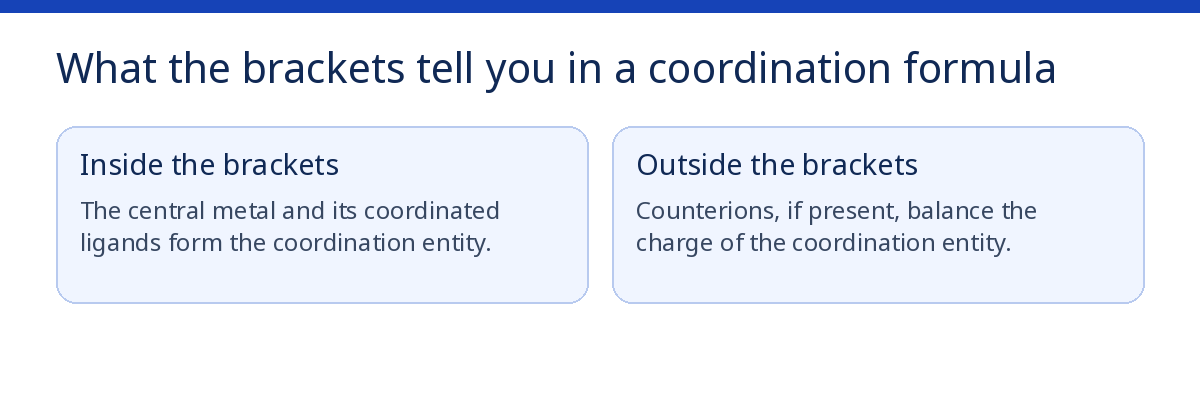
The coordination questions span naming, writing formulas, recognising isomerism and explaining electronic behaviour through crystal field theory. In a coordination formula, the square brackets distinguish the coordination entity from any counterions. An ion written outside the brackets serves a different role from a ligand attached to the central metal, even if both are represented by the same element symbol.
The crystal field case separately asks you to reason about orbital splitting, ligand field strength and electron pairing. For an octahedral complex, the comparison is between the splitting energy and the pairing energy; geometry matters, so do not carry an octahedral splitting picture into a tetrahedral question. The paper also covers transition-metal oxidation states, actinoid behaviour and lanthanoid contraction. For these questions, identify which property needs explaining before choosing a trend or an electronic argument.
Organic chemistry and biomolecules: Explain from structure
The organic questions include product prediction, conversions, structure identification and explanations of reactivity. In a multistep sequence, follow the functional group from one stage to the next and read the reagent and conditions on each arrow. A molecular formula may fit several structures; when the prompt also gives a chemical test or a structural feature, use those clues to narrow the possibilities rather than stopping at the first structure with the right formula.
The amines case makes the solvent relevant to comparisons of basicity: in aqueous solution, electron release, steric effects and solvation can all matter. Biomolecule questions call for a different kind of comparison. When distinguishing starch components, linkage types or protein classes, name the feature you are comparing and describe it for both sides. Two unrelated facts do not make a clear distinction.
Quick self-check after your timed attempt
Use the paper’s question-number links to open the worked solutions after finishing. Compare your reasoning with the resource’s formula, concept and explanation labels. In a numerical answer, look for the first step where your choice of quantity, sign or unit differs. In a written answer, check whether you explained the observation or merely restated it.
- For an assertion–reason item, did you judge each statement on its own before deciding whether the reason explains the assertion?
- For a case-based subpart, did you identify the relevant information in the passage and connect it to the chemical principle being tested?
- For an internal choice, can you explain what the unattempted branch tests before trying it untimed?
This guide omits the worked comparison in Question 2, where the explanation switches between two different colligative properties, and the option judgment in Question 10, where the worked solution qualifies the outcome by reaction conditions.
Spotted an error? Report a correction. Practise this in the app: notes, formula sheets and mind maps.















































































































































Loading comments…