Haloalkanes and Haloarenes: CBSE Class 12 PYQs and Solutions
CBSEChemistryHaloalkanes and Haloarenes
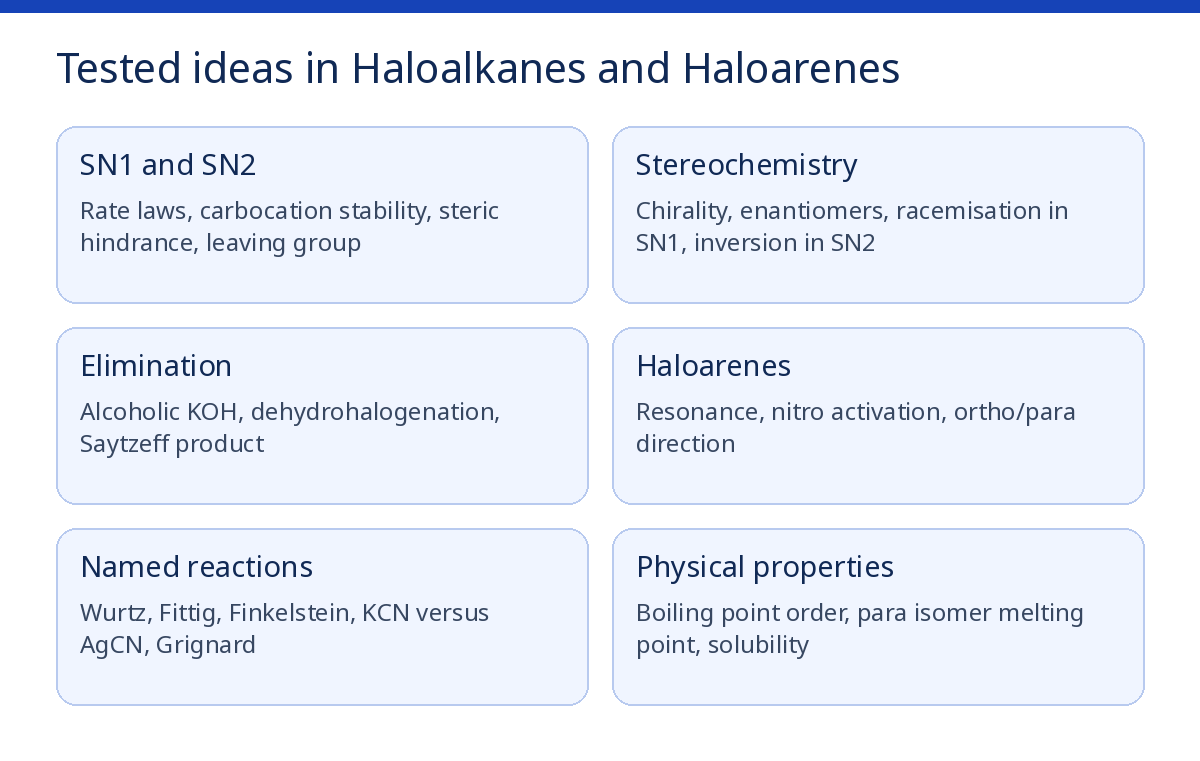
Haloalkanes and Haloarenes (CBSE Class 12 Chemistry, Chapter 6) is tested through mechanism reasoning, stereochemistry, haloarene reactivity, named reactions and property trends. This guide explains those ideas and shows how the solved PYQ collection, with papers labelled 2021 (Term 1) to 2026, frames them.
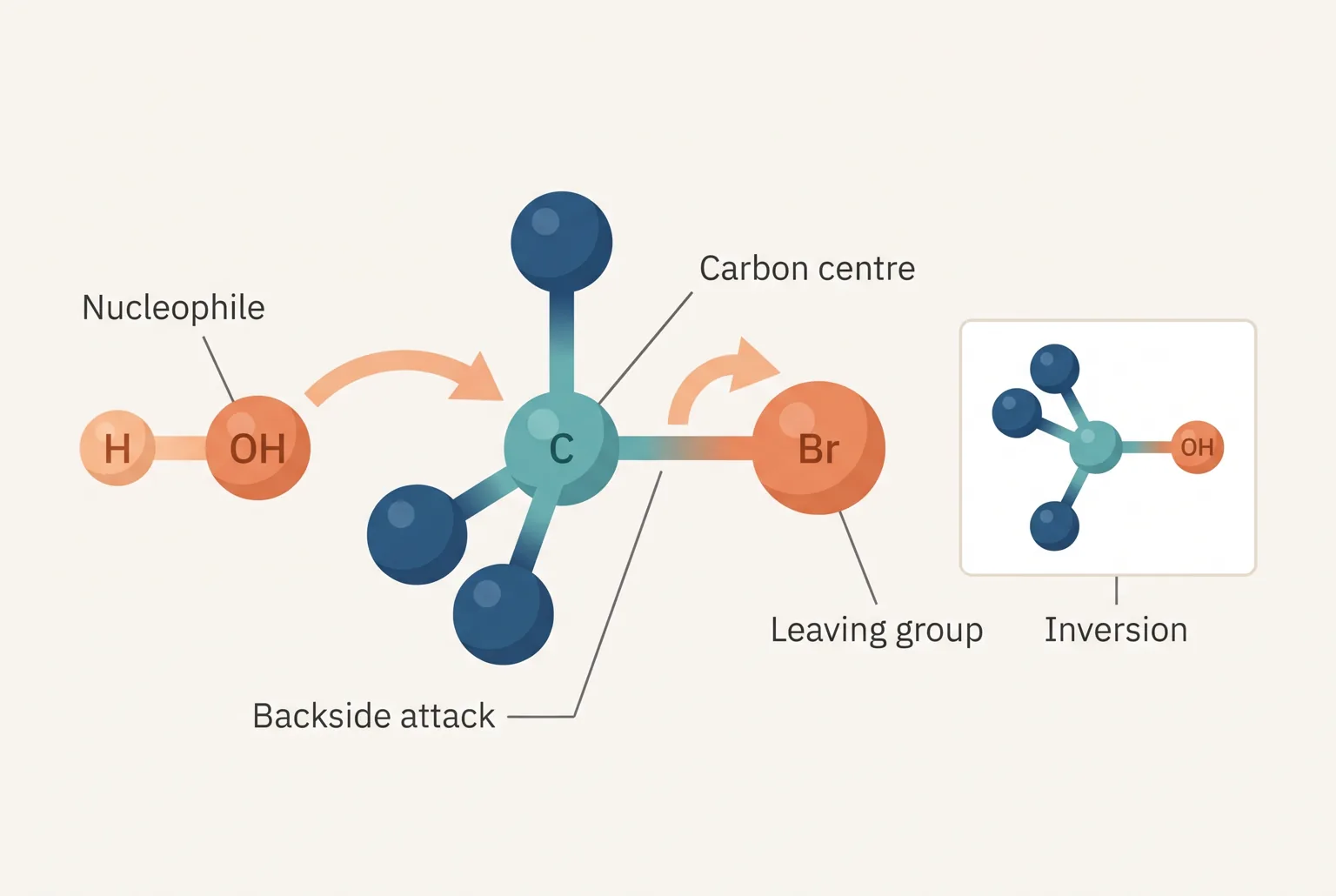
Deciding between SN1 and SN2 from rate and structure
Nucleophilic substitution is the largest cluster in the collection's topic finder. Questions approach it in two ways. Some give two structures and ask which reacts faster. Others describe kinetics and ask you to work back to a structure.
An SN1 reaction passes through a carbocation, so its rate depends only on the alkyl halide's concentration. Anything that stabilises the carbocation speeds it up. Tertiary carbocations are more stable than secondary, and secondary more than primary. Allylic and benzylic cations are stabilised by resonance. This is why pairs such as allyl chloride versus n-propyl chloride, or a benzylic chloride versus another chloride, recur.
An SN2 reaction is a single step: the nucleophile attacks as the halide leaves. Its rate therefore depends on both substrate and nucleophile. Crowding at the carbon slows it, so tertiary halides react least and methyl halides most. The leaving group matters too: CH–I reacts faster than CH–Br.
One 2026 question describes a CHBr isomer whose hydrolysis rate depends on the substrate alone. It pairs this with an optically active isomer whose rate depends on both reagents. Translate each rate law into a mechanism before drawing any structure.

Haloalkanes and Haloarenes | Class 12 | Previous Year Paper
In the StudentCurio app
A comprehensive 134-page collection of solved previous year questions (PYQs) for CBSE Class 12 Chemistry, covering SN1/SN2 mechanisms, nomenclature, and key name reactions with detailed solutions.
Why SN1 racemises and SN2 inverts configuration
Chirality, enantiomers, racemic mixture and racemisation are often asked as short definition parts beside a mechanism question. A chiral molecule cannot be superimposed on its mirror image. Enantiomers are that mirror-image pair. A racemic mixture contains both in equal amounts and shows no net optical rotation.
The definitions connect directly to mechanism. In SN1, the carbocation is planar, so the nucleophile can attack from either face. Both configurations form, which racemises an optically active substrate. In SN2, attack comes from the side opposite the leaving group, so the product forms with inversion of configuration.
Aqueous versus alcoholic KOH: substitution or elimination
Several stems contrast the same alkyl chloride with aqueous and with alcoholic KOH. In aqueous solution, hydroxide acts mainly as a nucleophile and an alcohol forms. In alcoholic KOH, it removes a β-hydrogen, and an alkene forms by dehydrohalogenation.
When more than one alkene is possible, the Saytzeff rule applies: the more substituted alkene is the major product. Questions on 2-bromobutane or 1-bromo-1-methylcyclohexane reward a clear method:
- Locate the β-hydrogens.
- Sketch each possible alkene.
- Justify the major one by its degree of substitution.
Why haloarenes resist nucleophiles yet direct ortho and para
A frequent question asks why haloarenes are less reactive towards nucleophilic substitution, often demanding two reasons. The standard points are:
- Resonance gives the C–X bond partial double-bond character.
- The sp carbon holds the bond more tightly. This links to the question on the shorter C–Cl bond in chlorobenzene than in methyl chloride.
- A phenyl cation is unstable.
- The electron-rich ring repels an incoming nucleophile.
Nitro groups at ortho or para positions change this. The source contrasts p-chloronitrobenzene, which reacts with aqueous NaOH at 443 K, with chlorobenzene, which needs 623 K and 300 atm. Explain the difference by showing how the negative charge in the intermediate delocalises onto the nitro group.
In electrophilic substitution, chlorine's −I effect deactivates the ring. Its +R effect, however, raises electron density at the ortho and para positions, so it is still ortho/para-directing. Sulfonation and Friedel–Crafts acylation of chlorobenzene test this idea.
Named reactions and conversions that keep returning
Product-drawing and 'what happens when' questions draw on a recurring set of reactions:
- Wurtz reaction: alkyl halides couple with sodium in dry ether. Some questions run backwards from a product such as 2,5-dimethylhexane.
- Wurtz–Fittig and Fittig reactions: couplings that involve aryl halides.
- Halogen exchange: Finkelstein (NaI in dry acetone) and silver fluoride exchange.
- KCN versus AgCN: cyanide is an ambident nucleophile. Alkyl cyanides form with KCN; isocyanides form with AgCN.
- Alcohol conversions: SOCl or HCl acting on molecules that contain both alcoholic and phenolic OH.
- Bromine additions: HBr addition with and without peroxide, and allylic or benzylic bromination using Br with heat or UV light.
- Grignard reagents: these must be prepared under anhydrous conditions.
Sequences labelled A to F chain several of these reactions together.
Ordering boiling points and melting points
Property questions usually ask for an order with a reason. For the same alkyl group, boiling points fall as RI > RBr > RCl > RF, following molecular mass and van der Waals forces. One 2026 item mixes butane with three 1-halobutanes. Another mixes straight-chain and branched chlorides, where branching lowers the boiling point.
p-Dichlorobenzene melts higher than its ortho and meta isomers, which links to its symmetry and crystal packing. Low water solubility despite polarity, and storing chloroform in closed dark bottles, are other short-reason favourites.
Common mistakes in mechanism and product answers
- Naming SN1 or SN2 without stating the rate dependence or the carbocation stability that justifies it.
- Reading chlorine's −I effect as meta-directing, which ignores its +R effect.
- Writing the less substituted alkene in alcoholic KOH problems without applying the Saytzeff rule.
- Ignoring whether peroxide is present when predicting where HBr adds to an alkene.
- Overlooking that the source treats aryl halides as not obtainable from phenol with concentrated halogen acids or phosphorus halides.
How the 146 questions are organised for practice
The collection prints 146 questions with added step-by-step solutions:
- 77 subjective items: 75 short or long answer and 2 case-based. Some use internal choice through OR.
- 69 single-answer items: 55 MCQs and 14 assertion-reason.
Marks appear only where the original papers printed them. The supplied material had answer keys but no complete written solutions, so every worked solution is labelled as added. Apparent source errors are kept in the questions and explained in the solutions. The chapter is Chapter 6 in the current CBSE sequence and Chapter 10 in older NCERT editions.
A sensible order is to work through the topic finder's substitution and stereochemistry lists first. Then move to haloarenes, named reactions and elimination, writing your reasons before opening each linked solution. Finally, attempt the MCQ and assertion-reason block (Q78–Q146) in one timed sitting.
Quick self-check: can you explain why one optically active halide gives a racemic product while another gives an inverted one?
Frequently asked questions
Are the solutions taken from CBSE marking schemes?
No. The collection states that the supplied material contained answer keys and online links but no complete written solutions, so every full solution was added and is labelled as an added solution.
Why does the PDF call this Chapter 6?
It follows the current CBSE Class 12 Chemistry sequence. The source notes that older NCERT editions may number the chapter as Chapter 10.
Spotted an error? Report a correction. Practise this in the app: notes, formula sheets and mind maps.















































































































































Loading comments…