The d- and f-Block Elements: Class 12 NCERT Guide
CBSEChemistryThe d- and f-Block Elements
This CBSE Class 12 NCERT Chemistry chapter connects electron configurations to the properties of transition metals. Use its tables and graphs to follow trends across the first transition series, then see how lanthanoid contraction helps explain a similarity between the heavier series.
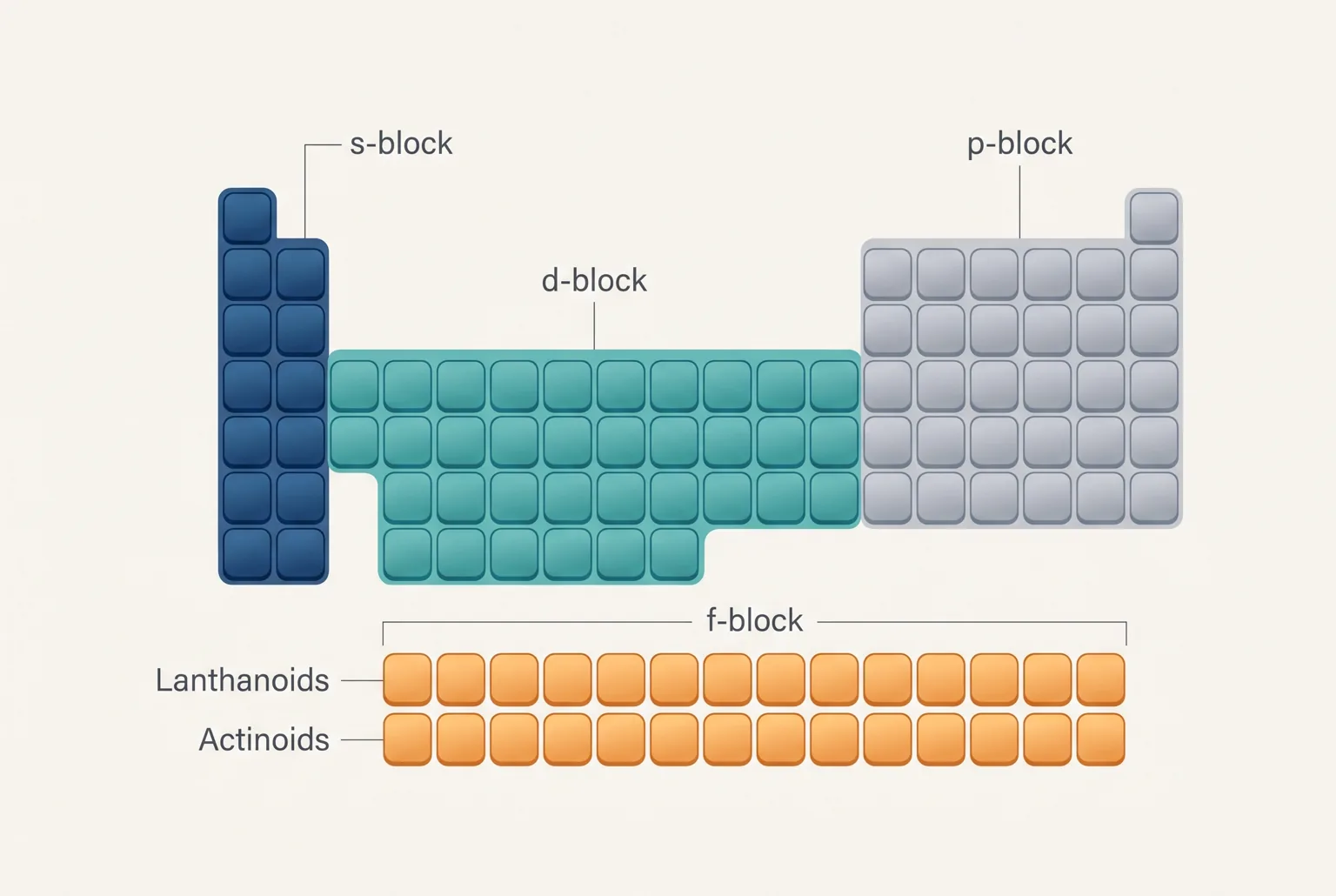
Where the d- and f-blocks fit
The d-block occupies groups 3–12 between the s- and p-blocks. Its four series are labelled 3d, 4d, 5d and 6d according to the subshell being filled. The f-block, shown separately below the main periodic table, contains the 4f and 5f series, known as the lanthanoids and actinoids respectively. The chapter introduces all four d-series but uses the first, or 3d, series for most of its detailed discussion of transition-metal properties.
Being in the d-block is not the same as being a transition element. The definition used in the textbook requires an incomplete d subshell in the neutral atom or in one of its ions. Zinc, cadmium and mercury sit at the end of their respective d-series, but their d subshells are full in the neutral atoms and in their common oxidation states. The chapter studies them alongside transition metals without classifying them as transition elements.

The d- and f-Block Elements | Class 12 | NCERT Textbook
In the StudentCurio app
This textbook chapter covers the properties and reactions of transition elements, including oxidation states, colour, magnetism, complex formation, catalysis, potassium dichromate and permanganate, and the chemistry of lanthanoids and actinoids. It helps Class 12 students learn and review the d- and f-block elements.
Common mistake: using the atom’s configuration for its ion
Table 4.1 gives ground-state outer electron configurations. Read the d and s occupancies separately rather than assuming that every neutral atom in a series has two outer s electrons. Chromium has the outer configuration , and copper has . These entries show why the general configuration pattern is a starting point, not a substitute for checking individual elements.
When d-block atoms form cations, the outer electrons are removed before the electrons. For the first series, that means removing 4s electrons before 3d electrons. Table 4.2 makes the distinction visible by placing the neutral-atom and ion configurations in separate rows. Check the charge before counting d electrons: the count for the neutral atom need not describe the species whose properties you are trying to explain.
What the tables and graphs reveal about trends
The melting-point and atomisation-enthalpy graphs connect physical properties with metallic bonding. The textbook relates the generally high melting points to the participation of both d and s electrons in bonding. Enthalpy of atomisation provides another way to compare how strongly atoms are held together in the metal. The graphs are worth reading as patterns with exceptions, rather than as rules that every element follows.
The same care applies to size. Across a series, increasing nuclear charge and incomplete shielding by added d electrons generally lead to smaller radii, though the change is modest and individual values do not decrease at every step. When you use Table 4.2 to compare ionic radii, stay within a single charge row. Mixing ions of different charges would obscure the trend the chapter is describing.
Oxidation states: what is possible and what is stable
Table 4.3 lists common oxidation states of the first row and uses bold type for the most common ones. The distinction matters: an oxidation state can occur without being the most typical state for that element. The range tends to be wider near the middle of the series, and successive states can differ by one, as vanadium’s states from to illustrate.
Ionisation enthalpies help explain the energy cost of removing electrons, but the chapter cautions against using them alone to judge the stability of an oxidation state. The discussion of standard electrode potentials brings in a different comparison: the relationship between a metal and its ions in solution. When reading the potential data, check the species in the heading first. The couple compares an ion with the metal, whereas compares two ionic oxidation states.
A useful connection: 4f filling and the size of 5d metals
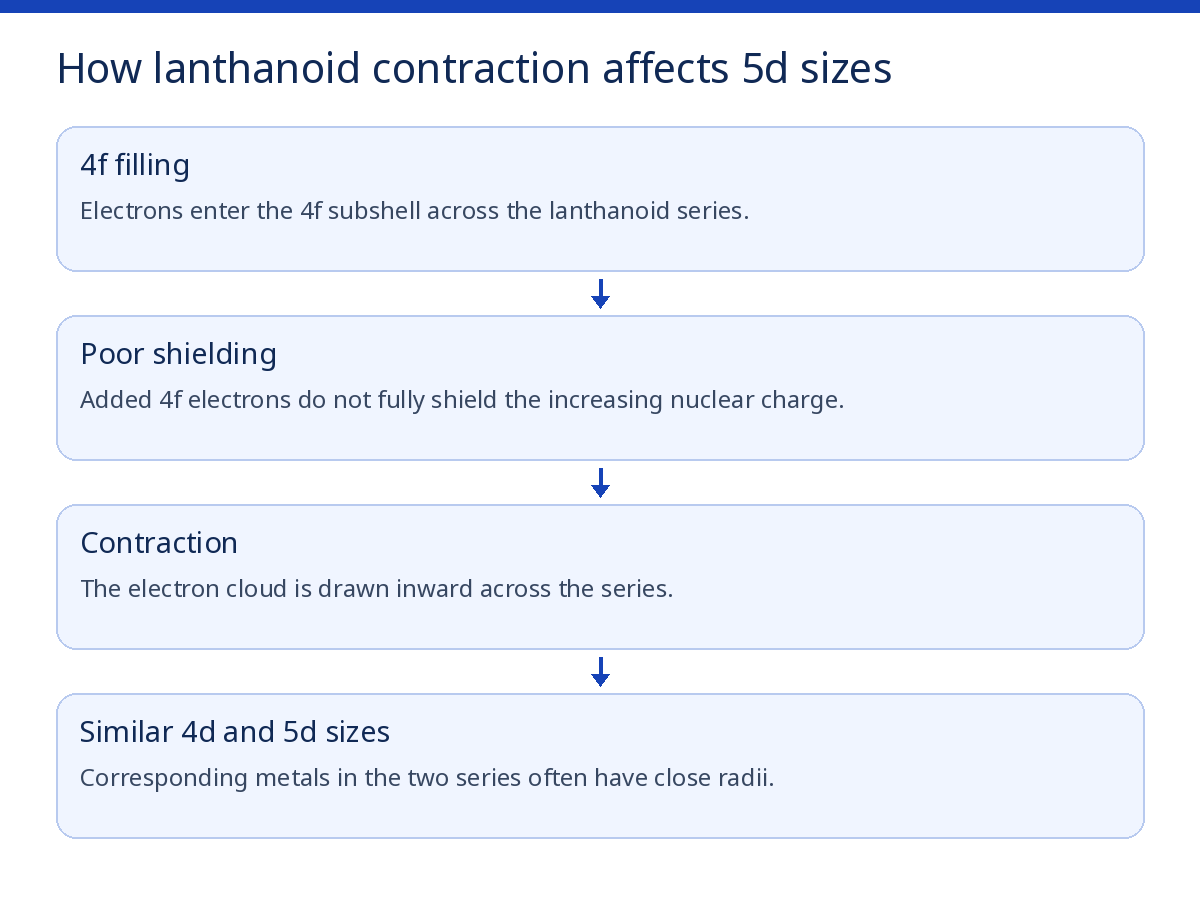
Corresponding 4d metals are generally larger than their 3d counterparts, but the sizes of corresponding 4d and 5d metals are often close. The chapter connects this result to lanthanoid contraction. As the 4f subshell fills, its electrons shield one another poorly. Increasing nuclear charge therefore pulls the electron cloud inward across the lanthanoid series. This contraction offsets much of the increase in size otherwise expected for the 5d metals.
The connection makes the f-block relevant to a trend you can see in the d-block graphs. For the f-block itself, the chapter asks you to compare lanthanoids and actinoids by electronic configuration, oxidation states and chemical behaviour. When consulting Table 4.9 for lanthanum and the lanthanoids, remember that its configurations show only the electrons outside the xenon core.
How to use the chapter for CBSE revision
Use the configuration tables first, then read the property discussions with the relevant atom or ion in mind. This gives you a way to approach the chapter’s treatment of colour, magnetism and complex formation without treating them as an unrelated list. The chapter also covers catalysis and treats potassium dichromate and potassium permanganate as compound studies, with preparation, properties, structures and uses as distinct points to review.
Try an intext question after reading the corresponding table or explanation. Before moving on, check whether your reasoning specifies the species, charge and comparison you are making. This guide leaves out the disputed chromium explanation on PDF page 2 and the disputed exchange-energy explanation on page 8. It does not reproduce the solution to Example 4.4 or answer Intext Question 4.4.
Spotted an error? Report a correction. Practise this in the app: notes, formula sheets and mind maps.















































































































































Loading comments…