CBSE Class 12 Chemistry 2024 Paper and Worked Solutions
CBSEChemistry2024 Previous Year Paper
Paper code: 56/2/2 · 2024Practise the full 2024 CBSE Class 12 Chemistry main board paper (56/2/2), then use the worked solutions to check your choice of method, your calculations and the reasoning behind your answers.
This set is one of the year's papers. See every set from 2024, grouped by series.
What this year-wise paper includes
This resource contains the English version of the 2024 CBSE Class 12 Chemistry main examination theory paper, set 56/2/2. It is a full paper rather than a chapter-wise question bank, so it lets you practise switching between physical, inorganic and organic chemistry and biomolecules. The file preserves the original English question layout, options and diagrams, and the cover links question numbers to their worked solutions.
The paper allows three hours for writing, carries 70 marks and does not permit calculators. The title page also records a separate 15-minute reading period during which candidates did not write answers. For a timed attempt, use that period to scan the sections, locate internal choices and note where you will need to read a diagram or a case passage closely.

Chemistry 2024 | Class 12 | Previous Year Paper | Code 56/2/2
In the StudentCurio app
Complete 2024 CBSE Class 12 Chemistry main examination paper (code 56/2/2) with worked solutions across the syllabus. Helps students practise the board-paper format and review answer methods.
How the five sections change what you write
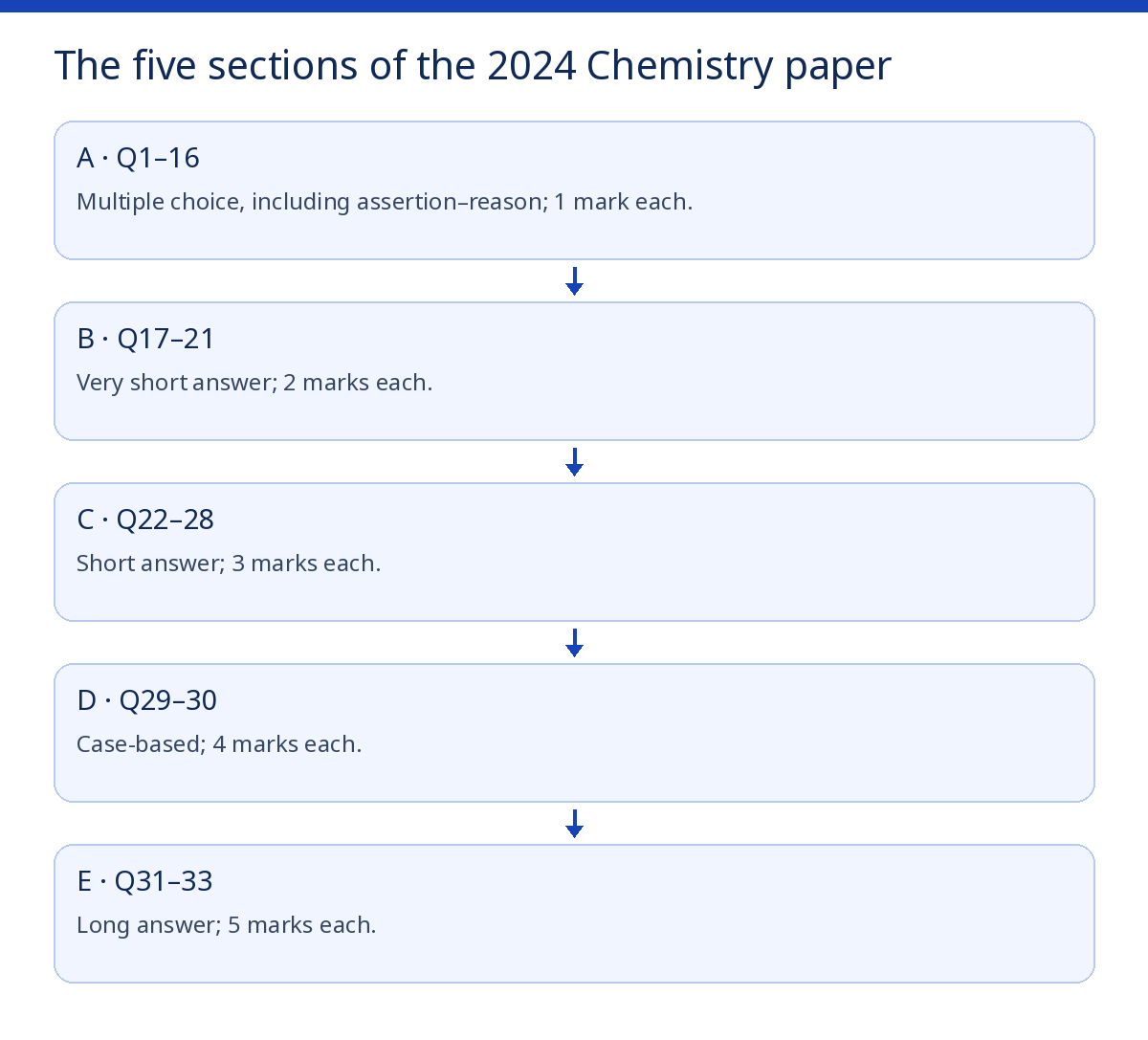
The paper contains 33 questions. Section A has 16 one-mark multiple-choice questions, including assertion–reason items. Sections B and C contain five two-mark very short answers and seven three-mark short answers, respectively. Section D has two four-mark case-based questions, and Section E has three five-mark long-answer questions.
There is no overall choice: all question numbers are compulsory, but some questions outside Section A offer internal choices. Read each item’s own directions before deciding how much to attempt; a printed OR and a direction to answer a specified number of subparts are different instructions. Use the marks shown beside subparts to check that you have addressed the whole prompt. In an assertion–reason item, judge each statement separately before deciding whether the reason actually explains the assertion.
Before calculating, identify what the formula describes
The physical chemistry questions draw on chemical kinetics, solutions and electrochemistry. They include first-order kinetics, activation energy, osmotic pressure, vapour pressure, cell emf and conductivity. In review, check whether your first line names the quantity being found. Reaction rate and rate constant are different quantities, just as resistance and molar conductivity are different quantities. Choosing a familiar equation before identifying the target can lead to a calculation that is neat but irrelevant.
Make assumptions visible in your working. A first-order half-life relation is not a general rule for every reaction order. Arrhenius calculations require absolute temperatures in kelvin. In a vapour-pressure problem that specifies complete electrolyte dissociation, account for the dissolved particles rather than treating each formula unit as one particle. These checks help you distinguish a wrong model from an arithmetic slip.
Read coordination formulas at two levels
The inorganic questions move between transition-element properties and the behaviour of individual coordination compounds. The paper asks you to reason about oxidation states and contraction as well as to work with nomenclature, geometry, magnetic behaviour and isomerism. The transition-metal case also provides electrode-potential data, giving you practice in distinguishing a trend shown by a table from the explanation the question requests.
For a coordination formula, first separate what lies inside the brackets from any counterions outside. Then distinguish the number of ligand molecules from the number of donor atoms attached to the metal: a ligand can bind through more than one donor atom. Keep those counts separate from the metal’s oxidation state. The same formula can supply several kinds of information, but each question asks you to use a particular part of it.
Let the organic prompt determine the form of your answer
The organic questions range from recognising halide structures and comparing reactivity to completing reaction sequences, writing named reactions and distinguishing compounds by a chemical test. These tasks are not interchangeable. If a sequence labels intermediates, keep the labels tied to the reaction arrows and read the reagent at each step. A request for an equation needs more than the reaction name, while a request for a reason needs the chemical basis for the comparison, not merely the order of reactivity.
For structure recognition, check where the relevant group is attached before applying a name or a reaction rule. For a distinction by chemical test, make clear what would be observed for the compounds being compared. This guide leaves out option-level interpretations of the ether-cleavage and RNA assertion–reason items, whose wording requires qualifications.
Quick self-check for the case passages
The two case questions use different kinds of evidence: one gives a passage and a data table about transition metals, while the other discusses carbohydrate classification and evidence about glucose structure. After reading a subpart, ask: Does this need a detail from the passage, a principle from the syllabus, or a link between the two? That distinction helps you avoid copying a passage sentence when the question asks you to account for an observation.
Use the solutions to diagnose the first wrong step
Attempt the question paper before opening the solutions. Then use the resource’s formula used, concept used and explanation in steps structure to locate where your reasoning first diverged. In a numerical answer, that might be the equation, the unit conversion or the substitution. In a written answer, it might be a missing reason, reagent or observation. For a multiple-choice item, compare your reasoning even if the option letters match.
The file provides worked solutions for the questions and subparts, including both printed OR alternatives. Attempt only the required branch in the timed sitting; use the other branch afterward as fresh practice. That keeps the mock attempt faithful to the paper while making use of the extra worked material.
Spotted an error? Report a correction. Practise this in the app: notes, formula sheets and mind maps.















































































































































Loading comments…