CBSE Class 12 Chemistry 2023 Supplementary Paper
CBSEChemistry2023 Previous Year Paper
Paper code: 56(B) · 2023Practise with the solved 2023 CBSE Class 12 Chemistry supplementary theory paper, code 56(B), adapted for visually impaired candidates. This full, year-wise paper lets you compare how you answer quick concept checks, case-based questions and longer reasoning tasks.
This set is one of the year's papers. See every set from 2023, grouped by series.
How the adapted paper is organised
The English version allows three hours for 70 marks. The original instructions also specify a separate 15-minute reading period and prohibit calculators. The 35 questions are arranged in five sections: Section A has one-mark multiple-choice questions, including assertion–reason items; Sections B and C have two-mark very short answers and three-mark short answers, respectively. Section D contains four-mark case-based questions, and Section E contains five-mark long answers.
There is no overall choice, but some questions in Sections B through E offer internal choices. For a timed attempt, follow the choice printed within each question. For revision, try the unused alternative later: it may test a different skill even though it carries the same marks.

Chemistry Supplementary 2023 | Class 12 | Previous Year Paper | Code 56(B)
In the StudentCurio app
A solved 2023 CBSE Class 12 Chemistry supplementary examination paper, identified as an adapted paper for visually impaired candidates. It includes questions and worked answers across physical, organic and inorganic chemistry.
Physical chemistry: name the quantity before choosing a rule
The solutions questions cover ideal and non-ideal behaviour, osmotic pressure and boiling-point elevation. The ideal-solution model applies across the composition range, not just at one composition. For colligative properties, distinguish the amount of solute added from the number of dissolved particles it produces. When a question states that a solute dissociates completely, treat that as an assumption of the calculation, not as a rule for every solution of that solute.
The kinetics questions ask you to reason about both concentration and temperature. A rate law describes how concentration affects the rate at fixed temperature, with other relevant concentrations held constant. An activation-energy calculation based on the Arrhenius equation instead compares rate constants at different absolute temperatures. Naming what changes prevents you from treating the reaction rate and the rate constant as interchangeable.
Common mix-up: conductivity and molar conductivity
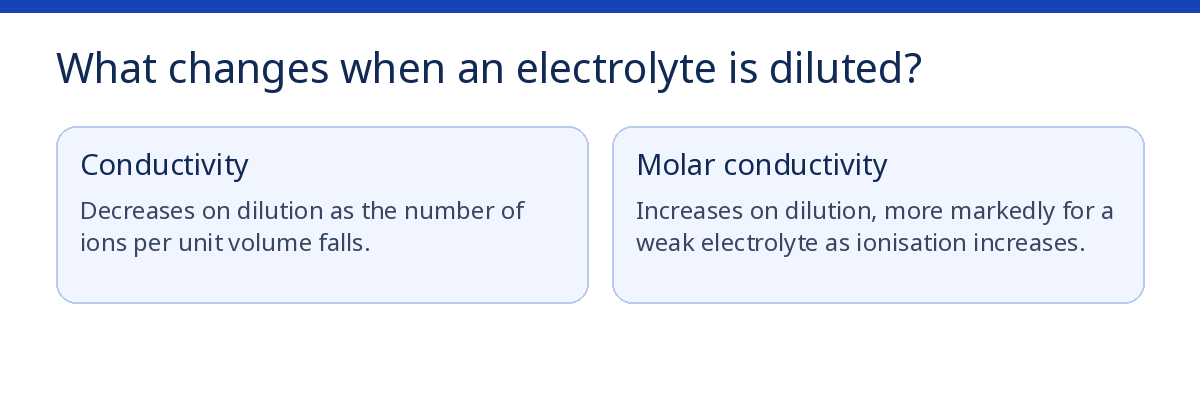
The paper asks about conductivity on dilution and separately asks for a comparison of molar conductivity for strong and weak electrolytes. At constant temperature, dilution lowers conductivity because there are fewer ions per unit volume. Molar conductivity instead accounts for the amount of electrolyte present and increases on dilution. The increase is more pronounced for a weak electrolyte because its degree of ionisation increases as the solution becomes more dilute.
For the requested diagram, label the vertical axis with the conductivity quantity you mean before drawing either curve. The paper also tests electrode reactions in a fuel cell and links cell potential to electrical work and equilibrium. In those questions, check the direction of the stated cell reaction before interpreting the sign of a thermodynamic quantity.
Coordination chemistry: keep charge, field and magnetism separate
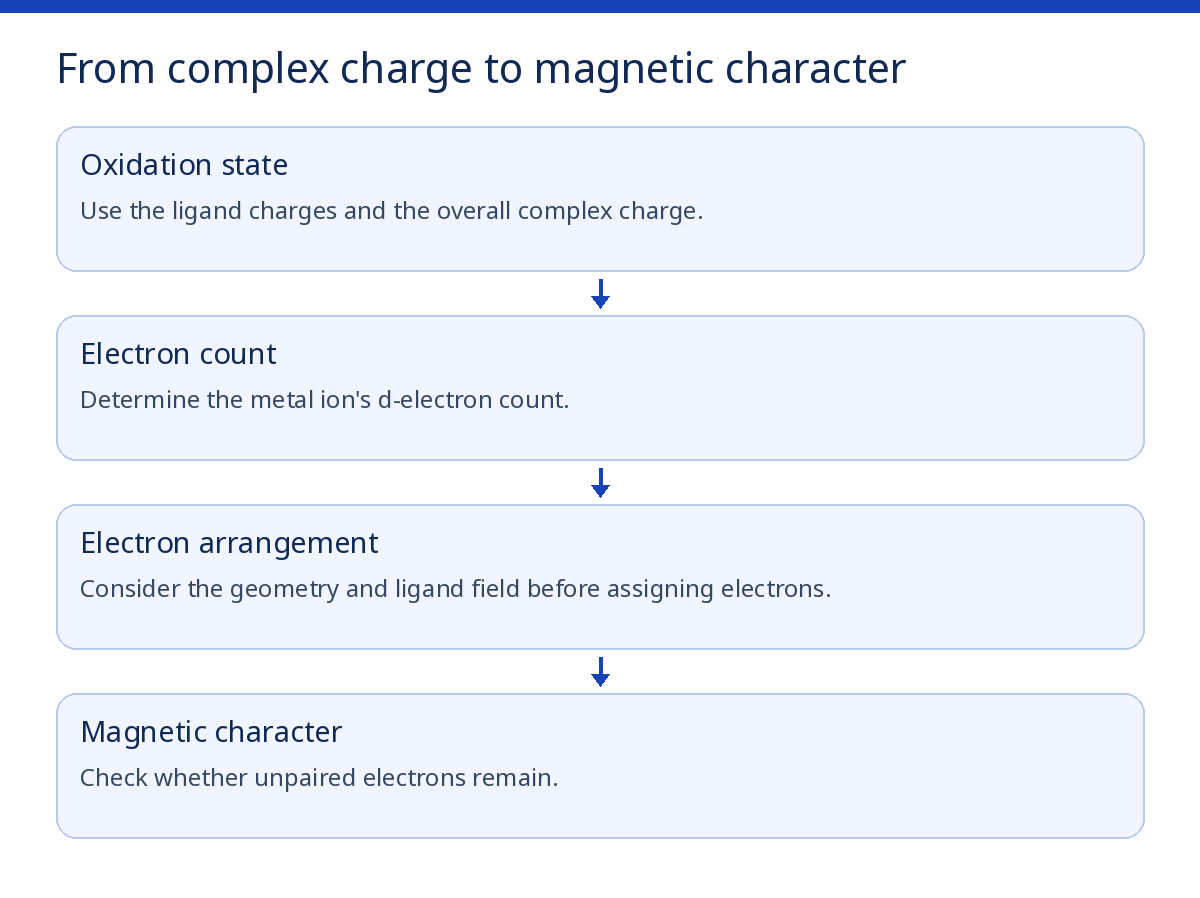
The inorganic questions range from naming coordination compounds and identifying ligand behaviour to explaining magnetic character. For a magnetism question, first use ligand charges and the overall complex charge to find the metal oxidation state. Then determine the metal ion's d-electron count and consider the geometry and ligand field before deciding how the electrons are arranged. Magnetic character follows from whether unpaired electrons remain, not from the oxidation state alone.
The longer inorganic questions also cover oxide acidity, oxidation states, contraction in the lanthanoids and actinoids, and preparation of inorganic compounds. Notice the difference between a prompt that asks you to account for a trend and one that asks for a preparation: the former needs a causal explanation, while the latter needs a chemical sequence.
Organic chemistry: conditions are part of the answer
The organic questions move between halo compounds, alcohols and phenols, amines, carbonyl compounds and carboxylic acids. For a conversion, identify the starting and target functional groups before recalling the reagent. Then check whether the solvent, medium or subsequent treatment matters. The paper makes these details visible by specifying conditions such as dry ether, ethanolic base and hydrolysis after a Grignard reaction. Leaving out a stated condition can change the transformation you are describing.
Distinguishing tests require a different kind of response from conversions. Name the test, but also state the contrasting observations that would let someone tell the compounds apart. For a comparison of acidity or reactivity, give the structural reason for the difference rather than simply placing the compounds in order.
Quick self-check for the case-based questions
One case links the properties of alcohols and phenols to routes for preparing or converting them. The other connects the components of nucleic acids with the structure and roles of DNA and RNA. Each case divides its four marks into one-, one- and two-mark parts, so a short definition and a reasoned comparison do not call for the same amount of detail.
Before checking the worked pages, ask yourself: Which information can I take from the passage, and which relationship do I need to explain using chemistry I already know? In the assertion–reason items, make a similar distinction: check the truth of each statement before deciding whether one explains the other.
How to review your attempt with the worked pages
The file pairs its question pages with numbered worked solutions that separate the formula, concept and explanation. After an independent attempt, use that structure to locate the first point where your reasoning diverged. In a numerical answer, that may be an assumption or a unit rather than arithmetic. In a written answer, it may be a missing reason even when the final statement is correct.
This guide leaves out the rechargeability item's answer because the resource itself flags the wording as ambiguous. When a sign, exponent or charge looks incomplete in extracted text, check the printed page before using it; don't practise a calculation from a guessed transcription.
Spotted an error? Report a correction. Practise this in the app: notes, formula sheets and mind maps.















































































































































Loading comments…