CBSE Class 12 Chemistry 2023 Paper: Set 2 Practice Guide
CBSEChemistry2023 Previous Year Paper
Paper code: 56/1/2 · 2023Practise with the full 2023 CBSE Class 12 Chemistry main examination paper, Set 2 (56/1/2). Use the worked solutions after your attempt to distinguish a concept gap from a mistake in setup, notation or chemical reasoning.
This set is one of the year's papers. See every set from 2023, grouped by series.
Read the structure of the 70-mark paper
This year-wise file pairs the English question paper with worked solutions. The theory paper allowed three hours, with a separate 15-minute reading period in which candidates could not write answers. Calculators were not allowed. The paper has 35 questions across five sections:
- Section A: 18 one-mark multiple-choice questions, including assertion–reason items.
- Sections B and C: Seven two-mark very short answers and five three-mark short answers, respectively.
- Section D: Two four-mark case-based questions, on coordination compounds and chemical kinetics.
- Section E: Three five-mark long-answer questions.
There is no overall choice: all numbered questions are compulsory, but some questions in Sections B through E offer internal alternatives. During the reading period, identify exactly which subpart an OR replaces. In a case-based question, the choice can apply only to the final subpart, leaving the earlier parts compulsory.

Chemistry 2023 | Class 12 | Previous Year Paper | Code 56/1/2
In the StudentCurio app
The 2023 CBSE Class 12 Chemistry main examination paper with worked solutions, covering questions across the syllabus, including coordination compounds, chemical kinetics, organic chemistry, electrochemistry and biomolecules. It helps students practise the board-paper format and review solution methods.
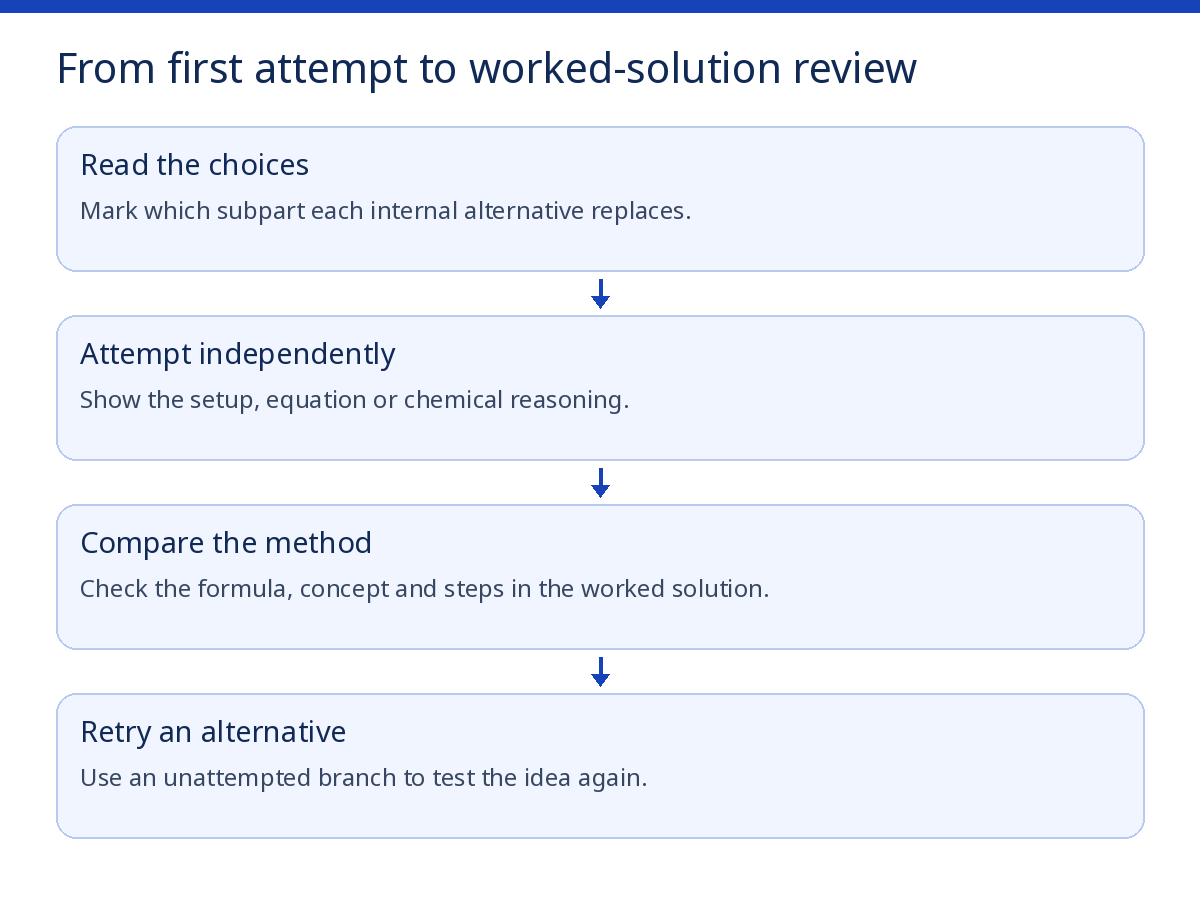
Attempt first, then compare the reasoning
Keep the solution pages closed during your first attempt. In assertion–reason items, judge each statement on its own before deciding whether the reason explains the assertion. In written questions, show the relevant equation, chemical transformation or explanation. That gives you something to check even when your final result looks right.
The solutions separate the formula used, the concept used and the explanation in steps. Read those parts in that order to locate the first point where your method diverges. If you chose the right equation but used the wrong unit, revise the setup rather than relearning the chapter. If you selected a reagent without being able to explain its role, revisit the reaction and its conditions. Save the unattempted internal alternatives for a second pass rather than treating both branches as compulsory in the mock.
Kinetics: keep order and molecularity separate
The kinetics questions move between short items and a case passage about rates and rate laws. An average rate refers to a finite time interval; an instantaneous rate refers to a particular moment. Before using concentration data, check which of the two the question asks for.
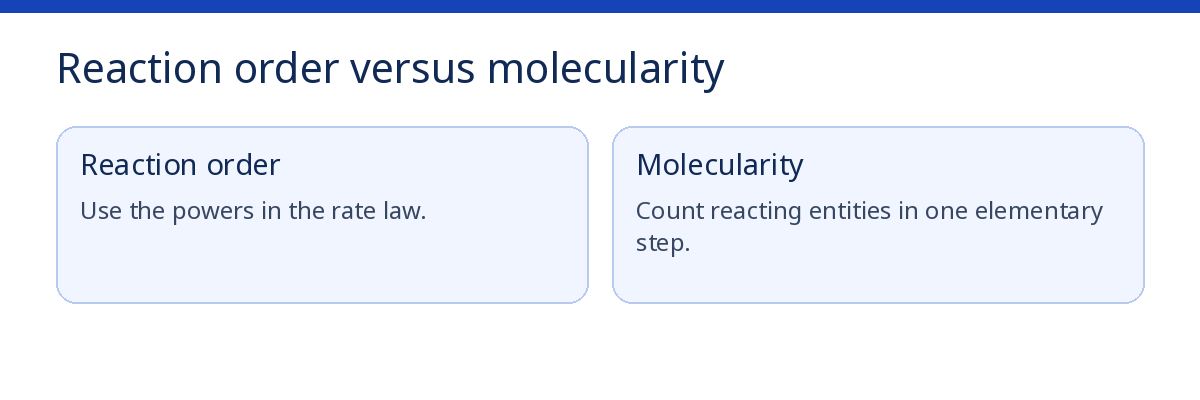
The first-order relation applies when the reaction follows first-order kinetics. The half-life is then independent of the initial concentration, and the unit of is the inverse of the time unit used. For other orders, work out the unit from the rate law rather than carrying that unit over. Common mistake: Reaction order comes from the powers in the rate law. Molecularity counts reacting entities in one elementary step and cannot be assigned by counting reactants in an overall multistep equation.
Physical chemistry: check what each quantity describes
Electrochemistry in this set includes electrode potentials, conductivity and molar conductivity, as well as links between cell potential and equilibrium. For a standard cell calculation using tabulated reduction potentials, use . Balancing the electrons can change the coefficients in the reaction, but it does not scale either electrode potential. Keep conductivity and molar conductivity distinct when reading dilution questions: they are different quantities, not interchangeable names for the same measurement.
The solutions chapter asks you to interpret vapour-pressure lowering, osmotic pressure and gas solubility. When the relation applies: For an ideal solution with a non-volatile solute, the relative lowering of the solvent’s vapour pressure equals the solute mole fraction. In a two-component solution, that fraction uses the total moles of solvent and solute in the denominator. Using solvent moles alone is a dilute-solution approximation, not the definition of mole fraction.
Coordination compounds: read the brackets before naming
The coordination case draws on Werner’s distinction between primary and secondary valencies and asks you to move between formulas and names. Start by separating the species inside the square brackets from the counter-ions outside. When finding the metal’s oxidation state, use the charges of the ligands and the net charge of the complex. When finding its coordination number, count donor atoms attached to the metal, not simply the number of ligand molecules.
That same inside–outside distinction helps you recognise what changes in ionisation isomerism: an ion inside the coordination sphere in one compound occupies a counter-ion position in the other. Elsewhere, the transition-metal questions ask for reasons behind properties such as oxidation-state stability. Practise giving an explanation rather than merely restating the trend.
Organic reactions and biomolecules: explain the change
The organic questions ask for products, conversions, chemical tests and reasons for differences in properties. In a conversion, mark the functional group at each stage and place the reagent and condition over the arrow where they act. In a test question, distinguish the reagent from the observation that would let you tell the compounds apart. In a basicity explanation, check whether the comparison is in water: solvation and steric effects can matter alongside the electron-donating effect of alkyl groups.
For biomolecules, keep descriptions of structure separate from descriptions of chemical change. Hydrolysis questions ask what is formed when linkages are broken. A structural comparison asks how the units are connected, while a protein denaturation question asks what happens to the protein’s organisation. These prompts call for different kinds of statements, even when the answers are short.
Set aside disputed items when reviewing
The paper preserves the original wording and options, and the worked notes flag local problems. This guide omits the disputed starch-linkage item and first-order numerical option, as well as the intended answer choices for the photochemical order, overall molecularity and aniline acetylation items. Those questions involve wording, a reported option mismatch or assumptions that matter to the interpretation. If one interrupts your review, separate the chemical principle you can justify from the choice the printed item appears to expect. Do not use a disputed option to decide whether you understand the topic.
Spotted an error? Report a correction. Practise this in the app: notes, formula sheets and mind maps.















































































































































Loading comments…