Class 12 NCERT Notes: The d- and f-Block Elements
CBSEChemistryThe d- and f-Block Elements
These NCERT revision notes for CBSE Class 12 Chemistry connect electron configurations to the properties of transition elements. They also trace the preparation and reactions of potassium dichromate and potassium permanganate, and compare the two inner transition series.
Where the d- and f-blocks fit
The notes begin with the periodic table. The d-block occupies groups 3 to 12, where electrons are added across a series to the d subshell of the last-but-one shell. The general configuration, , allows for variation in the occupancy of the outer s subshell. The four d-block series correspond to filling the 3d, 4d, 5d and 6d subshells.
Block membership and transition-element status are different. Position identifies a d-block element, but the transition-element definition asks whether the atom or an ion in at least one oxidation state has an incomplete d subshell. The f-block is organised around a different filling pattern: the 4f subshell fills across the lanthanoids in period 6, and the 5f subshell fills across the actinoids in period 7.

The d- and f-Block Elements | Class 12 | NCERT Notes
In the StudentCurio app
Revision notes cover the general properties of transition elements, including electronic configurations, radii, oxidation states, colour, magnetism, complex formation, catalysis and alloy formation. They also review potassium dichromate and permanganate, lanthanoids, lanthanoid contraction and actinoids for Class 12 students.
What electron configuration helps explain
The properties section links the participation of outer s and d electrons in metallic bonding to generally high enthalpies of atomisation and high melting and boiling points. The proximity in energy of the two sets of electrons also helps explain variable oxidation states: both can participate in bonding. These are related explanations, but strong bonding in the metal is not the same property as the ability to form compounds in different oxidation states.
For atomic radii, the notes explain the initial decrease from scandium to chromium through increasing effective nuclear charge. Do not extend that early decrease uniformly across the series: shielding and electron repulsion also change as the d subshell fills. The discussion of ionisation enthalpy similarly treats size and electronic configuration together rather than presenting a smooth trend.
Common mix-ups: colour, magnetism and lattice structure
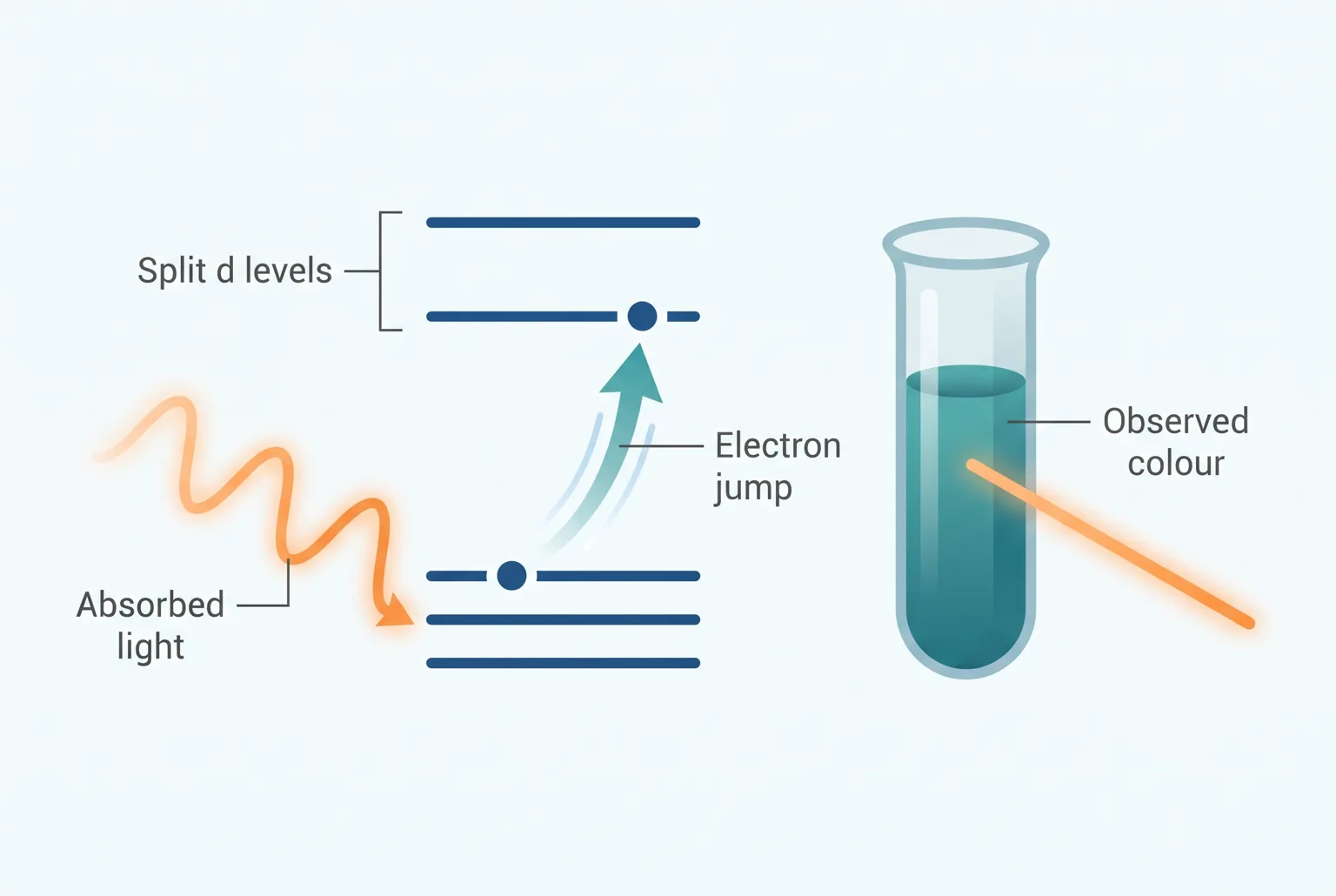
Use the diagram of split d levels to distinguish two effects that are often studied together. Paramagnetism depends on unpaired electrons in the particular atom or ion being considered; a species with all its electrons paired is diamagnetic. Colour in many transition-metal complexes comes from absorption of visible light as an electron moves between split d levels. The observed colour is complementary to the light absorbed. The notes also identify charge transfer as another source of colour, so colour alone does not establish that a species has unpaired d electrons.
The solid-state examples call for a different distinction. In an interstitial compound, small atoms occupy gaps in a metal lattice. The notes contrast this with substitution in alloys, where atoms of comparable size can take one another’s lattice positions.
Potassium dichromate: preparation, equilibrium and reduction
The preparation diagram follows chromium from chromite ore to sodium chromate by oxidative fusion, then to sodium dichromate by acidification. Adding potassium chloride gives the less soluble potassium dichromate. Reading the sequence alongside the equations helps distinguish the step that changes the chromium-containing ion from the final step that changes the salt obtained.
The pH diagram and the reduction half-equation describe different processes. In the aqueous chromate–dichromate equilibrium, acid or base changes which ion is favoured, but chromium remains in oxidation state . In the acidic reduction half-equation, chromium changes oxidation state and electrons appear as reactants. When revising this page, label each equation as a preparation step, an acid–base interconversion or a redox process before comparing the species on either side.
When the medium matters for permanganate
Start by separating manganate(VI) from permanganate(VII). The notes trace the commercial route from manganese dioxide through manganate, which is oxidised electrolytically in alkaline solution to give permanganate. The laboratory route shown starts instead with manganese(II) and uses peroxodisulfate as the oxidising agent. Manganate disproportionation is a separate reaction: manganese in the same initial oxidation state is partly oxidised and partly reduced.
When permanganate itself acts as an oxidising agent, the notes distinguish its reduction in acidic solution from its reduction in neutral or faintly basic solution. The manganese product and the number of electrons accepted are not interchangeable between those conditions. Use the medium to select the relevant half-equation, then check that both atoms and total charge balance.
Lanthanoid contraction and the two inner transition series
The comparison table uses the convention that the lanthanoids run from cerium to lutetium and the actinoids from thorium to lawrencium, with lanthanum and actinium studied alongside their respective series. The oxidation state predominates among lanthanoids and is common among actinoids, but the actinoids also exhibit a wider range of higher oxidation states. All actinoids are radioactive; the notes single out promethium among the lanthanoids as having no stable isotopes.
Follow the contraction diagram from cause to effect: nuclear charge rises across the lanthanoid series, while 4f electrons shield poorly. The resulting increase in effective nuclear charge reduces atomic and ionic radii. This trend matters beyond the f-block because it helps explain why corresponding 4d and 5d metals can have similar radii.
Quick self-check before using the examples
Use the chapter index to revisit a specific diagram, comparison table or reaction sequence, then attempt the prompts at the end of that topic without looking back. For a properties question, ask whether your explanation depends on the electronic configuration of a species, the arrangement of atoms in a solid or the interaction of an ion with ligands. For a reaction question, identify the medium and decide whether the equation describes a change in oxidation state before trying to balance it.
Spotted an error? Report a correction. Practise this in the app: notes, formula sheets and mind maps.















































































































































Loading comments…