Coordination Compounds: Class 12 NCERT Solutions Guide
CBSEChemistryCoordination Compounds
Use this CBSE Class 12 Chemistry solutions file to practise naming and drawing coordination compounds, then connect ligand arrangement and electron occupancy to their properties. The guide shows which parts of a worked solution to check when your reasoning differs.
What the NCERT Solutions file covers
The file is organised around Chapter 5 of Class 12 NCERT Chemistry. Its linked indexes lead to worked solutions for 10 intext questions and 31 exercises. Three earlier-edition questions are listed separately. If your textbook labels Coordination Compounds as Chapter 9, use the topic labels as well as the question numbers to find the matching prompt.
The intext questions move from formula writing, naming and isomerism to comparisons of geometry, spin and magnetism. The exercise index also includes Werner’s postulates, double salts, metal carbonyl bonding, colour, stability, chelation and applications. Use the intext solutions to check individual concepts and the exercise index to find problems that bring several ideas together.

Coordination Compounds | Class 12 | NCERT Solutions
In the StudentCurio app
Complete NCERT in-text and exercise solutions cover coordination-compound nomenclature, formula writing, isomerism, bonding theories, spin states, magnetic and colour properties, stability, chelation and applications. Useful for Class 12 students practising questions and reviewing the chapter’s key concepts.
Start with charge balance, then name the compound
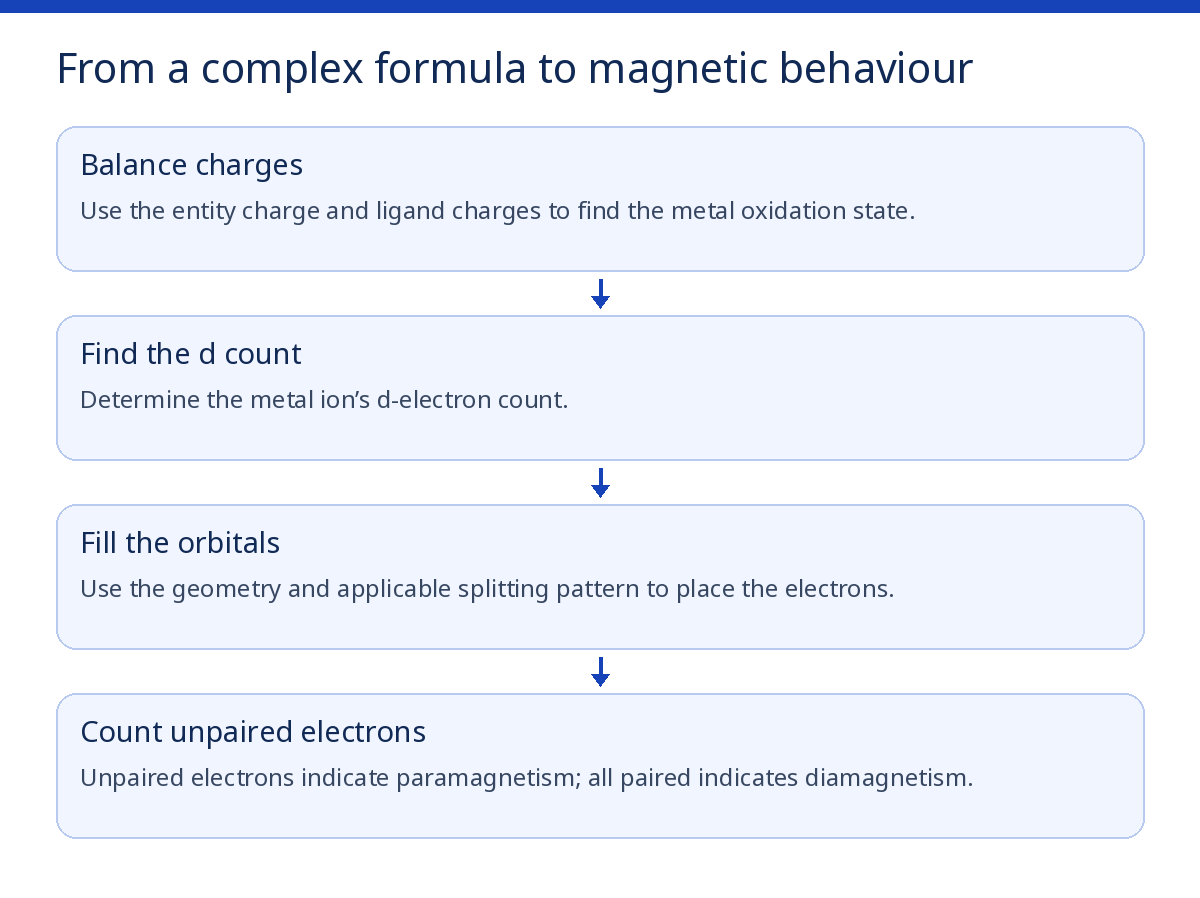
Read the square brackets first: they enclose the coordination entity, which consists of the metal and its bound ligands. The metal oxidation number plus the sum of the ligand charges gives the charge on that entity. In a neutral salt, the ions outside the brackets balance this charge. They do not contribute to the sum of ligand charges, even when the same chemical species appears both inside and outside the brackets.
When working from a name, use the stated oxidation number and ligand charges to find the entity’s charge before adding any counter-ions. Add them only if the name specifies a salt. When working from a formula, reverse the calculation to find the oxidation number. Name the ligands alphabetically before the metal, ignoring multiplicative prefixes when alphabetising. The Roman numeral gives the metal’s oxidation number, while the -ate ending indicates an anionic coordination entity.
Good to remember: count donor atoms, not ligands
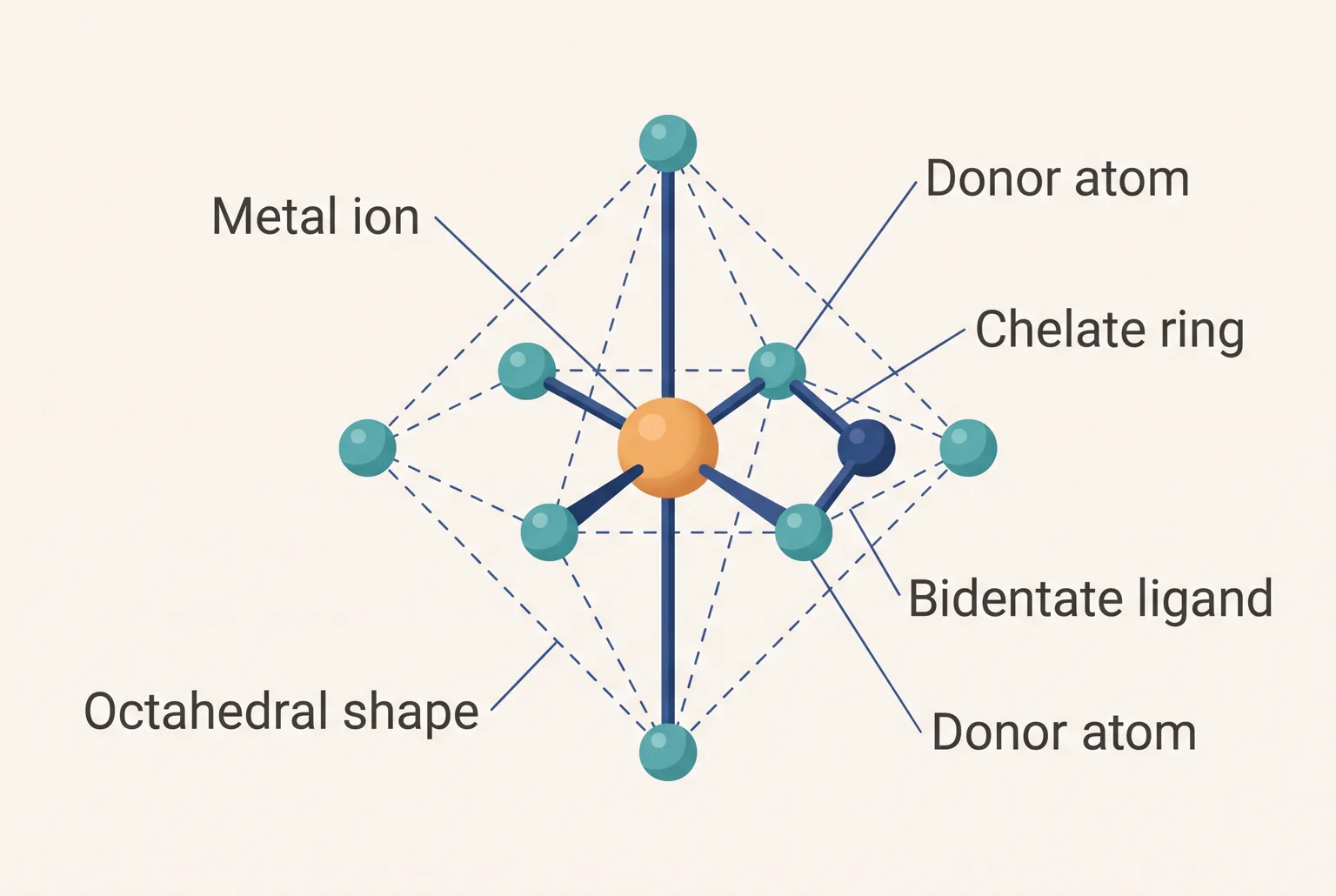
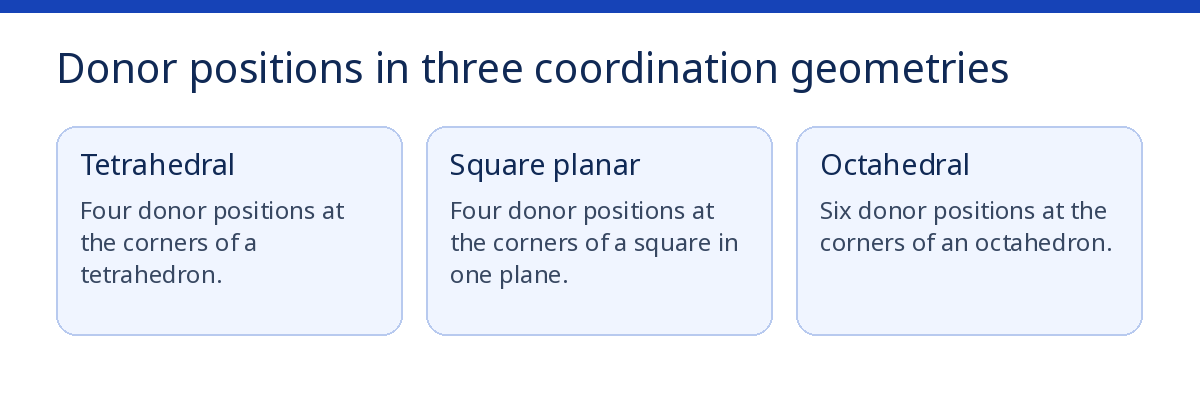
Coordination number counts the donor atoms directly bonded to the metal, whereas denticity describes how many donor atoms a ligand uses to bind to that metal. Ethane-1,2-diamine binds through two nitrogen atoms, so it contributes two donor atoms even though it is one ligand. An ambidentate ligand such as nitrite can instead use either of two alternative donor atoms. It does not use both at once in the linkage forms discussed here.
The opening geometry diagram makes a second distinction clear: a coordination number of four can correspond to either a tetrahedral or a square-planar arrangement. The number tells you how many positions are occupied, not how those positions are arranged. That distinction matters when you decide which spatial arrangements to draw.
For isomerism, check connectivity before shape
The exercises distinguish structural isomers, which differ in connectivity or in what lies inside the coordination sphere, from stereoisomers, which have the same connectivity but different spatial arrangements. In linkage isomerism, the donor atom changes. In ionisation isomerism, a ligand and a counter-ion exchange places, changing which free ion is released on dissolution. This is why the file discusses solution tests alongside structural formulas.
For stereoisomers, draw the donor positions before comparing arrangements. In a square-planar complex, two groups are cis when adjacent and trans when opposite. Optical isomerism requires a separate check: can the structure and its mirror image be superimposed? When reading the octahedral drawings, follow the wedges and dashes for depth, and keep the joined donor atoms of each chelating ligand together.
When the octahedral spin rule applies
The file uses valence bond theory to relate hybrid orbitals to geometry and to distinguish inner- from outer-orbital complexes. Its crystal field theory explanations instead track how ligand fields split the metal’s d orbitals and how electrons occupy the resulting levels.
For an octahedral field, the three lower orbitals are labelled and the two higher orbitals . Where high- and low-spin occupations are both possible, compare the splitting energy with the pairing energy . If , occupying the upper level is favoured over additional pairing in the lower level. If , pairing in the lower level is favoured. Before using this rule, establish the metal’s oxidation state and d-electron count; the ligand name alone does not tell you how many electrons are available to place.
Connect orbital occupancy to magnetism and colour
Count the unpaired electrons after filling the orbitals. A complex with unpaired electrons is paramagnetic; one with all electrons paired is diamagnetic. For a spin-only estimate, use , where is the number of unpaired electrons and is the Bohr magneton. The input is not the total d-electron count. The nickel comparisons are useful because they ask you to distinguish what geometry tells you from what electron occupancy tells you.
The colour exercises use a different consequence of splitting: when visible light is absorbed in a transition between split d levels, the energy gap determines the absorbed wavelength. A larger gap corresponds to a shorter absorbed wavelength for that transition. Keep the wavelength absorbed distinct from the colour observed.
Quick self-check: find the first step that differs
Try a prompt before reading its worked solution. For a naming problem, compare the bracket charge before checking spelling or ligand order. For a bonding problem, compare the oxidation state and d count before checking the orbital diagram. For an isomer drawing, check whether you changed a bond or only moved a group in space. Finding the first difference tells you which concept to revisit.
For a separate review of stability, use the chelate-effect exercise to revisit what changes when one ligand binds through more than one donor atom and forms a ring. The stability and applications entries give you places to continue beyond naming and structure. One flagged intext subpart has been left out of this guide.
Spotted an error? Report a correction. Practise this in the app: notes, formula sheets and mind maps.















































































































































Loading comments…