CBSE Class 12 Electrochemistry: Case-Based Assessment Guide
CBSEChemistryElectrochemistry
This CBSE Class 12 Chemistry assessment uses 12 case studies to connect conductivity, cell potentials and electrolysis with diagrams, data and practical contexts. Use the linked solutions to check why a rule applies, not just whether your final answer matches.
How the assessment is organised
The file presents the questions first and the worked solutions later. Its clickable index lists each case by topic and gives separate links to its questions and solutions. Individual items and OR alternatives also have links to the corresponding solutions and back to the questions. There is no separate chapter-practice section, so use the index when you want to revisit a particular concept rather than work through the file in order.
The formats call for different kinds of reasoning. In a multiple-choice item, identify the quantity or relationship being tested before comparing options. In a short answer, connect your explanation to the passage or diagram. For assertion and reason, judge each statement independently before deciding whether the reason actually explains the assertion.

Electrochemistry | Class 12 Chemistry | CBSE Case-based Assessment
In the StudentCurio app
Case-based questions and worked solutions cover conductivity and molar conductivity, electrochemical cells, electrode potentials, cell EMF, the Nernst equation, electrolysis, batteries and fuel cells. Useful for Class 12 CBSE students practising applications of Electrochemistry.
Why dilution affects two measures differently
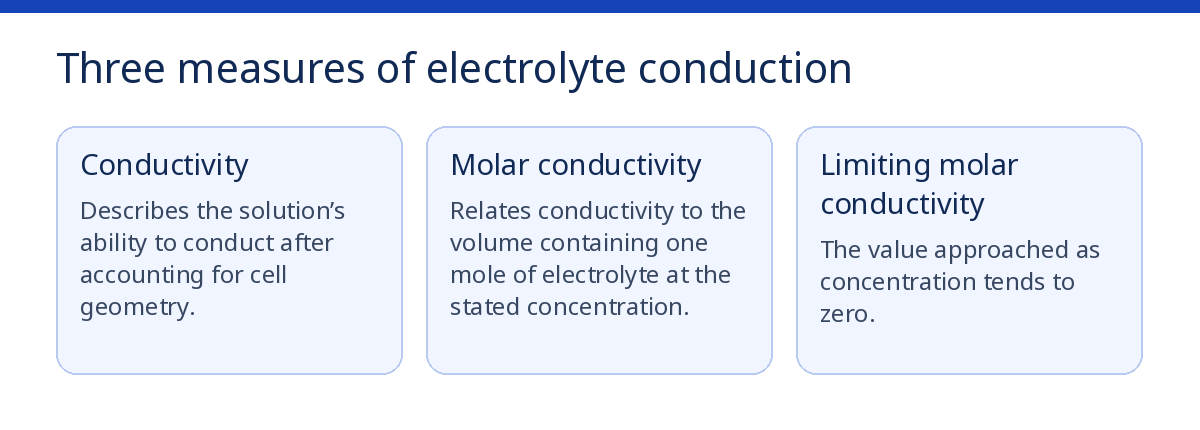
Cases 1 and 10 approach conductivity through dilution, while Case 4 uses ionic mobility to examine how different ions contribute to conduction. Conductance depends on the geometry of the measuring cell; conductivity accounts for that geometry. Molar conductivity describes conduction on a per-mole basis. The distinction explains how dilution can lower conductivity because there are fewer ions per unit volume while increasing molar conductivity.
At a given concentration, , where is the volume of solution containing one mole of electrolyte. With in and in , use to obtain . The factor of 1000 converts the volume basis from litres to cubic centimetres; it is not independent of the chosen units.
When the straight-line dilution rule applies
Distinguish the molar conductivity at a stated concentration, , from the limiting value, , approached as concentration tends to zero. For a strong electrolyte in dilute solution, the assessment’s solution notes give the approximation . Under those conditions, a plot against the square root of concentration can be extrapolated to estimate the limiting value. A weak electrolyte’s degree of dissociation changes substantially with dilution, so the same straight-line extrapolation is not appropriate. Kohlrausch’s law instead uses the stoichiometrically weighted contributions of the ions at infinite dilution.
This guide leaves out the disputed geometry description in Case 2 and the flagged notation, unit, unfinished equation lead-in and first two numerical examples in Case 1. It follows the distinctions verified in the solution notes.
Read the cell diagram before using potentials
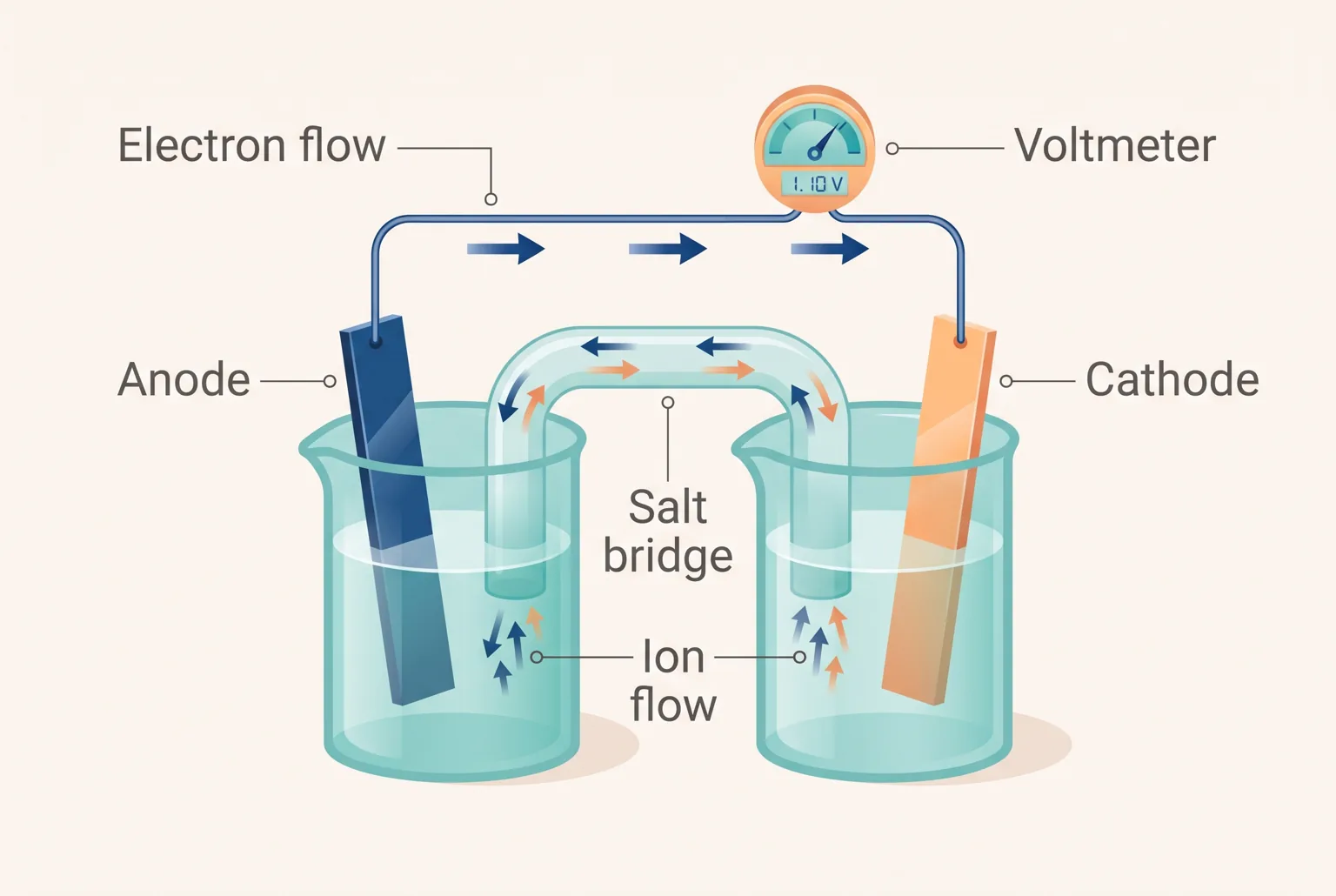
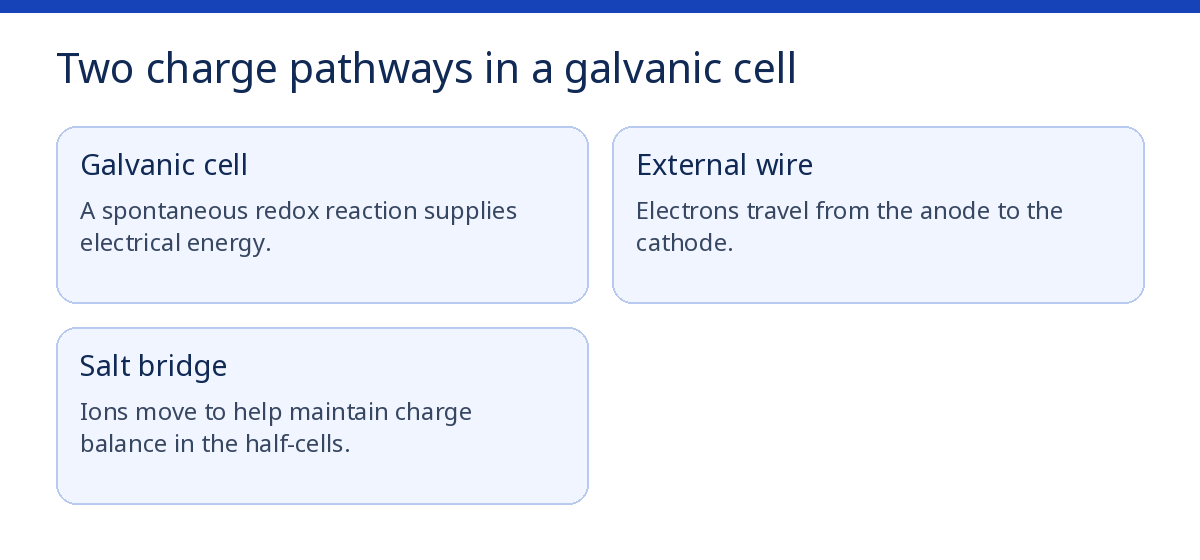
Case 2 gives you a labelled galvanic-cell diagram. Trace the external path for electrons separately from the ionic path through the salt bridge. The bridge helps maintain charge balance in the half-cells; it is not an electron pathway. A galvanic cell uses a spontaneous redox reaction to supply electrical energy, whereas electrolytic operation uses an external source to drive a reaction that is not spontaneous in the driven direction.
Cases 5 and 9 move from cell diagrams to standard reduction potentials. Identify which half-reaction is reduction and which is oxidation before assigning the electrodes. When both tabulated values are reduction potentials, subtract the anode value from the cathode value. Balance electrons in the half-reactions, but do not multiply electrode potentials by the balancing coefficients.
Keep standard conditions separate from equilibrium
Cases 7, 8 and 12 connect concentration cells to the Nernst equation and equilibrium. In a concentration cell with the same electrode couple on both sides, the standard electrode potentials cancel. Unequal ion activities can still produce a potential. When the case treats concentrations as approximations to activities, the concentration ratio enters the reaction quotient. Write the reaction direction first so that the quotient and the sign of the potential refer to the same reaction.
Case 11 connects cell potential to Gibbs energy through , where is the number of moles of electrons transferred per mole of reaction as written and is the Faraday constant. At equilibrium, the actual cell potential vanishes. The standard potential instead relates to the equilibrium constant and need not vanish.
Use electrode reactions to connect charge and products
The aqueous sodium chloride case links the mole concept to Faraday’s laws. Start by identifying the electrode process under the stated conditions: in an aqueous system, the dissolved ions are not the only species that can take part. Once the half-reaction is established, use its electron coefficient to relate the amount of product to the charge passed. Keep the mole ratio from the equation separate from the conversion between moles of electrons and coulombs.
The lead storage battery case provides discharge half-reactions, so you can practise connecting changes in chemical composition with electron transfer and electrical work. Its fuel-cell discussion raises a different question: assess the environmental implications of producing and supplying hydrogen separately from what happens when the fuel cell operates.
Before opening a worked solution
Write one line naming the quantity you need and the condition that governs your choice of rule. For a conductivity calculation, check the concentration units; for a potential calculation, check whether the data refer to standard or actual conditions. For an assertion-and-reason item, identify whether the reason supplies the missing explanation or merely states another relevant fact.
Then use the solution link to find the first step where your reasoning differs. Classify the difference as a choice of model, a sign convention, a unit conversion or a stoichiometric step. Return to the question and redo that step without the solution in view. An OR alternative can then test whether you can apply the same distinction when the information is presented differently.
Spotted an error? Report a correction. Practise this in the app: notes, formula sheets and mind maps.















































































































































Loading comments…