CBSE Class 12 Chemistry 2025 Previous Year Paper
CBSEChemistry2025 Previous Year Paper
Paper code: 56/1/2 · 2025This year-wise resource contains the full English version of the 2025 CBSE Class 12 Chemistry main examination, paper 56/1/2, with worked solutions. Use it for a three-hour, 70-mark practice attempt, then check whether your reasoning supports the answers you chose.
This set is one of the year's papers. See every set from 2025, grouped by series.
What this year-wise paper includes
This is a complete CBSE Class 12 board paper, not a chapter-wise worksheet. It preserves the original English question layout, including options and diagrams. The accompanying solutions cover every question and subpart, including both alternatives where an OR is printed. That gives you two ways to use the file: attempt the paper as printed, or revisit an individual question and see how its method is explained.
The cover index lets you jump to a question by number. Use that feature after your first attempt so you can review a specific question without losing your place. In the worked solutions, the formula or rule, the underlying concept and the explanation are presented separately. When checking your work, identify which of those three you missed rather than reading straight through to the answer.

Chemistry 2025 | Class 12 | Previous Year Paper | Code 56/1/2
In the StudentCurio app
Complete 2025 CBSE Class 12 Chemistry main examination paper with worked solutions, covering questions across organic, inorganic and physical chemistry, including electrochemistry, solutions, kinetics, biomolecules and coordination compounds. Helps students practise the board examination and review answer methods.
Make the first attempt a board-paper rehearsal
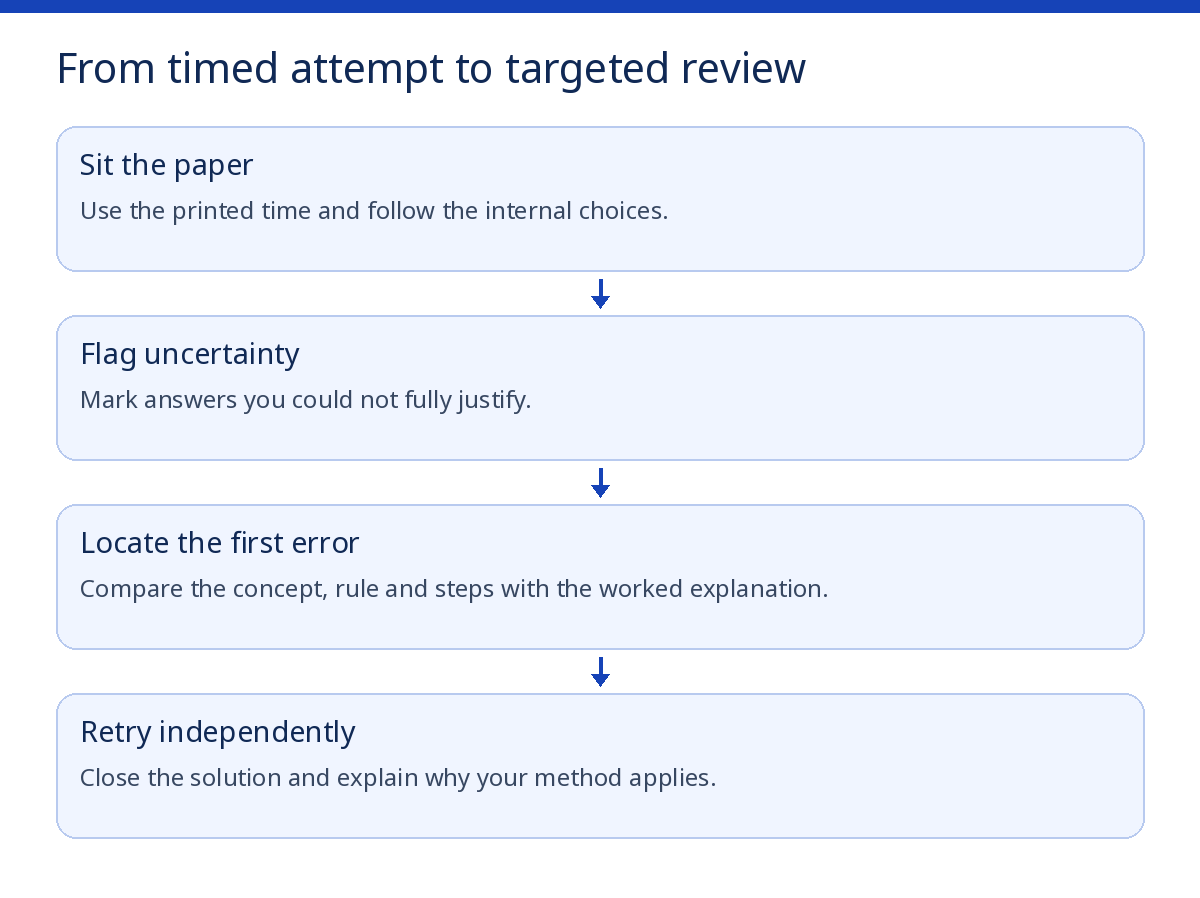
Set aside the printed three hours and work from the question pages without opening the solutions. Follow the paper’s instructions for internal choices: the presence of worked solutions for both alternatives does not mean you should attempt both during the timed sitting. Save the unused alternative for later; it gives you another question to try before seeing its method.
As you work, mark questions where you made a choice but could not justify it. That distinction matters on a paper with assertion–reason items: recognising two familiar statements is not enough. Check the truth of each statement separately, then ask whether the reason actually explains the assertion under the stated conditions. In review, give as much attention to a correct choice made on weak reasoning as to an incorrect one.
Physical chemistry: check the conditions before calculating
The paper covers solutions, electrochemistry and chemical kinetics. In the worked material on colligative properties, focus on what the measurement reflects: the number of dissolved solute particles. If solute units associate, there are fewer independently dissolved particles than there would be without association. A molar mass inferred from the colligative effect without accounting for that change is an apparent value, not necessarily the true molar mass.
For electrochemistry, write down whether the tabulated values are reduction potentials before assigning the electrodes. When both values are written as standard reduction potentials, use . Balancing the half-reactions may require multiplying their stoichiometric coefficients, but it does not require multiplying the potentials. Keeping those two operations separate helps you pinpoint whether a mismatch comes from the electrode assignment, the sign or the arithmetic.
Common mix-up: coordinated ligands and counterions
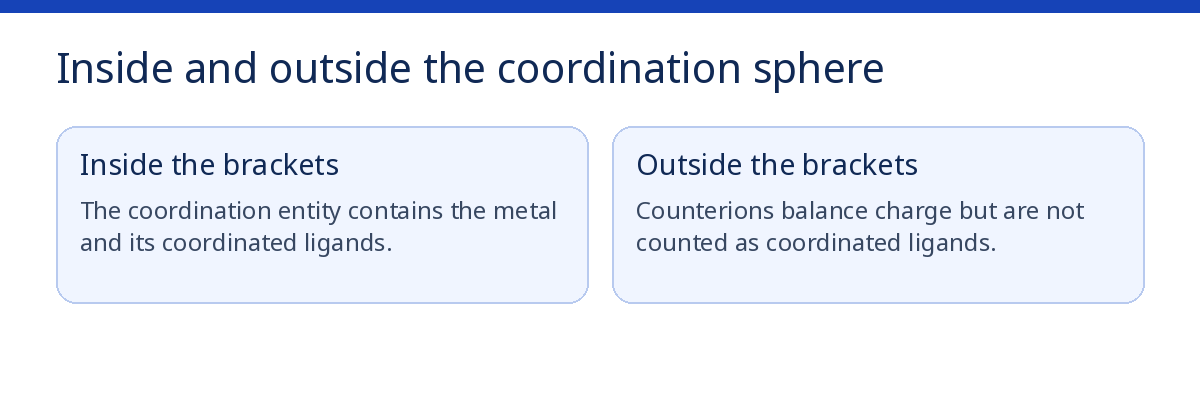
Coordination compounds give you a chance to check three distinct skills: identifying the ligand types, finding the metal’s oxidation state and applying naming rules. Start by locating the coordination sphere. For a bracketed complex, species outside the brackets are not counted as coordinated ligands. A complex is homoleptic when it contains only one kind of coordinated ligand, even if that ligand occurs several times.
For charge balance, use the charge of the coordination entity, not the overall charge of the salt. The metal oxidation state plus the charges contributed by the coordinated ligands must add up to the entity’s charge. During review, pause before looking at the name in the solution and check whether your charge calculation and your identification of the complex as cationic or anionic agree with the formula.
Organic chemistry and biomolecules: track what changes
The organic passages include substitution, reductions and reaction sequences. Before writing a product, ask whether the reaction preserves the carbon skeleton, introduces a carbon atom or removes one. A useful way to review a sequence is to track each carbon through each step, separately from the change in functional group. That helps distinguish a product with the wrong chain length from one with the right chain length but the wrong functional group.
For stereochemistry, pay attention to geometry rather than relying on labels alone. In an displacement, backside attack inverts the local arrangement at the reacting carbon. The biomolecules material offers a different check: when deciding whether an amino acid’s alpha carbon is stereogenic, inspect the groups actually bonded to it. An L designation, where applicable, does not by itself tell you the sign of optical rotation.
Quick self-check: identify the first step to fix
After marking your attempt, pick a question you missed and find the first point where your reasoning departed from the worked explanation. Could you identify the concept but not the condition for using it? Did you choose the right rule but apply it to the wrong species? Write a short correction describing the decision you need to make differently, not just the answer you should have reached.
Then close the solution and try the question again, or attempt the unused printed alternative if it tests the same idea. The useful check is whether you can now explain why your method applies before doing the calculation or committing to a product. That turns the worked solutions into a way to test your reasoning rather than an answer list to memorise.
Spotted an error? Report a correction. Practise this in the app: notes, formula sheets and mind maps.















































































































































Loading comments…