CBSE Class 12 Chemistry 2026 Previous Year Paper
CBSEChemistry2026 Previous Year Paper
Paper code: 56/4/2 · 2026Practise with the full English-language 2026 CBSE Class 12 Chemistry main examination paper, set 56/4/2. Use the worked solutions after a timed attempt to check not just what you answered, but which chemical principle and assumptions your method relied on.
This set is one of the year's papers. See every set from 2026, grouped by series.
Know the format before you start
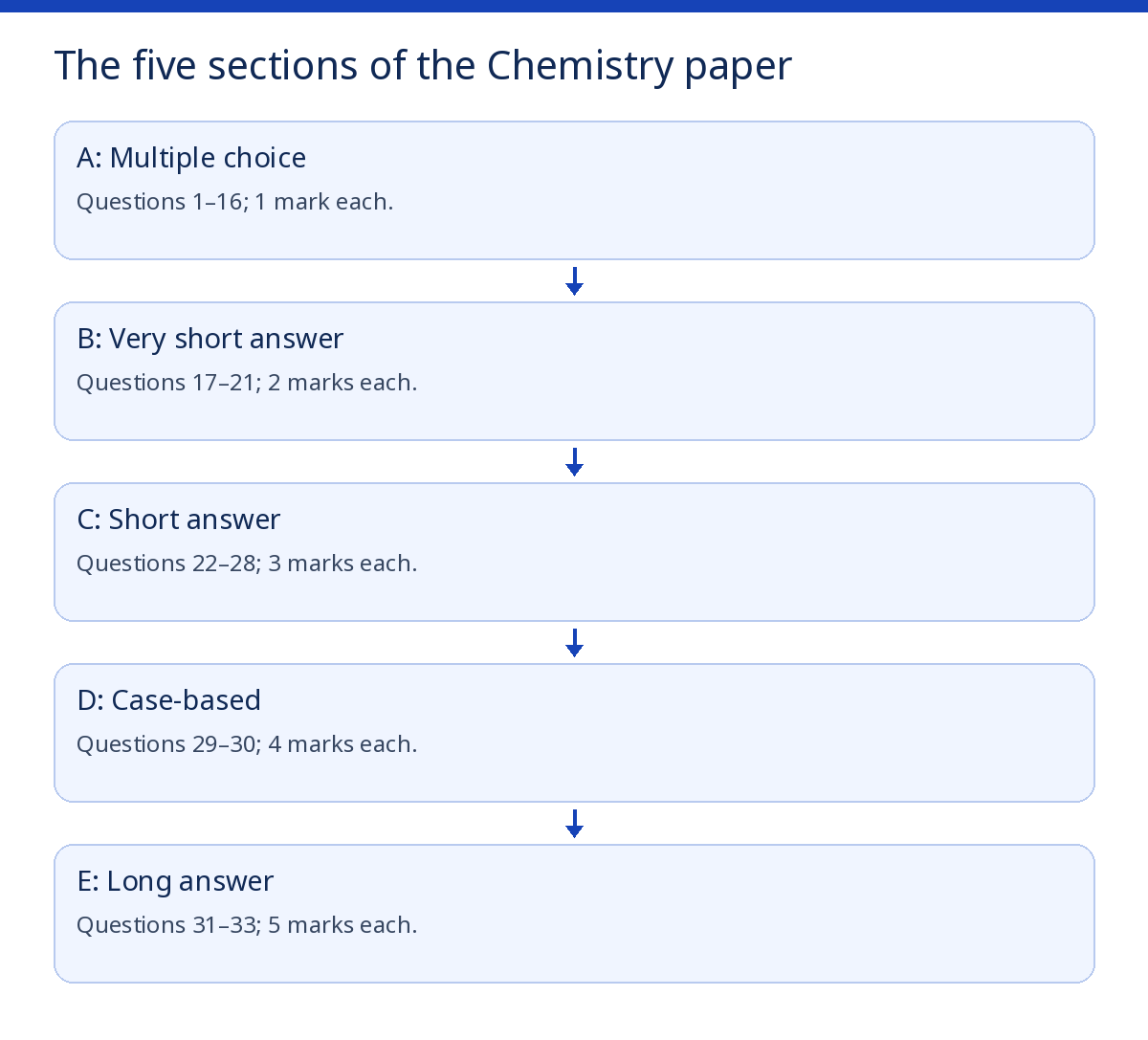
This year-wise resource pairs the question paper with worked solutions. The paper has 33 questions, a three-hour time limit and 70 maximum marks. Section A contains 16 one-mark multiple-choice questions, including assertion–reason items. Section B has five two-mark very short answers, and Section C has seven three-mark short answers. Section D contains two four-mark case-based questions, and Section E has three five-mark long answers.
There is no overall choice: all question numbers are compulsory, but some questions in Sections B to E provide an internal OR choice. In a timed attempt, answer only the required alternative and leave the other for review. Work without a calculator, as the printed instructions require. After marking a question for a second look, move on rather than letting a single calculation or reaction sequence take time away from an entire section.

Chemistry 2026 | Class 12 | Previous Year Paper | Code 56/4/2
In the StudentCurio app
A complete 2026 CBSE Class 12 Chemistry main examination paper with worked solutions, covering physical, inorganic and organic chemistry. Helps students practise board-exam questions and review solution methods across the syllabus.
Physical chemistry: name the quantity before calculating
The paper moves among solution properties, kinetics and electrochemistry. Its solutions questions include boiling-point elevation and vapour pressure under specified assumptions about dissolved particles. In a colligative-property calculation, check whether the solute is treated as dissociating or associating before using the amount of solute to represent the number of particles. Also distinguish molality, which is based on the mass of solvent, from molarity, which is based on the volume of solution.
In kinetics, reaction order describes the concentration dependence of the observed rate. Molecularity counts the reacting species in a single elementary step; it is not a label to infer for an entire multistep reaction from its balanced equation. Keep those tasks separate when a question supplies both an overall equation and a mechanism.
The electrochemistry questions range from cell potential and conductivity to electrolysis, corrosion protection and batteries. Before applying a relation, identify whether the question asks for a potential under specified conditions, a standard potential, or a charge. For an electrolysis explanation, read the electrode material as part of the setup, not just the name of the electrolyte.
Inorganic chemistry: separate structure from explanation
Coordination chemistry appears through nomenclature, ligand-field splitting, stereoisomerism and valence bond descriptions of bonding and magnetism. When translating a name into a formula, distinguish the ligands inside the coordination sphere from the counterions outside it. When interpreting a precipitation observation, ask what it tells you about ions available in solution before using it to infer the structure.
For orbital questions, first establish the geometry of the complex: the relative energies of the two sets of d orbitals depend on how the ligands approach. For isomer questions, pay attention to whether the prompt asks only about geometrical isomers or about all stereoisomers; the latter can also include optical forms. The questions on transition and inner-transition elements call for a different kind of reasoning, including comparisons of oxidation states, oxide character and trends in electrode potentials. Identify the specific property being compared before explaining it.
Organic chemistry: follow the conditions and the evidence
The organic questions ask for product structures, conversions, chemical tests and explanations of reactivity. In a conversion, keep the reagents and their order visible in your written work. If a reaction is followed by hydrolysis or heating, the product asked for is the one after that step, not necessarily the intermediate formed first. For an identification problem, treat each test or reaction as a constraint: a proposed structure must account for the full set of observations, not just one familiar test.
The case-based questions focus on alcohols and phenols, and on carbohydrates. The first connects structure with acidity and reactivity, so keep an acidity argument separate from an argument about substitution on an aromatic ring. The glucose case contrasts evidence for functional groups with behaviour explained by a cyclic form. In review, note which form of the molecule your explanation refers to rather than switching between the open-chain and ring representations without saying so.
Quick self-check: does the reason explain the assertion?
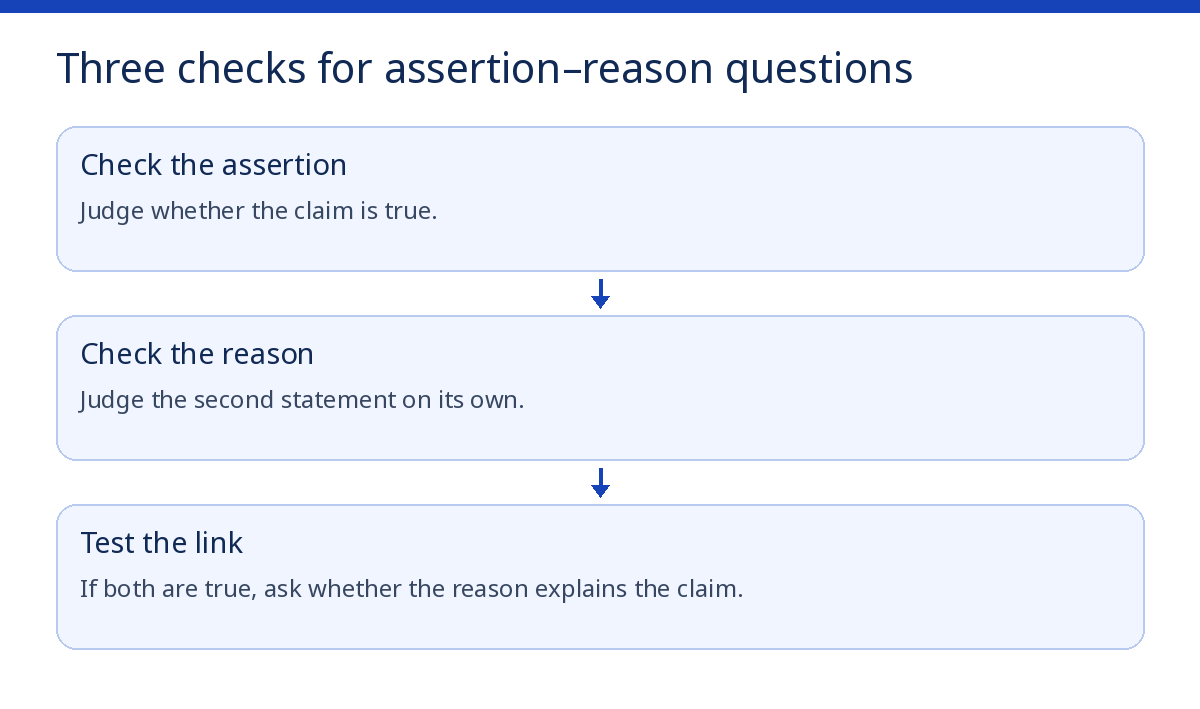
For assertion–reason items, make three separate judgements: Is the assertion true? Is the reason true? If both are true, does the reason actually explain the assertion? Two statements can concern the same substance or reaction without one explaining the other. Before choosing a code, try stating the causal link in your own words. If you cannot connect the statements without bringing in a different principle, check whether the printed reason is doing the explanatory work you have attributed to it.
Review the first step where your method changed
The file links question numbers to worked solutions and separates the formula, concept and step-by-step explanation. After attempting the paper, use those parts in that order to locate the first difference between your method and the worked one. A wrong numerical result might begin with a unit choice or a missed assumption; an incomplete written response might name the correct concept without explaining how it applies to the stated conditions.
Then attempt the internal alternatives you skipped. They let you revisit the same section format without treating the OR choices as additional compulsory work. The worked answer to Question 14 is omitted from this guide because its explanation does not match the printed reason.
Spotted an error? Report a correction. Practise this in the app: notes, formula sheets and mind maps.















































































































































Loading comments…