CBSE Class 12 Chemistry 2023 Question Paper With Solutions
CBSEChemistry2023 Previous Year Paper
Paper code: 56/5/2 · 2023Practise with the full 2023 CBSE Class 12 Chemistry main board exam paper (Set 2, code 56/5/2). Use the worked solutions after your attempt to check not just your answers, but also the formulas, assumptions and reasoning behind them.
This set is one of the year's papers. See every set from 2023, grouped by series.
How the 2023 paper is organised
This English-language theory paper has 35 questions, a three-hour writing limit and a maximum of 70 marks. Section A contains one-mark multiple-choice questions, including assertion–reason items. Sections B and C contain two-mark very short answers and three-mark short answers, respectively. Section D has four-mark case-based questions, and Section E has five-mark long answers. There is no overall choice, but some questions in Sections B to E offer internal alternatives.
For a timed attempt, use the 15-minute reading period to locate the case passages and mark where you have an internal choice. Choose between alternatives only where the paper prints an OR, and keep the worked solutions closed. The original instructions do not allow a calculator, so practise setting out arithmetic and units by hand.

Chemistry 2023 | Class 12 | Previous Year Paper | Code 56/5/2
In the StudentCurio app
Complete CBSE Class 12 Chemistry 2023 main examination paper with worked solutions, covering organic, physical and inorganic chemistry topics including electrochemistry, kinetics, coordination compounds, biomolecules and colligative properties. Useful for board-exam practice and reviewing solution methods across chapters.
Electrochemistry: keep potentials and conductivities distinct
The electrochemistry questions move between cell notation, standard electrode potentials, electrolysis and a conductivity case. When both tabulated values are standard reduction potentials, the standard cell potential is the cathode reduction potential minus the anode reduction potential. Balance electron transfer when writing the overall equation, but do not multiply an electrode potential by the coefficient used to balance its half-reaction. Also distinguish a standard potential from the potential of a cell whose concentrations or gas pressures are specified separately.
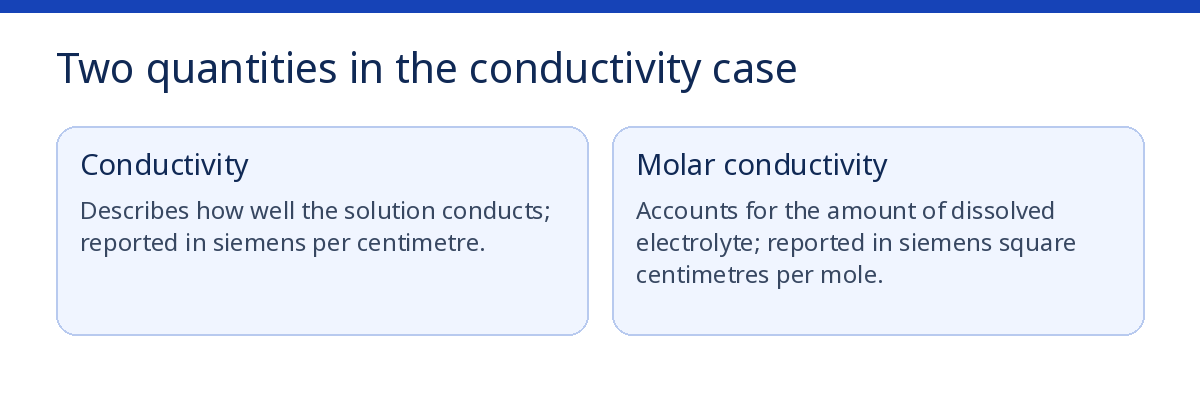
In the conductivity case, the table reports conductivity in and molar conductivity in . The latter takes the amount of dissolved electrolyte into account. Before explaining a change on dilution, identify which column the subpart asks about; a statement about one quantity is not automatically a statement about the other.
Kinetics: compare like with like
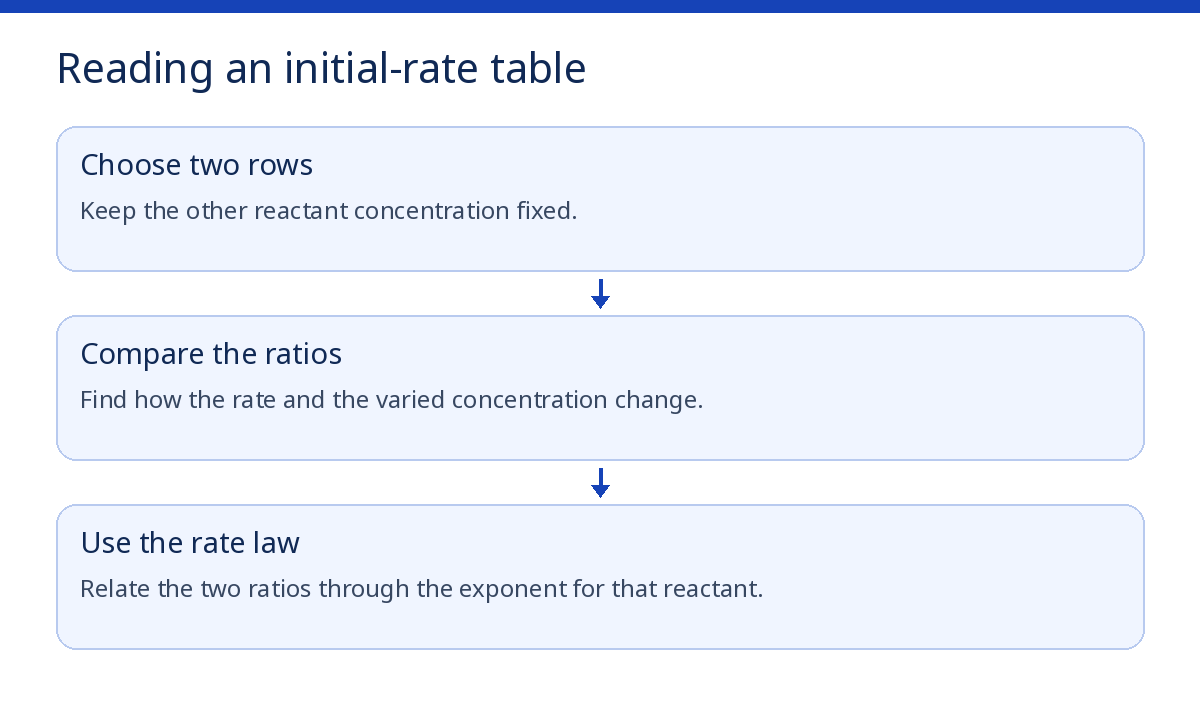
The initial-rate table tests whether you can isolate the effect of one reactant concentration. Select two rows in which the other reactant concentration is held fixed. Then connect the change in rate to the concentration ratio using the rate law. This is an experimental comparison: the coefficients in the balanced reaction do not, by themselves, give the orders in the rate law.
The paper also switches between questions on temperature and the rate constant, and questions on how long a reaction takes to reach a stated extent. Before using an integrated rate expression, identify the specified order. For a time-to-completion calculation, distinguish the fraction reacted from the fraction remaining before putting a concentration into the expression.
When the colligative-property formula applies
The long-answer section includes vapour-pressure lowering, boiling-point elevation, freezing-point depression and osmotic pressure. These questions are connected by their focus on the number of dissolved particles, but they do not all use the same concentration measure. For boiling-point elevation in a dilute solution, uses molality, in moles of solute per kilogram of solvent. In the dilute-solution osmotic-pressure expression, , is molar concentration, based on the volume of the solution, and is in kelvin.
Read the assumption about the solute before choosing the van ’t Hoff factor. Complete dissociation is a stated assumption in some of this paper’s calculations, not something to assume for every electrolyte solution. Association, also represented in the paper, reduces the effective number of solute particles.
Organic chemistry and biomolecules: write the evidence
The organic questions ask for conversions, reaction equations, mechanisms, chemical tests and explanations of property differences. In the compound-identification questions, treat each test or transformation as a constraint on the same proposed structure. A structure that fits a molecular formula but cannot account for another observation is not enough. In the biomolecules questions, make the same distinction between naming a structural feature and explaining what a reaction or observation tells you about it.
The second case study compares and substitution. Keep the two-step pathway distinct from the one-step pathway, and identify whether a subpart asks about stereochemistry, the leaving group or the haloalkane’s structure. Use the printed structures when comparing substrates, rather than relying on a transcription of the passage.
Quick self-check: can you justify a coordination answer?
The inorganic questions cover ligand behaviour, linkage isomerism, crystal-field splitting and magnetic moment, alongside questions on transition elements and their oxidation states. For a coordination problem, can you explain how you obtained the metal’s oxidation state and then its d-electron count? Can you identify the information about geometry or ligand field that you need before deciding how the electrons occupy the orbitals?
Those steps serve different purposes. An oxidation state is not an electron arrangement, and a d-electron count alone does not fix the number of unpaired electrons. When using the spin-only magnetic-moment expression, the count that enters it is the number of unpaired electrons, not the total number of d electrons.
Use the worked solutions to find your first wrong step
After marking your attempt, use the question-number links to return to items where your reasoning was uncertain, including correct guesses. The worked pages separate the formula, concept and explanation steps. Compare the principle you chose before checking your arithmetic or conclusion. If you knew the formula but used the wrong concentration basis, for example, revise that distinction and then retry the question without looking at the steps. Save the unused OR alternatives for a second attempt.
This guide leaves out the numerical example in Q29(a), the proposed half-reaction in Q12(II), the specific ranking in Q7 and the solvent-rate figures and broad solvent rule in Q32. Use the remaining material to review the underlying topics.
Spotted an error? Report a correction. Practise this in the app: notes, formula sheets and mind maps.















































































































































Loading comments…