CBSE Class 12 Chemistry Supplementary Paper 2026
CBSEChemistry2026 Previous Year Paper
Paper code: 56/7/1 · 2026Practise the full 2026 CBSE Class 12 Chemistry supplementary paper (56/7/1) under its three-hour, 70-mark format. Then use the worked solutions to check not just your final answers, but also the assumptions, units and chemical reasoning behind them.
This set is one of the year's papers. See every set from 2026, grouped by series.
Know the five sections before you start
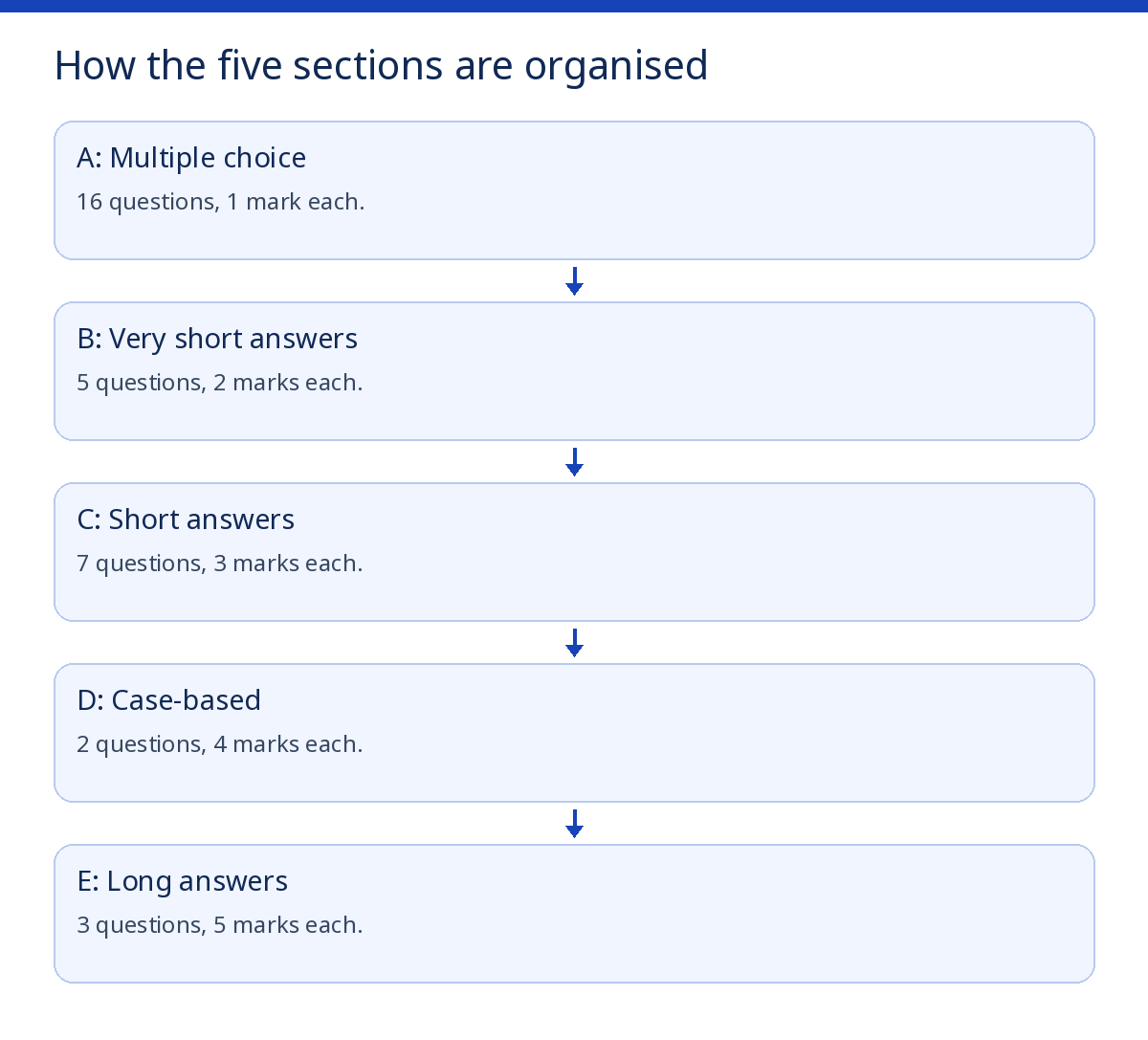
This English-language paper contains 33 questions across Sections A to E. Section A has 16 one-mark multiple-choice questions, including assertion–reason items. Section B has five two-mark very short answers, and Section C has seven three-mark short answers. Section D has two four-mark case-based questions, while Section E has three five-mark long answers. That progression lets you practise switching from selecting an option to explaining a trend, interpreting a graph or showing a calculation.
There is no overall choice: answer every question number, choosing one branch where an internal OR is printed. Section A has no internal choice. For a timed attempt, work from the question pages and leave the linked solutions closed. Calculators are not allowed, so use any logarithm values provided in the question rather than checking them on a device.

Chemistry Supplementary 2026 | Class 12 | Previous Year Paper | Code 56/7/1
In the StudentCurio app
A complete Class 12 CBSE supplementary Chemistry examination paper with worked solutions, covering questions across multiple chemistry chapters. It helps students practise the board-paper format and review exam-style problems.
Physical chemistry: check what each equation assumes
The paper tests vapour-pressure lowering and freezing-point depression in different settings. The vapour-pressure problem specifies a non-volatile solute, while the freezing-point problem explicitly assumes complete dissociation. Before substituting values, decide whether the equation needs to account for the number of dissolved particles produced per formula unit. For freezing-point calculations, molality uses the mass of the solvent in kilograms, not the mass or volume of the solution.
Electrochemistry moves between electrode reactions, cell potentials and conductivity. In the conductivity problem, the same cell is used at two concentrations. Its geometry, and therefore its cell constant, stays fixed; the resistance and conductivity need not. Kinetics calls for a different distinction: a rate law relates rate to concentration, whereas an integrated rate law relates concentration to elapsed time. In the graph review, note whether the vertical axis shows concentration or its logarithm before interpreting the slope.
Inorganic chemistry: connect each observation to its cause
The transition-metal questions ask you to explain observations such as ionic colour, variable oxidation states and similarities between elements in different series. In the case-based passage on atomic radii, separate the two effects acting across a series: increasing nuclear charge tends to draw electrons inward, while additional d-electron shielding partly offsets that pull. That balance is a different explanation from lanthanoid contraction, which helps account for the similarity in size between corresponding metals in the second and third transition series.
For coordination compounds, distinguish oxidation state from coordination number. Oxidation state is obtained by balancing formal ligand charges against the overall complex charge. Coordination number counts the donor atoms directly bonded to the metal, so a ligand that binds through two donor atoms contributes two, not one. Keeping those counts separate helps you check a complex before moving on to nomenclature, geometry or magnetic behaviour.
Before predicting an organic reaction, check the conditions
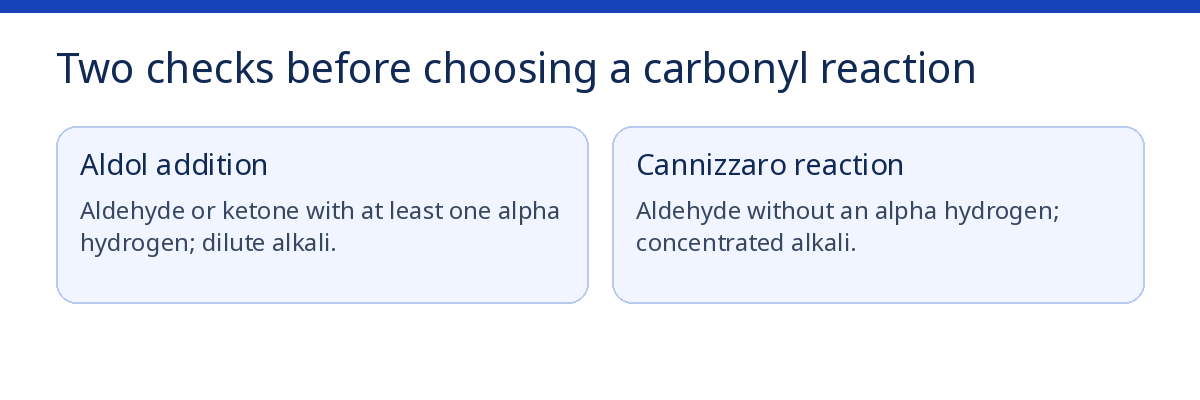
Organic questions span haloalkanes, alcohols, phenols and ethers, carbonyl compounds, carboxylic acids and amines. The carbonyl case passage makes a useful distinction: aldehydes and ketones with at least one alpha hydrogen can undergo aldol addition under dilute alkaline conditions, whereas the Cannizzaro reaction described applies to aldehydes without an alpha hydrogen in concentrated alkali. Check both the substrate and the reagent conditions before applying a reaction name. An alpha hydrogen is attached to a carbon next to the carbonyl carbon, not to the carbonyl carbon itself.
The amines questions also show why conditions matter outside reaction prediction: one comparison specifies the gaseous phase, so an order recalled for aqueous solution is not automatically applicable. Biomolecules require a different kind of precision. When reviewing protein secondary structure, distinguish a description of how the chain folds from simply naming its amino acid building blocks.
Quick self-check for assertion–reason and case questions
In an assertion–reason item, make three decisions in order: Is the assertion true as written? Is the reason true independently? If both are true, does the reason explain the assertion? A statement can be correct and relevant to the same chapter without explaining the particular claim. Read qualifiers carefully before looking at the option codes, especially when a statement sounds like a familiar rule.
For the two case-based questions, practise separating what the passage supplies from what the subpart asks you to infer. After drafting a response, ask whether you have cited a trend, explained its cause or done both. In an organic case, ask which structural feature or reaction condition your reasoning depends on. If you can name the reaction but cannot point to the feature that makes it applicable, revisit that step before opening the solution.
Use the worked solutions to find your first wrong step
The file preserves the question layout, options and diagrams and provides worked solutions for the subparts and both branches of printed OR choices. The solution format separates the formula, the concept and the explanation in steps. Compare your reasoning in that order: did you choose the right relationship, did its assumptions fit, and did you carry it through accurately? In a numerical answer, a correct setup with an inconsistent unit calls for a different correction from choosing the wrong relationship in the first place.
After reviewing the branch you attempted, try the other OR branch without reading its solution first. This gives you extra practice without changing the conditions of your timed attempt. This guide omits the ether-cleavage item’s disputed product labels and the disputed cobalt-complex stability comparison; neither is needed to review the surrounding topics.
Spotted an error? Report a correction. Practise this in the app: notes, formula sheets and mind maps.















































































































































Loading comments…