CBSE Class 12 Chemistry 2024 Paper: Set 3 Practice Guide
CBSEChemistry2024 Previous Year Paper
Paper code: 56/1/3 · 2024Use the full 2024 CBSE Class 12 Chemistry main examination paper (56/1/3) for a timed attempt, then use the worked solutions to review how you chose a method, applied it and presented your answers.
This set is one of the year's papers. See every set from 2024, grouped by series.
Know the paper before you start
This year-wise resource contains the English version of Set 3 of the 2024 CBSE Class 12 Chemistry theory paper. It carries 70 marks, allows three hours for writing and includes 33 questions across five sections. The original title page also specifies a separate 15-minute reading period during which candidates do not write answers. Calculators are not allowed.
Section A contains one-mark multiple-choice questions, including assertion–reason items. Sections B and C contain two-mark very short answers and three-mark short answers, respectively. Section D contains four-mark case-based questions, and Section E contains five-mark long-answer questions. There is no overall choice: follow the internal choices where printed. During a mock attempt, mark those choices in the reading period so that you do not spend writing time answering both alternatives.

Chemistry 2024 | Class 12 | Previous Year Paper | Code 56/1/3
In the StudentCurio app
The complete 2024 CBSE Class 12 Chemistry main examination paper with worked solutions, spanning topics across the syllabus. It helps students practise the board-paper format and review answer methods.
Kinetics and electrochemistry: Read the evidence first
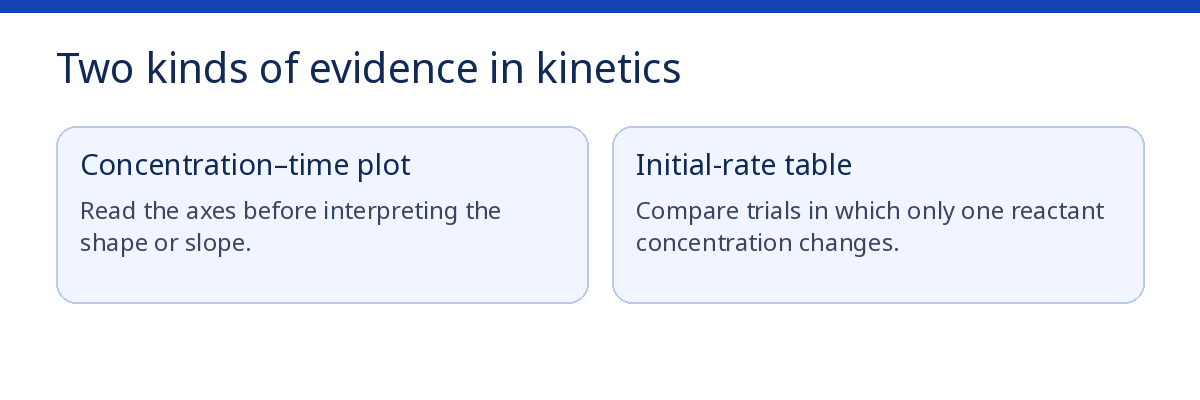
The kinetics questions use two different kinds of evidence: a concentration–time plot and a table of initial rates. For the plot, identify the quantities on the axes before relating its shape or slope to an integrated rate law. For the table, look for a pair of trials in which one reactant concentration changes while the other stays fixed. That comparison isolates the effect of the changing concentration. Once you have a rate law, check that the units of the rate constant are consistent with its overall order.
Electrochemistry likewise calls for different methods in different settings. For an electrode potential, distinguish the stated ion concentration from standard conditions and use the half-reaction as written to set up the calculation. For the conductivity-cell question, distinguish the measured resistance from the conductivity of the solution. The use of the same cell matters because its cell constant links the two measurements; molar conductivity then also takes the solution concentration into account.
Good to remember: Name the solution quantity
The long-answer choices on solutions bring together gas solubility, vapour pressure, boiling-point elevation and osmotic behaviour. Start by naming the quantity you need, not by choosing a formula from a familiar keyword. A mole fraction in the vapour is a fraction of the total vapour pressure contributed by that component; it need not equal the component’s mole fraction in the liquid. When applying Raoult’s law to an ideal solution, keep those two compositions distinct.
For colligative properties, separate the amount of solute added from the effective number of dissolved particles. If an electrolyte is only partly ionised, neither the undissociated limit nor the fully dissociated limit describes the stated situation. Keep the concentration basis visible in your working: boiling-point elevation uses molality, whereas an osmotic-pressure calculation for a dilute solution uses molar concentration.
Organic chemistry: Treat conditions as part of the reaction
The organic questions range from recognising functional groups and comparing reactivity to writing equations, explaining a mechanism and tracing a multistep conversion. For a reaction sequence, record which functional group changes at each arrow and whether the carbon skeleton changes. A proposed intermediate has to fit the step that produced it and the reagent or transformation that follows; matching a molecular formula alone is not enough.
The prompts involving alkyl halides and Grignard reagents make reaction conditions worth checking explicitly. The solvent can change which pathway is favoured for an alkyl halide. In a Grignard reaction, distinguish the dry conditions needed while the reagent is present from the later workup. Also match your response to the task: a product structure is not a mechanism, and a named chemical test is more useful when you can state the observation that distinguishes the compounds.
Coordination chemistry and biomolecules: Match the explanation to the task
The coordination questions distinguish naming, isomerism and electronic explanations. In a formula-writing task, separate ligands inside the coordination sphere from counter-ions outside it and check the overall charge. For magnetic behaviour, account for unpaired electrons rather than citing geometry alone. The case passage also distinguishes valence bond theory from crystal field theory: check which model the prompt asks you to use before deciding what to explain.
Elsewhere, the paper moves between explanations for d- and f-block properties and shorter biomolecule prompts about carbohydrates, proteins, DNA and vitamins. The distinction between identifying a class, naming a linkage and giving an example matters here: each asks for a different kind of response. Read the verb before deciding how much to write.
After the mock: Find the first step that went wrong
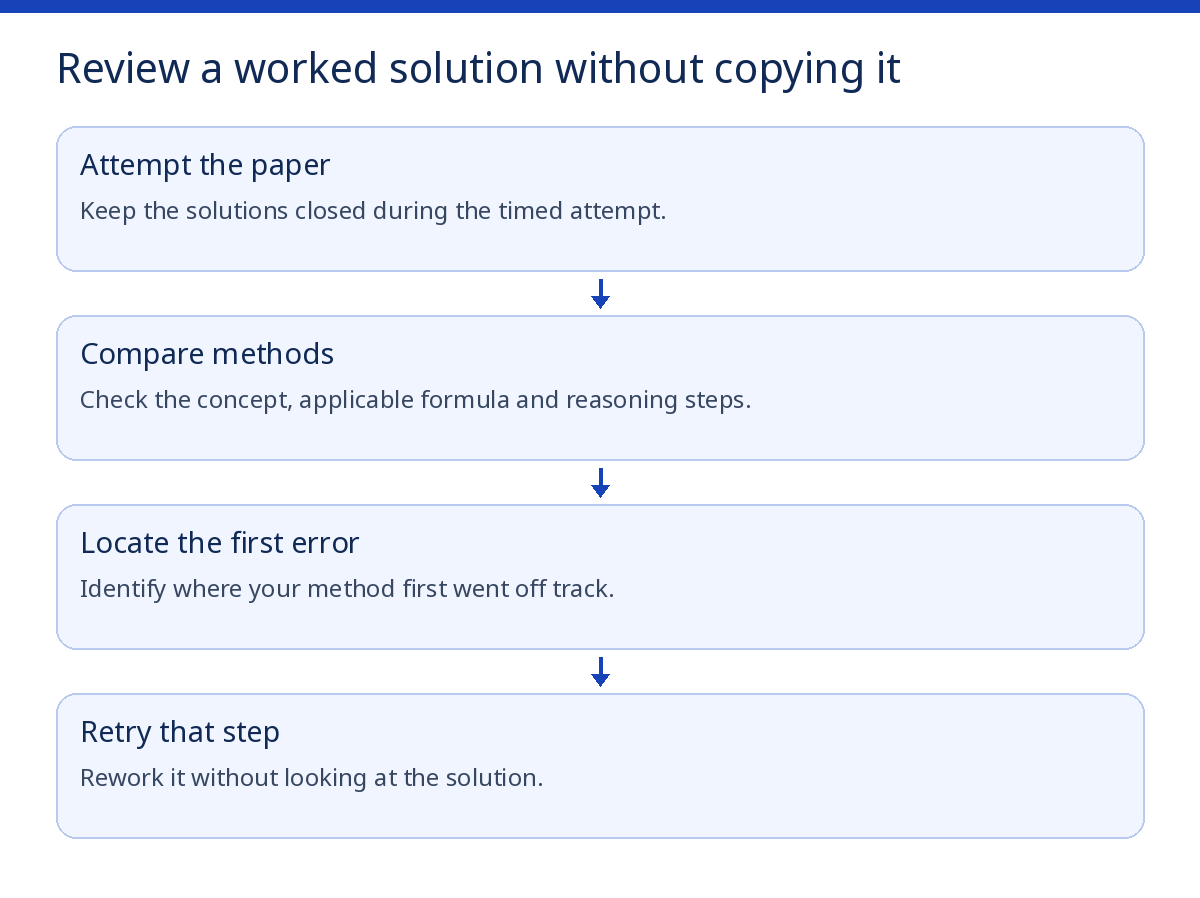
Use the question-number links to move from your attempt to the relevant worked explanation. The solutions separate the formula, the concept and the reasoning steps. Compare those parts in that order only if a formula is relevant; for a conceptual question, start with the principle. In an assertion–reason item, judge each statement independently before deciding whether one explains the other. A true statement need not explain a second true statement.
For each missed item, note the first point where your reasoning diverged: reading the graph, selecting a model, interpreting a reagent or carrying a unit through the calculation. Then retry that part without looking at the solution. This guide leaves out the abbreviated chromate–dichromate item because its wording does not clearly distinguish the existence of the equilibrium from the conditions that favour one direction.
Spotted an error? Report a correction. Practise this in the app: notes, formula sheets and mind maps.















































































































































Loading comments…