CBSE Class 12 Chemistry 2023 Paper: Set 56/4/3
CBSEChemistry2023 Previous Year Paper
Paper code: 56/4/3 · 2023Use the full 2023 CBSE Class 12 Chemistry main examination paper for a three-hour practice attempt. Then use the worked solutions to check which concepts you chose, how you applied them and what your written answers left out.
This set is one of the year's papers. See every set from 2023, grouped by series.
What the file contains
This year-wise resource contains the English question paper for the 2023 CBSE Class 12 Chemistry main examination, Set 56/4/3, followed by worked solutions. It is a full theory paper worth 70 marks, not a chapter-wise worksheet. That makes it useful for practising a skill that topic lists cannot test: recognising which area of chemistry a question draws on when the chapter name is not supplied.
The question pages preserve the printed options and diagrams. The cover links to the solutions by question number, and the solution pages link back to the corresponding questions. Use the question pages for a first attempt, then switch to the links when you want to review a particular response without scanning the entire file.

Chemistry 2023 | Class 12 | Previous Year Paper | Code 56/4/3
In the StudentCurio app
Complete CBSE Class 12 Chemistry main examination paper for 2023 (Set 56/4/3), with worked solutions across organic, physical and inorganic chemistry. Helps students practise a full previous-year paper and review solution methods.
Read the five-section layout before you start
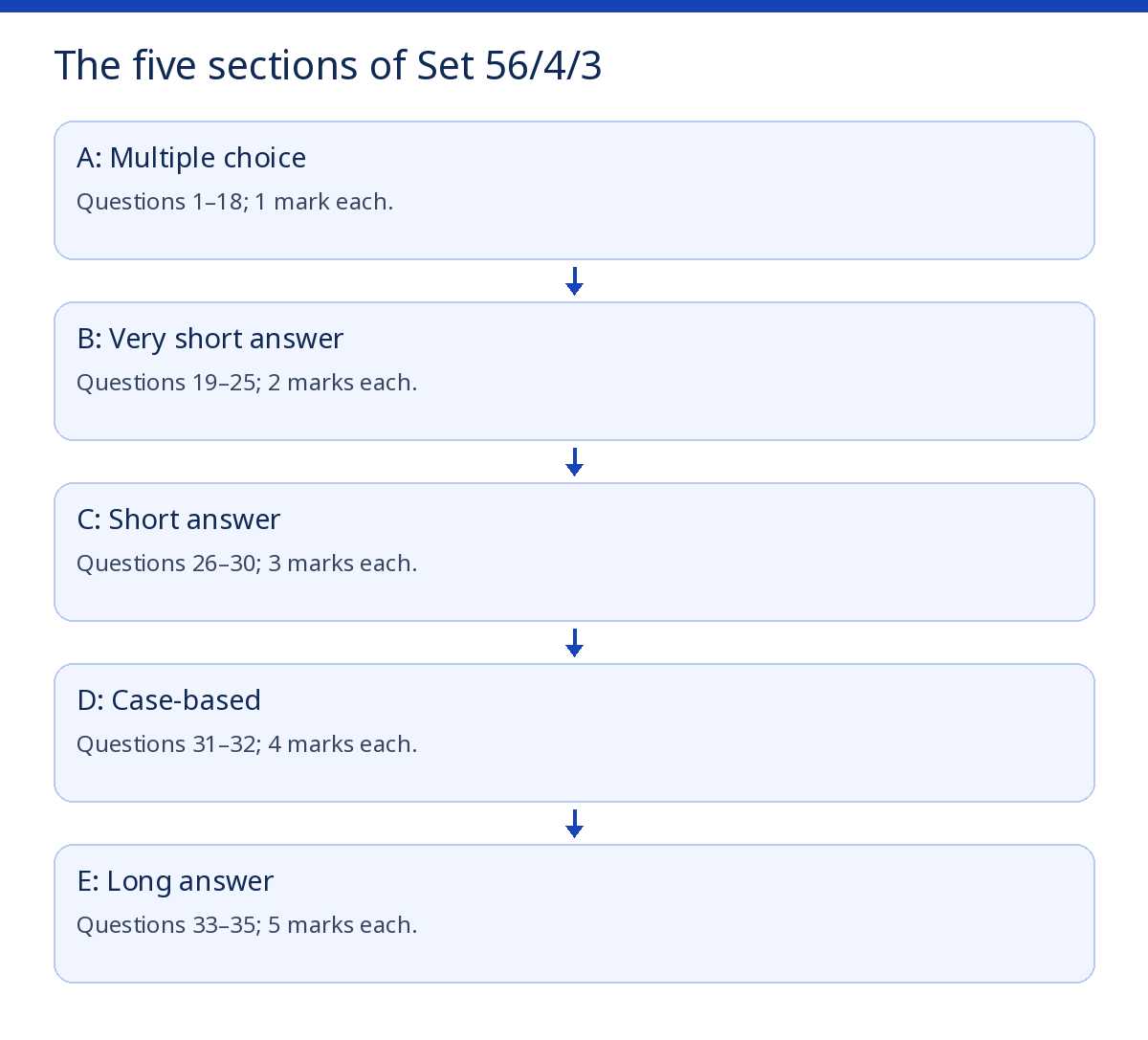
The paper has 35 questions. Section A has 18 one-mark multiple-choice questions, including assertion–reason items at the end. Section B has seven two-mark very short answers, and Section C has five three-mark short answers. Section D has two four-mark case-based questions. Section E closes the paper with three five-mark long-answer questions.
There is no overall choice: you cannot drop an entire question because another looks easier. Internal choices are available at specified points in Sections B to E. Read each choice where it appears, since it may apply to a subpart rather than the whole question. To reproduce the original conditions, allow 15 minutes for reading without writing answers, followed by three hours of writing time. Attempt the paper without a calculator, as its instructions require.
Physical chemistry: check the model before the arithmetic
The physical chemistry questions draw on solutions, chemical kinetics and electrochemistry. Look at what the data actually represent before selecting an equation. In kinetics, for example, a problem that supplies total gas pressure during decomposition does not directly give the amount of reactant remaining. Use the reaction stoichiometry and the stated conditions to connect the measured pressure to the reactant quantity needed by the rate law.
In solution chemistry, distinguish a change in solute particle count from a change in the amount of solute added. Association changes the number of independently dissolved particles, which matters when interpreting a colligative property such as osmotic pressure. In electrochemistry, keep conductivity, molar conductivity and limiting molar conductivity distinct. When reviewing an equation or graph, identify which of those quantities is measured or calculated and which is defined at infinite dilution.
Organic chemistry and biomolecules: follow the task verb
The organic questions ask for different kinds of evidence: products under stated conditions, conversions with a step limit, a mechanism, explanations of reactivity and a test that distinguishes two compounds. A conversion needs a sequence with its reagents; a mechanism needs the steps by which the change occurs. If a question requests equations only, extra explanation cannot replace a missing equation. Re-read the verb before deciding how much to write.
The case-based section covers biomolecules and amines. In the biomolecules passage, separate ideas about the bonds that join units from ideas about how a protein is organised. In the amines passage, treat the solvent and reaction conditions as part of the evidence. For basicity in a polar protic solvent, electron release is not the only consideration: steric effects and hydrogen bonding can affect how well the substituted ammonium ion is stabilised.
Good to remember: shape alone does not predict magnetism
The inorganic questions move between naming coordination compounds, drawing isomers and explaining properties. Read the brackets before naming a complex: species directly bound to the metal belong to the coordination sphere, while counterions and water outside it must be accounted for separately. A correct overall composition does not tell you which species are coordinated.
For a magnetic comparison, identify the metal's oxidation state and consider its electron configuration and pairing. The presence of unpaired electrons is what matters for paramagnetism; matching geometries do not guarantee matching magnetic behaviour. The long-answer section also draws on transition-metal properties and redox chemistry. When checking an ionic equation, check both atoms and charge, keeping the stated reaction medium in view.
Quick self-check before opening the solutions
For an assertion–reason item, ask three separate questions: Is the assertion true? Is the reason true? If both are true, does the reason actually explain the assertion? A fact on the same topic is not necessarily an explanation. For a case-based response, ask which detail in the passage is relevant and which chemical principle you still need to supply yourself.
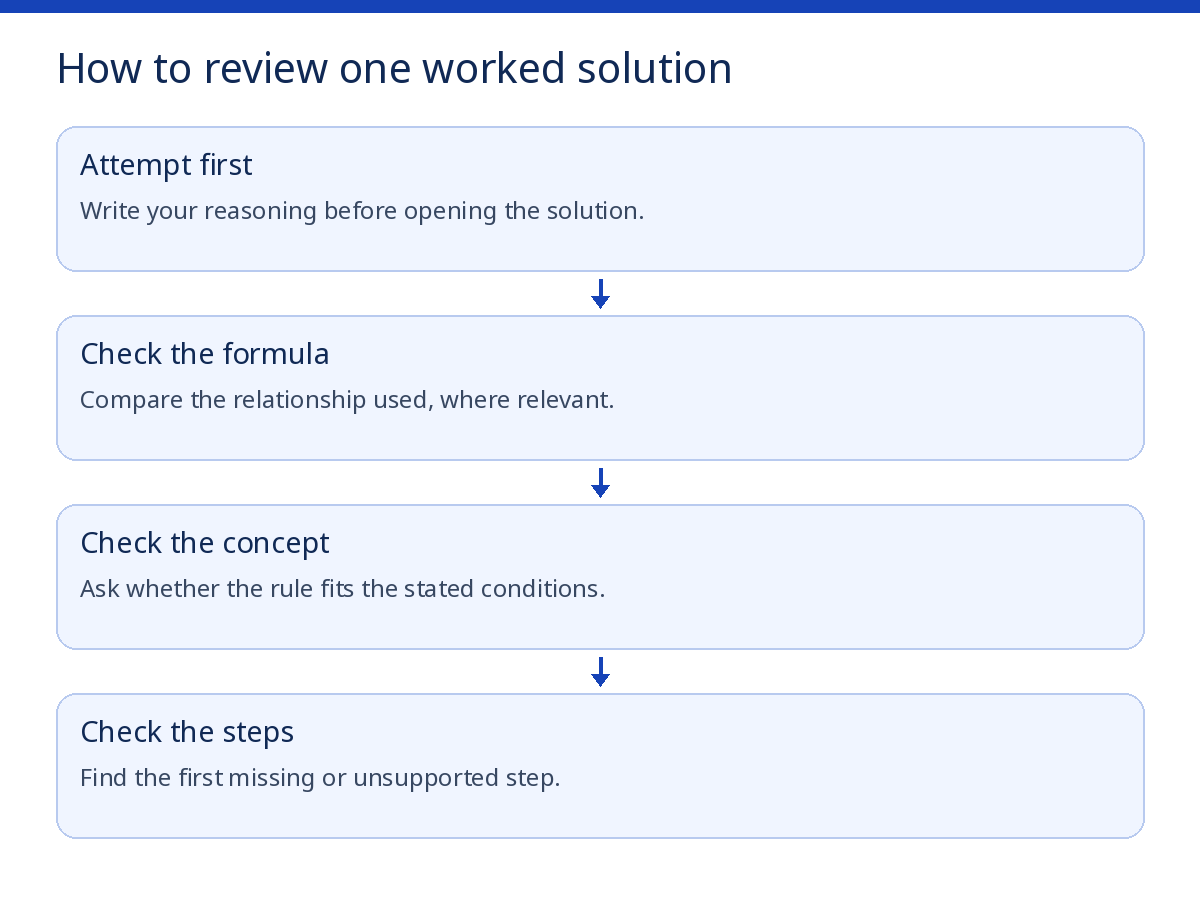
The worked solutions separate formula used, concept used and explanation in steps. Compare your reasoning in that order: was the rule appropriate, were its conditions met and did each step follow? This guide leaves out the option-level conclusions for the nitrobenzene reduction and acetal classification items: the former depends on whether a basic work-up is assumed, and the latter on how broadly acetal is defined. Use the rest of the paper to identify which errors came from choosing a rule and which came from applying or expressing it.
Spotted an error? Report a correction. Practise this in the app: notes, formula sheets and mind maps.















































































































































Loading comments…