CBSE Class 12 Chemistry 2024 Supplementary Paper
CBSEChemistry2024 Previous Year Paper
Paper code: 56/S/1 · 2024Practise with the full 2024 CBSE Class 12 Chemistry supplementary theory paper, Set 1 (56/S/1). Use the English question paper for a timed attempt, then use the worked solutions to review how you chose formulas, applied concepts and explained your reasoning.
This set is one of the year's papers. See every set from 2024, grouped by series.
How the 70-mark paper is organised
This is one complete year-wise paper, not a chapter-wise question bank. It has 33 questions and a writing time of three hours. The original instructions allow a separate 15-minute reading period and prohibit calculators. The file preserves the English question layout, options and diagrams, so you can practise interpreting the prompts as printed before opening the solutions.
Section A has sixteen 1-mark multiple-choice questions, including assertion–reason items. Section B has five 2-mark very short answers, and Section C has seven 3-mark short answers. Section D has two 4-mark case-based questions, and Section E has three 5-mark long answers. There is no overall choice, but some questions outside Section A provide internal choices. Read each instruction carefully: choosing an alternative or a specified number of subparts is not the same as skipping a question.

Chemistry Supplementary 2024 | Class 12 | Previous Year Paper | Code 56/S/1
In the StudentCurio app
Complete 2024 CBSE Class 12 Chemistry supplementary examination paper with worked solutions, covering questions across physical, inorganic and organic chemistry. Useful for practising board-style questions and reviewing solution methods across the syllabus.
Physical chemistry: identify what the data can tell you
The physical chemistry questions span electrochemistry, kinetics and solutions. In electrochemistry, the paper moves between electrode potentials, conductivity, electrolysis and a lead storage battery. Keep resistance, resistivity, conductivity and molar conductivity distinct. Resistance depends on the dimensions of the conducting path, whereas resistivity is a property of the solution under the stated conditions. Conductivity is the reciprocal of resistivity; relating conductivity to molar conductivity also requires the concentration and consistent units.
The kinetics items test different uses of a rate law. Rate comparisons give evidence for a concentration exponent, while a stated first-order rate constant lets you relate elapsed time to the fraction of reactant remaining. Identify which kind of information the prompt provides before choosing a formula: a change in rate and a change in the amount remaining are not interchangeable.
Good to remember: assumptions belong in the method
In a boiling-point elevation calculation, molality is based on the mass of solvent in kilograms, not the mass of the solution. The paper includes a problem that explicitly assumes complete ionisation. That assumption determines how you account for dissolved particles in the colligative-property model; it is not a general claim that every electrolyte solution behaves ideally.
The sucrose hydrolysis question provides a different kind of condition: water is present in excess. In a rate model, a reactant whose concentration stays effectively constant can be absorbed into an apparent rate constant. Keep reaction order, which comes from the rate law, distinct from molecularity, which describes the number of reacting species in an elementary step.
Inorganic chemistry: connect structure with evidence
The coordination chemistry questions ask you to work with geometry, geometrical isomerism, electron arrangement, magnetism, colour and naming. Start by distinguishing the metal's oxidation state from the charge on the whole complex. Then use the stated geometry or ligand-field information where relevant. For an octahedral electron-filling question, the comparison between the splitting energy and the pairing energy matters: a count of d electrons alone does not tell you how they are distributed.
The long-answer section also samples transition and inner-transition elements through oxidation states, redox behaviour, contraction and catalysis. Two items are not used as answer models in this guide: the complex-stability comparison lacks the conditions for a universal ranking, and the coordination nomenclature item offers two names for the same ligand attachment.
Organic chemistry: read the reaction conditions first
The organic questions range from naming a haloalkane to explaining reaction outcomes, distinguishing compounds and planning conversions. When a prompt supplies a reagent, medium or temperature, treat it as part of the chemical information. When it asks for a conversion, keep track of the functional group you start with and the one you need to reach, rather than recalling a named reaction in isolation.
Two distinctions are especially useful here. A trend stated for gas-phase basicity should not be transferred directly to water, where solvation can affect the comparison. And in ordinary self-aldol chemistry, an alpha hydrogen is needed to form the nucleophilic partner. A carbonyl compound that cannot supply that partner can still act as the electrophile in a crossed aldol reaction with a suitable partner.
Quick self-check: make the case passage useful
Section D pairs a biomolecules passage on nucleic acids with a solutions passage on non-ideal mixtures and azeotropes. Use the first to check whether you can keep structural comparisons separate from questions about biological function. In the second, distinguish a molecular explanation for non-ideal behaviour from a macroscopic observation about a boiling mixture. The passage supplies context, but each subpart determines what your response must explain or calculate.
Before checking a solution, ask yourself: Can I point to the detail in the passage or prompt that my reasoning uses? For an assertion–reason item in Section A, make a different check: even if both statements are true, does the reason actually explain the assertion?
Use the worked solutions after a closed attempt
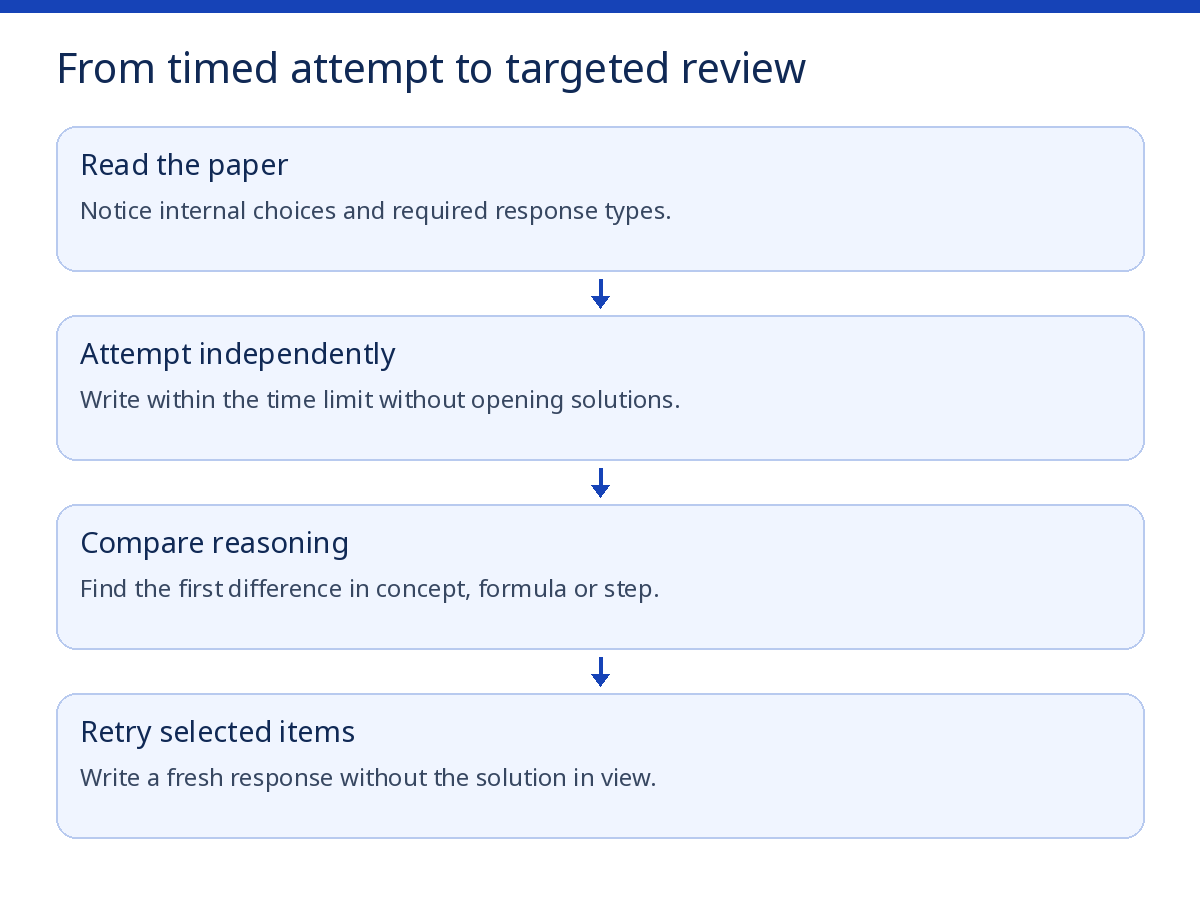
Use the reading period to notice internal choices and identify prompts that require a diagram, an equation or a calculation. Then write a closed attempt without opening the linked solutions. Afterward, use the question-number index to review selected responses. The solutions separate the formula or concept from the explanation in steps, which lets you compare your method rather than just the final line.
Find the first point where your reasoning diverged. A wrong unit calls for a different correction from a missed reaction condition or an unexplained assertion. Then attempt that question again without the solution in view. Save unused internal alternatives for a second round; they provide additional practice without changing what the original paper required in one sitting.
Spotted an error? Report a correction. Practise this in the app: notes, formula sheets and mind maps.















































































































































Loading comments…