CBSE Class 12 Chemistry: 2023 Supplementary Paper Guide
CBSEChemistry2023 Previous Year Paper
Paper code: 56/C/1 · 2023Use the full 2023 CBSE Class 12 Chemistry supplementary paper (56/C/1) for a timed theory practice session. This guide explains the five-section format, the chemistry tested and how to review your attempt using the worked solutions.
This set is one of the year's papers. See every set from 2023, grouped by series.
Know the paper before you start
This year-wise resource contains the English version of the 2023 CBSE Class 12 Chemistry supplementary theory paper, Set 1, with worked solutions. It is a full paper, not a chapter-wise question bank, so it lets you practise switching between physical, inorganic and organic chemistry in one sitting. The printed paper allows three hours, carries 70 marks and does not permit calculators. It also specifies a 15-minute reading period during which candidates do not write answers.
Use that reading period to spot the printed choices, note what each subpart asks for and find questions you may want to revisit. All 35 questions are compulsory subject to the stated choices: there is no overall choice, but some questions let you choose between alternatives.

Chemistry Supplementary 2023 | Class 12 | Supplementary Paper | Code 56/C/1
In the StudentCurio app
Complete 2023 CBSE Class 12 Chemistry supplementary examination paper with worked solutions, covering physical, inorganic and organic chemistry. Helps students practise the board examination and review solution steps.
Match your response to the five sections
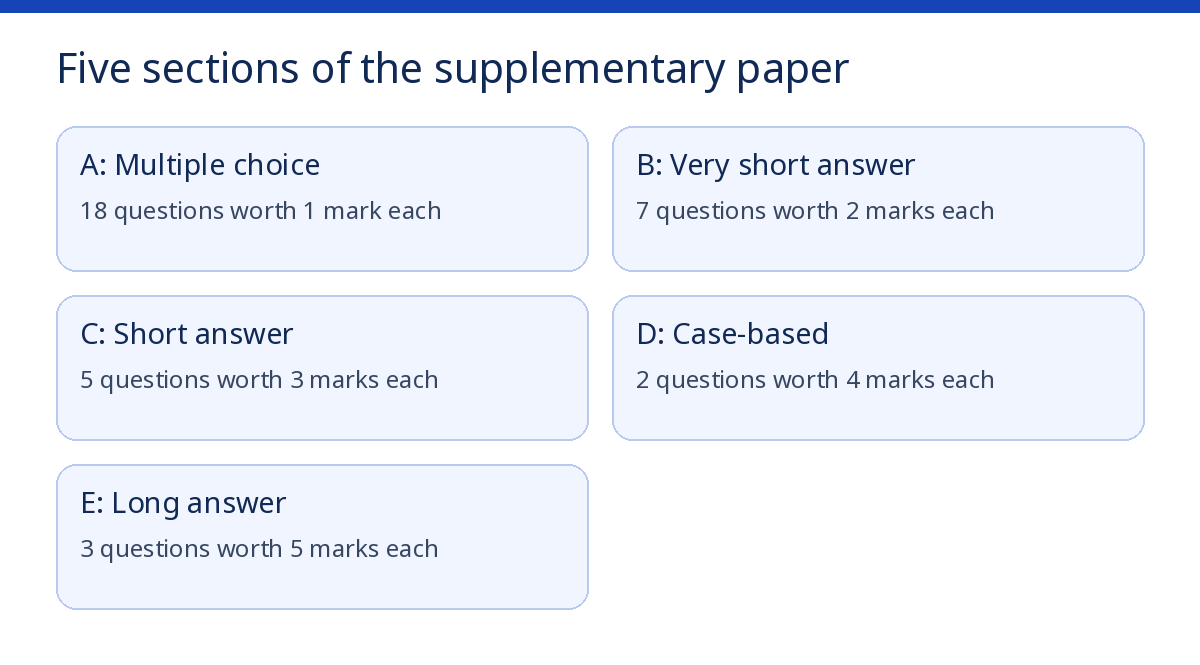
Section A has 18 one-mark multiple-choice questions, including assertion–reason items at the end. For those items, judge the truth of each statement before deciding whether the reason explains the assertion. Two true statements are not necessarily an explanation pair. Section B has seven two-mark very short answers, and Section C has five three-mark short answers. Read the subpart labels: a question may ask you to write a structure, give a reason or supply an equation, and those tasks call for different responses.
Section D has two four-mark case-based questions. Section E has three five-mark long answers. In both, follow the marks printed beside the subparts rather than treating the question as a single essay. Where an OR is printed, follow it at the point where it appears; it does not necessarily replace the entire question.
Physical chemistry: check the conditions before calculating
The paper tests chemical kinetics through rate laws, half-life, activation energy and molecularity. Keep reaction order separate from molecularity: order comes from the exponents in the rate law, whereas molecularity describes a single elementary step. Do not infer the order of a multistep reaction from its overall balanced equation. In the activation-energy calculation, the question explicitly assumes that activation energy does not change over the stated temperature interval.
Solutions questions cover association, osmotic pressure and vapour pressure. Before choosing a vapour-pressure expression, check whether both components are volatile or whether the solute is non-volatile. Electrochemistry ranges from molar conductivity and its change on dilution to cell emf and electrolysis. In an emf calculation, first distinguish the standard electrode potentials supplied as data from the actual cell conditions specified in the question.
Inorganic chemistry: separate charge, structure and behaviour
The coordination chemistry questions ask you to work with oxidation state, nomenclature, isomerism, colour, geometry and magnetism. Start by distinguishing the species inside the coordination brackets from the counterions outside them. For oxidation-state bookkeeping, account for ligand charges and the charge on the complex before assigning a value to the metal. For a question that explicitly asks for valence bond theory, use that model to connect the electron arrangement to hybridisation, shape and magnetic behaviour rather than listing unrelated labels.
The paper also tests ideas from the d- and f-block, including oxidation states, differences between lanthanoids and actinoids, and redox behaviour. When the prompt asks for an ionic equation, use the stated medium and check that both atoms and total charge balance.
Organic chemistry: track what each reagent changes
Organic questions move between structures, properties and transformations. The paper asks about acidity and basicity, substitution in halogen compounds, ether reactions, carbonyl tests and amine chemistry. A long-answer identification task gives several clues across a reaction sequence. When practising that format, track the functional group and carbon skeleton at each stage, then check that your proposed structure fits all the observations, not just the first reagent. For a distinction test, specify the observable difference rather than giving only the test name.
Source note: This guide omits the alternative in Question 34(b). The supplied text labels two different reaction products as C while asking for both C and D, so the intended labels cannot be confirmed from that passage.
Quick self-check: read the two case studies actively
The case studies cover carbohydrates and vapour pressure in solutions. In the carbohydrate passage, keep three distinctions separate: how sugars are grouped by the number of units, what happens on hydrolysis, and whether a sugar is reducing. Ask yourself which distinction a subpart is testing before you write. In the solutions passage, identify whether the prompt gives a volume observation, asks for a qualitative comparison or supplies pressure data for a calculation. Those clues do not all call for the same kind of reasoning.
Before checking the worked solutions, ask: Can I point to the detail that supports my explanation, and have I used any additional chemistry the question requires?
Review the steps, not just the final answer
Keep the solutions closed for your first attempt. The file’s question-number index lets you return directly to an item after the session, and the worked entries separate the formula, concept and explanation where applicable. Compare your reasoning in that order. If the idea was right but the calculation went wrong, check substitutions, powers of ten and units. If the arithmetic was sound but the method was wrong, note the condition or wording you overlooked.
After reviewing, retry the missed subpart without looking. For extra practice, attempt the unused printed alternatives separately. Keeping them out of the timed attempt preserves the original choice structure while giving you more material for revision.
Spotted an error? Report a correction. Practise this in the app: notes, formula sheets and mind maps.















































































































































Loading comments…