CBSE Class 12 Chemistry 2025 Previous Year Paper
CBSEChemistry2025 Previous Year Paper
Paper code: 56/2/1 · 2025Practise with the complete 2025 CBSE Class 12 Chemistry main board paper (Q.P. Code 56/2/1). After your attempt, use the worked solutions to check not only your final answers but also whether you chose a rule that fits the question.
This set is one of the year's papers. See every set from 2025, grouped by series.
What’s in the 2025 Chemistry paper
This is a full, year-wise previous year paper, not a chapter worksheet. The English version is a three-hour examination for 70 marks. The file preserves the original question layout, answer options and diagrams, so you can read each prompt in context. A question-number index lets you move directly to an item, and the worked solutions cover subparts and both printed alternatives where a question offers an OR choice.
For a timed attempt, work from the question pages and follow the printed directions on choices. Save the second branch of an OR question for later practice rather than trying to complete both during the mock. Afterward, use the index to revisit a specific question without having to search through the whole file.

Chemistry 2025 | Class 12 | Previous Year Paper | Code 56/2/1
In the StudentCurio app
The complete 2025 CBSE Class 12 Chemistry main examination paper (Q.P. Code 56/2/1), with worked solutions, covers questions across the syllabus. It helps students practise board-exam questions and review solution methods.
Chemical kinetics: when the rate law applies
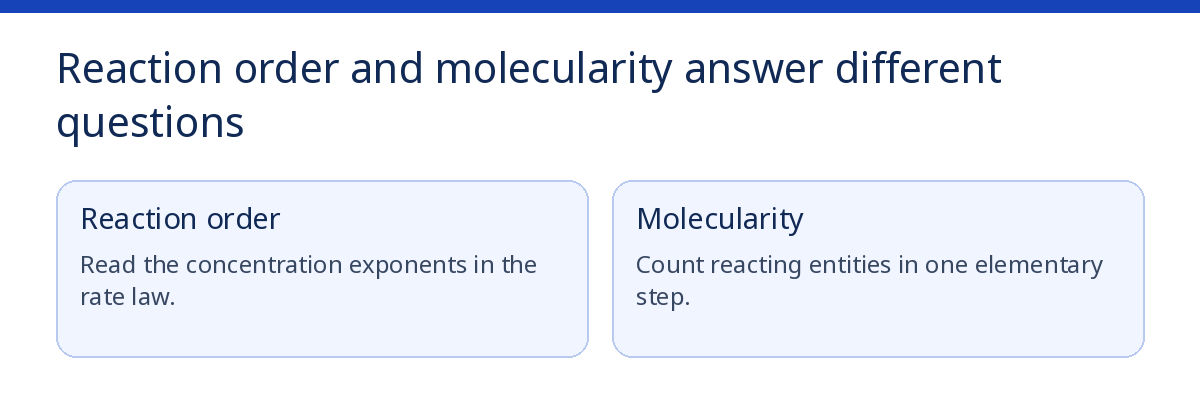
The kinetics questions draw on reaction order, molecularity, half-life and rates of concentration change. Order comes from the exponents in a rate law, whereas molecularity counts the reacting entities in one elementary step. Zero order means the rate is independent of concentration in the regime where that law applies. It does not mean an elementary step can involve zero reacting entities.
The half-life expressions show why identifying the order matters. For a first-order reaction, , independent of the initial reactant concentration. For zero-order disappearance described by , , provided the zero-order law holds over that interval. When reviewing your work, check which concentration or rate the symbol represents before treating a familiar expression as the right one.
Electrochemistry: track electrons and check the conditions
The electrochemistry material uses oxidation-state changes and standard reduction potentials for different purposes. An oxidation-state change helps establish how many electrons are transferred; a potential comparison helps assess the direction of a proposed redox process under standard conditions. When reviewing a half-reaction, check that both atoms and charge balance before using the electron coefficient to reason about charge transfer.
Keep the proposed reduction in view when reading a question about a metal and an acid. Hydrogen-ion reduction and a reduction involving an oxidizing acid are not the same cathodic process. A conclusion about hydrogen evolution in dilute nonoxidizing acid should not be transferred unchanged to an oxidizing acid.
Coordination chemistry: separate linkage from magnetism
The paper includes electronic configurations, coordination isomerism and magnetic behaviour. To review linkage isomerism, look at what is actually bonded to the metal. An ambidentate ligand has more than one possible donor atom; linkage isomers differ in which of those atoms binds. Recognising the ligand by name is not enough if the question turns on the point of attachment.
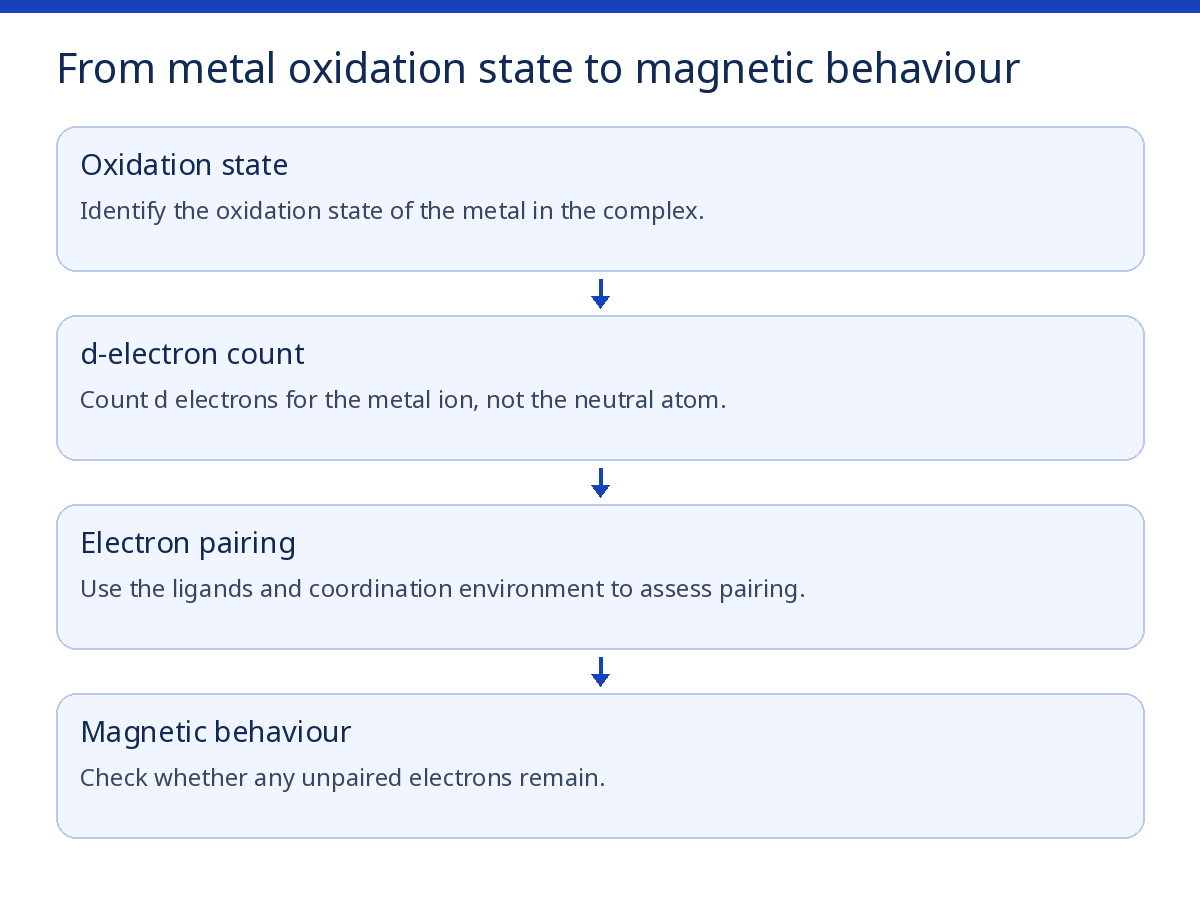
A magnetism question requires a different chain of reasoning. Start with the metal ion’s oxidation state and corresponding d-electron count, rather than using the neutral atom’s configuration unchanged. Then consider the coordination environment and the effect of the ligands on electron pairing. The magnetic classification follows from whether unpaired electrons remain, not from the d-electron count alone.
Organic chemistry: let the structure guide the rule
The organic questions include substituted benzene nomenclature, alcohol oxidation, phenol reactions and the scope of an amine preparation. In a naming question, first read the positions from the diagram and apply the lowest-locant rule. Alphabetical order can break a tie between otherwise equivalent numbering choices; it does not override the requirement for the lowest set of locants.
For reaction questions, identify the functional group and the type of carbon involved before recalling a reagent or named reaction. The worked material on amine preparation illustrates why this matters: a route that requires an alkyl-type substitution cannot simply be carried over to an ordinary aryl halide. In review, note the structural feature that makes a method applicable, rather than recording the reaction name alone.
Quick self-check: identify the structural level in biomolecules
The biomolecules material spans protein denaturation, nucleic-acid linkages and vitamin properties. These topics call for different kinds of explanations. For proteins, distinguish a change in higher-level folding from a change in the amino-acid sequence. For nucleic acids, distinguish a linkage along the sugar-phosphate backbone from an interaction between paired bases. For vitamins, keep solubility, storage and deficiency effects separate rather than treating one as a substitute for the others.
Before reading the relevant explanation, ask yourself: am I describing how units are joined, how a larger structure is held together, or a property of the molecule? That distinction helps you answer at the level the prompt requires.
Review the reasoning, not just the answer
Use the file’s formula, concept and step-by-step explanation to locate the first point where your reasoning diverged. If you chose the right law but defined the wrong quantity, revise the setup. If you missed a condition in the prompt, write it beside the rule before trying the question again. For an assertion–reason item, check each statement independently before deciding whether the reason explains the assertion.
One kinetics alternative is flagged in the file because the printed wording does not specify whether the quoted rate constant refers to reactant disappearance or to the stoichiometrically normalized reaction rate. The numerical outcomes for that alternative are omitted here. When reviewing it in the file, focus on why the rate convention must be stated rather than treating the different outcomes as an arithmetic disagreement.
Spotted an error? Report a correction. Practise this in the app: notes, formula sheets and mind maps.















































































































































Loading comments…