The d- and f-Block Elements: CBSE Class 12 Case Assessment
CBSEChemistryThe d- and f-Block Elements
This CBSE Class 12 Chemistry assessment uses eight case studies to practise applying electronic configurations, oxidation states and periodic trends. Work through the questions first, then use the linked solutions to check how each explanation uses the passage, the chemical conditions and the data given.
What the assessment contains
The PDF contains 31 numbered questions and six OR alternatives, with multiple-choice, short-answer and assertion–reason formats. The clickable index lists separate starting pages for each case and its solutions. Individual questions link to numbered explanations, and each solution links back to its question. This is a case-based assessment, not a separate set of chapter exercises.
Attempt a whole case before opening its solutions. In a multiple-choice item, note what rules out the option you found most plausible. In a short answer, write the chemical reason as well as the conclusion. That gives you something to compare with the worked explanation even when your final choice was correct.

The d- and f-Block Elements | Class 12 Chemistrty| CBSE Case-based Assessment
In the StudentCurio app
Case-based questions and worked solutions cover transition-element properties, oxidation states, electronic configurations, lanthanoid contraction, vanadium chemistry, and potassium dichromate reactions. Useful for Class 12 CBSE students practising application-based questions from the d- and f-block chapter.
Chromium chemistry: follow the clue and the medium
The first two cases approach chromium chemistry differently. The chromyl chloride case presents a sequence of observations involving a solid, vapours, a solution and a precipitate. Read the observations in order: a colour is evidence about what is present at that stage, but it does not replace the reagent and reaction clues that connect one stage to the next.
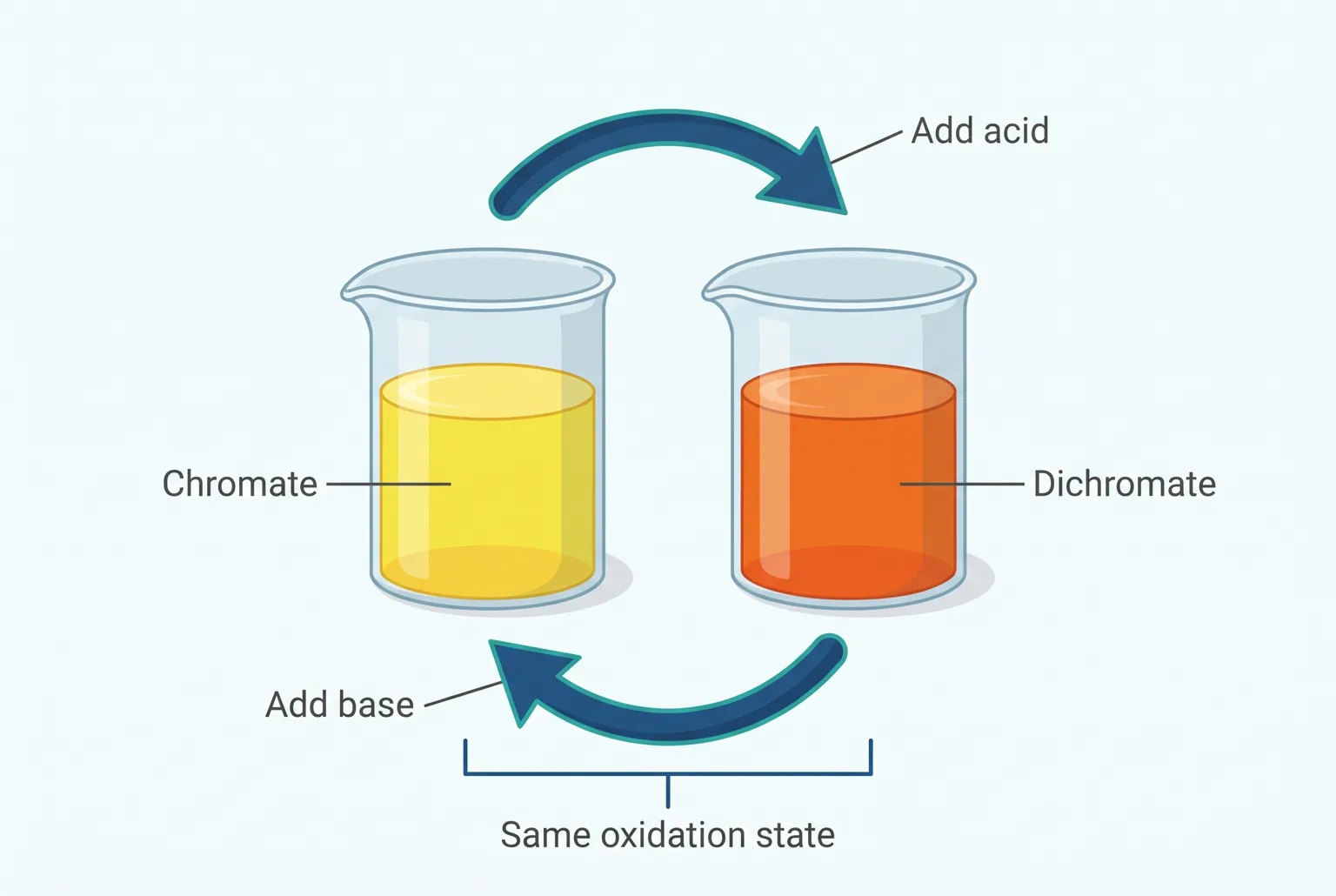
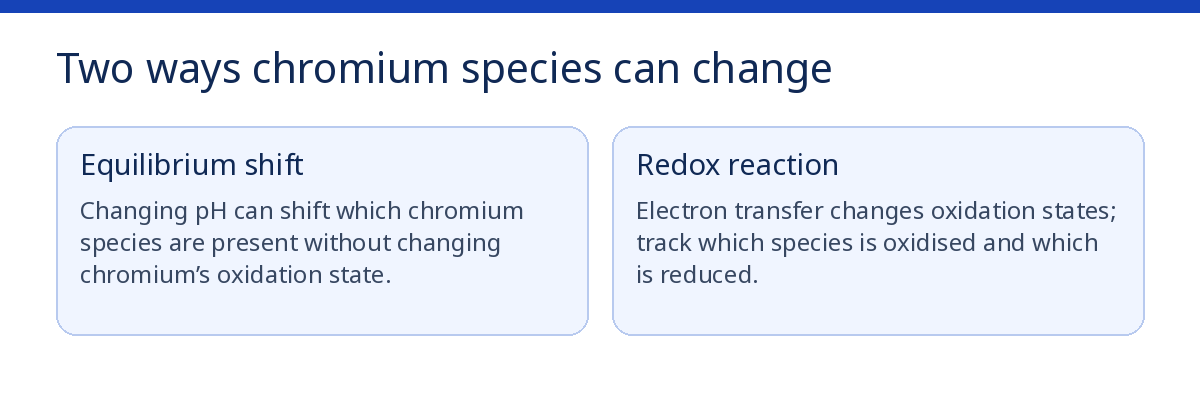
The second case brings together pH-dependent equilibria and redox. A shift between chromate and dichromate changes the species present without changing chromium’s oxidation state. In a redox reaction, by contrast, an oxidation number changes and electrons must be accounted for. Also distinguish a net ionic change from a list of salts: the latter depends on which acid supplies the accompanying ions. This guide leaves out the disputed salt-product choice and the malformed equilibrium notation in the question passage. The solution notes explain the acid assumption and give the balanced equilibria.
Good to remember: d-block position is not the definition
Cases 3 and 4 ask you to connect the periodic table with electronic configurations and bulk properties. The d-block lies between the s- and p-blocks, but position alone does not make an element a transition element. Check whether the atom or one of its cations has an incomplete d subshell. A filled d subshell in the neutral atom is therefore not enough, on its own, to decide the classification.
These cases also cover enthalpy of atomisation, alloys and catalytic behaviour. Keep the kind of explanation matched to the property: atomisation concerns separating a metal into gaseous atoms, whereas alloy formation concerns how atoms of different elements fit into a metallic structure. The guide omits the conflicting descriptions of series completeness: the 6d d-block series extends through copernicium.
Before comparing electrode potentials, read the couple
The electrode-potential case uses standard reduction potentials to compare redox tendencies and stability. Start by reading both species in the couple. A value for concerns reduction of an ion to the metal; a value for concerns a change between two ionic oxidation states. Neither is a single potential that describes everything the element does.
A more positive standard reduction potential indicates a greater tendency for reduction when the listed half-reactions are compared under standard conditions. Whether a species is oxidised or reduced in a particular reaction depends on its partner half-reaction. Likewise, identifying an anode requires knowing which half-cell undergoes oxidation in that cell. When a question asks why an ion is relatively stable, consider the configuration and the aqueous setting rather than treating the potential as a measure of subshell stability alone.
Lanthanoid contraction: compare ions of the same charge
The f-block case focuses on the 4f series and distinguishes electronic configuration, oxidation state and ionic size. The common oxidation state of the lanthanoids is , but it is not their only one. Before comparing configurations, check whether the question refers to a neutral atom or an ion; the charge determines how many electrons you must account for.
Lanthanoid contraction is the cumulative decrease in size across the series. For an ionic comparison, follow the trivalent ions as atomic number increases. The 4f electrons shield the increasing nuclear charge poorly, so the remaining electrons are drawn closer. Comparing ions of different charges would mix the trend across the series with the effect of changing the charge.
Vanadium oxides: separate acid–base behaviour from redox
The vanadium case compares oxides at different oxidation states and connects changes in oxidation state with catalysis. When reading the passage, separate an oxide’s acid–base character from its role in an electron-transfer reaction. An oxide described as amphoteric can react with both acids and bases; that description does not, by itself, identify an oxidising or reducing agent.
For a redox question, instead track the oxidation number of each relevant element from reactants to products. The species that is reduced acts as the oxidising agent. This distinction lets you use the same oxide formula in different kinds of reasoning without assuming that its acid–base behaviour predicts its redox role.
Quick self-check for assertion–reason questions
The final case tests general transition-element properties through paired statements. Judge the assertion and reason separately before deciding whether the reason explains the assertion. Two statements about the same element or property can both be true without one accounting for the other.
Before opening a linked solution, ask: what condition or mechanism would make this reason explain that assertion? Then check for sweeping language. The chapter describes tendencies such as colour and paramagnetism, not properties to assign automatically to every d-block ion. In particular, paramagnetism requires unpaired electrons, so inspect the configuration of the species actually named.
Spotted an error? Report a correction. Practise this in the app: notes, formula sheets and mind maps.















































































































































Loading comments…