Solutions: CBSE Class 12 Chemistry PYQs and Worked Solutions
CBSEChemistrySolutions
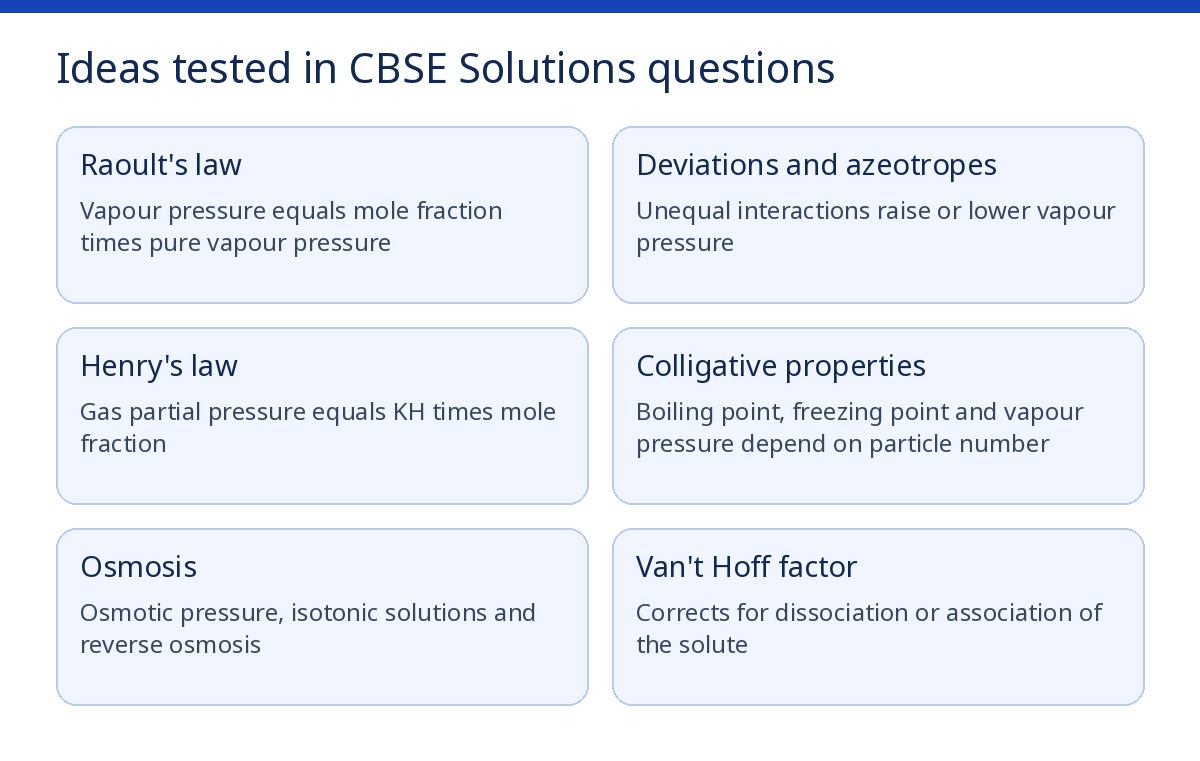
This guide covers Chapter 1, Solutions, through a chapter-wise collection of CBSE board questions labelled 2021 (Term 1), 2023, 2024, 2025 and 2026. It explains the ideas these questions test: Raoult's and Henry's laws, deviations and azeotropes, colligative properties, osmosis and the van't Hoff factor.
Raoult's law and relative lowering of vapour pressure
Raoult's law says that the partial vapour pressure of a volatile component equals its mole fraction multiplied by its pure vapour pressure: . For two volatile liquids, the total pressure is the sum of the two partial pressures. Board questions turn this around and give a total pressure, then ask for the composition of the liquid.
When the solute is non-volatile, only the solvent contributes vapour. The relative lowering then equals the mole fraction of solute. This lets you find a solute's molar mass from a measured vapour pressure. One 2026 compartment question, for example, gives the vapour pressure of a solution and of pure water at 308 K and asks for the solute's molar mass. In dilute solutions, the solute mole fraction is approximately .

Solutions | Class 12 | Previous Year Paper
In the StudentCurio app
Comprehensive 114-page collection of solved previous year CBSE board questions for Class 12 Chemistry, covering Henry's law, Raoult's law, and colligative properties with detailed step-by-step solutions.
Ideal solutions, positive and negative deviations, and azeotropes
The topic finder lists more questions under this heading than under any other. A case passage in the collection defines an ideal solution as one in which the forces between like and unlike molecules are equal. The same passage notes that very dilute solutions behave ideally with respect to the solvent.
In a non-ideal solution, unlike interactions differ from like ones. If A–B attractions are weaker than A–A and B–B attractions, molecules escape more easily and the vapour pressure is higher than Raoult's law predicts. This is a positive deviation. If A–B attractions are stronger, the vapour pressure is lower, which is a negative deviation.
Papers link each type of deviation to observable signs, such as a change in volume on mixing, heating or cooling of the mixture, and a shift in boiling point. Several 2026 sets use the same template. They name a liquid pair, then ask for the deviation type, the reason for it and the effect on boiling point.
An azeotrope boils at constant composition, so its liquid and vapour have the same composition. Questions ask you to define it, relate its type to the sign of the deviation and give an example.
Henry's law: pressure, mole fraction and real-life contexts
Henry's law relates a gas's partial pressure to its mole fraction in solution: . Here carries pressure units. The source uses Pa in one question and mmHg in another. For a fixed pressure, a larger means a smaller mole fraction, so the gas is less soluble.
Numerical questions give and a packing pressure, often for CO₂ in soda water. You find the mole fraction first. Then you convert it to moles using the moles of water present.
Descriptive questions ask you to explain bends, anoxia or the comfort of aquatic life in cold water using Henry's law. One case question asks you to comment on the statement that Raoult's law is a special case of Henry's law.
Boiling point, freezing point and osmotic pressure formulas
Colligative properties depend on the number of solute particles, not on their identity. The key relations are:
- Elevation of boiling point:
- Depression of freezing point:
- Osmotic pressure:
Here is molality, , with the solvent mass in grams. is molarity in mol L⁻¹. For non-electrolytes such as glucose, urea and ethylene glycol, . Rearranging the equations gives the molar mass of an unknown solute.
Recurring patterns include antifreeze in a radiator and isotonic urea and glucose solutions. Others convert a boiling-point elevation into a freezing-point depression for the same solution. Because is shared, this can be done through the ratio .
Osmosis vocabulary from the case-based passages
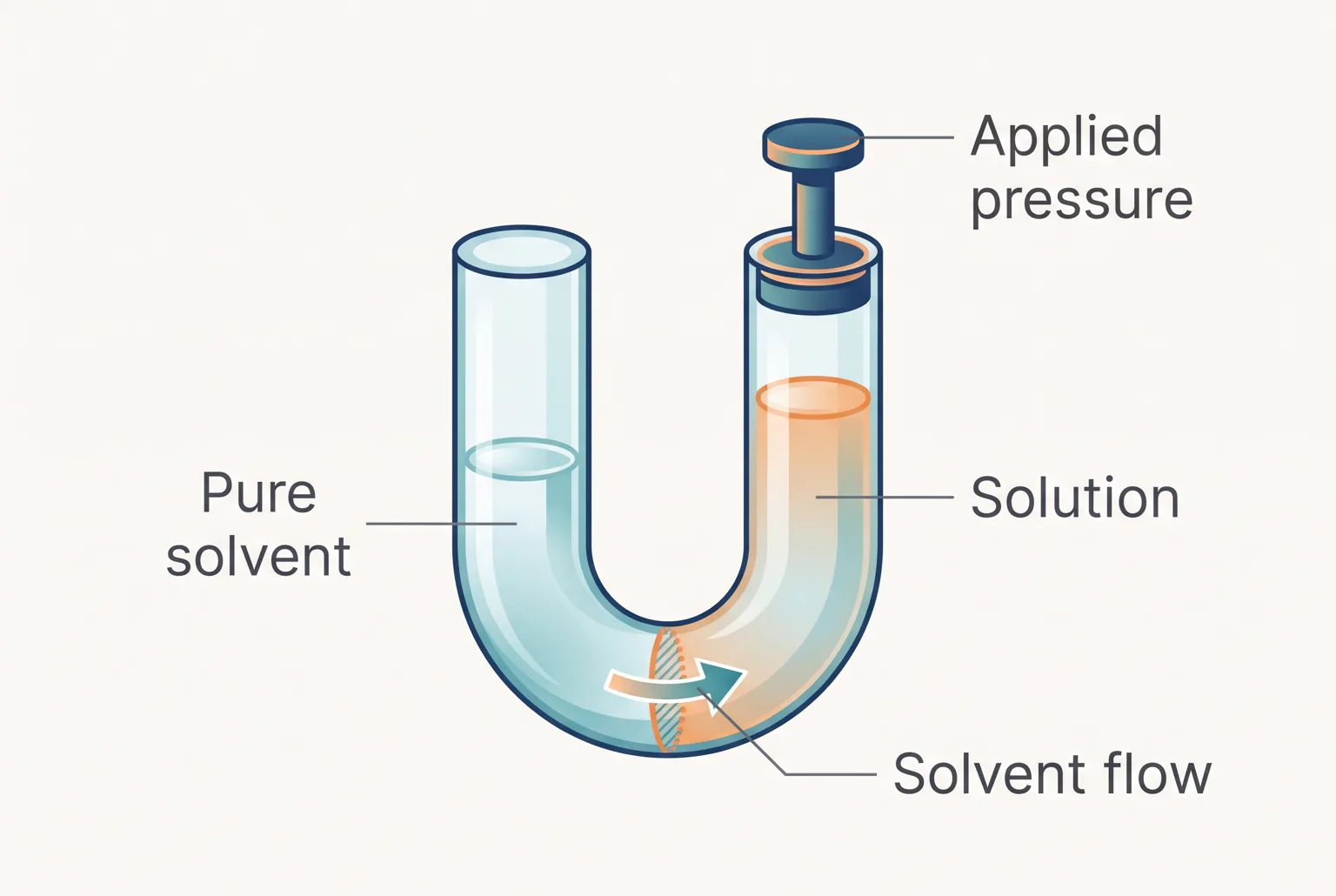
The case passages define osmosis as solvent flow through a semipermeable membrane. The flow goes from pure solvent, or a dilute solution, into a more concentrated solution. Osmotic pressure is the external pressure needed to stop this flow. Reverse osmosis occurs when the applied pressure exceeds the osmotic pressure, and it underlies desalination.
Solutions with equal osmotic pressure are isotonic. A solution with lower osmotic pressure is hypotonic relative to the other, and one with higher osmotic pressure is hypertonic. The passages state that fluid inside blood cells matches 0.9% (mass/volume) NaCl, known as normal saline. Questions then ask what happens to red blood cells placed in other NaCl concentrations, or to eggs and raisins placed in water or brine.
Van't Hoff factor for dissociation and association
Electrolytes dissociate into more particles, so . Solutes that associate, such as acids forming dimers in benzene or CS₂, give fewer particles, so . The factor is defined as .
For a degree of dissociation into ions, . For dimerisation, . The phrases "complete dissociation" and "complete dimerisation" signal that you should take .
The collection repeats close variants of the same question. Two 2025 sets give an abnormal molar mass for NaOH from osmotic pressure and ask for the percentage dissociation, using different numbers.
Common mistakes in Solutions numericals
- Using molarity in equations. Freezing- and boiling-point formulas need molality, which is per kg of solvent.
- Leaving in °C in . Convert to kelvin, so 27 °C becomes 300 K. A temperature difference, however, is the same in K and °C.
- Forgetting when the question says an electrolyte dissociates completely.
- Mixing pressure units within Henry's law. Keep and in the same unit.
Practising with this chapter-wise PYQ collection
The file holds 70 subjective questions, including 5 case-based, and 81 MCQs, including 21 assertion–reason items. Its topic and question-type finders link to each question, and offline links connect each question to its solution. Marks are not printed, and no question is labelled 2022, because the 2021–22 Term 1 paper was held in 2021.
The file marks every worked solution as an Added solution, since the original material had only an MCQ key. Source notes flag data or keys that need qualification.
A sensible practice order:
- Revise one topic group through the finder.
- Attempt its subjective numericals.
- Move to the MCQs and assertion–reason items.
- Open a solution only after writing your own steps.
Quick self-check: can you explain why osmotic pressure suits macromolecules, and why fractional distillation fails for an azeotrope?
Frequently asked questions
Which years do the questions come from?
The exam-year labels in the collection are 2021 (Term 1), 2023, 2024, 2025 and 2026. Questions from the 2021–22 Term 1 paper are dated 2021.
Are the worked solutions official CBSE answers?
No. The original material had an MCQ answer key but no written solutions, so every full solution in this edition is labelled as an added solution.
Why is Solutions called Chapter 1 here?
It follows the current CBSE Class 12 Chemistry sequence. Older NCERT editions may number Solutions as Chapter 2.
Spotted an error? Report a correction. Practise this in the app: notes, formula sheets and mind maps.















































































































































Loading comments…