NCERT Solutions: CBSE Class 12 Chemistry Textbook Guide
CBSEChemistrySolutions
Use the NCERT Solutions chapter to connect three ideas: how to express the composition of a mixture, what determines how much solute dissolves, and how liquid composition affects vapour pressure. The chapter also covers ideal and non-ideal solutions and introduces colligative properties as a way to relate solution behaviour to solute molar mass.
Identify the solvent before classifying the solution
A solution is a homogeneous mixture: its composition and properties are uniform throughout. The solvent is generally the component present in the largest quantity, and it determines the physical state of the solution. The other component in a binary solution is the solute. The chapter lists gaseous, liquid and solid solutions, then focuses mainly on liquid solutions with two components.
Read the classification table by identifying the solvent first, then the solute. Oxygen dissolved in water, ethanol dissolved in water and glucose dissolved in water are all liquid solutions. They differ in the physical state of the solute, not in the classification of the resulting solution. This distinction matters when a question describes the starting materials rather than naming the type of solution.

Solutions | Class 12 | NCERT Textbook
In the StudentCurio app
Covers solution types and concentration, gas solubility and Henry’s law, Raoult’s law, ideal and non-ideal solutions, and colligative properties including osmotic pressure and the van’t Hoff factor. Helps Class 12 Chemistry students review the chapter’s concepts and work through related numerical problems and exercises.
Common mistakes: using the wrong denominator
The chapter replaces relative labels such as dilute and concentrated with quantities you can calculate. For mass percentage, the denominator is the total mass of the solution, not the mass of the solvent. For volume percentage, it is the final volume of the solution. The textbook’s ethanol example makes this distinction clear: a 10% volume-by-volume solution contains 10 mL of ethanol in 100 mL of final solution, not 10 mL of ethanol added to 100 mL of water. Mass by volume percentage expresses the mass of solute in 100 mL of solution. For trace quantities, the chapter introduces parts per million, or ppm; check which basis is being used before comparing values.
Molarity uses litres of solution, whereas molality uses kilograms of solvent. Molarity can change with temperature because solution volume can change; molality does not depend on volume. Mole fraction uses moles of a component divided by total moles of all components. It has no unit, and the fractions in a binary solution must add to one.
Distinguish concentration from solubility
Concentration describes the amount of a component actually present. Solubility describes the maximum amount that can dissolve in a specified amount of solvent under given conditions. A saturated solution in contact with undissolved solid has reached dynamic equilibrium: dissolution and crystallisation continue at equal rates, so the dissolved concentration stays constant. An unsaturated solution can still dissolve more solute under the same conditions.
The chapter uses differences in solute–solvent interactions to explain why substances that dissolve readily in water need not dissolve readily in benzene. Its phrase like dissolves like is a general guide to those interactions. For solids in liquids, the temperature trend depends on the sign of the enthalpy of dissolution: warming generally increases solubility for endothermic dissolution and decreases it for exothermic dissolution. Pressure has no significant effect on the solubility of solids in liquids.
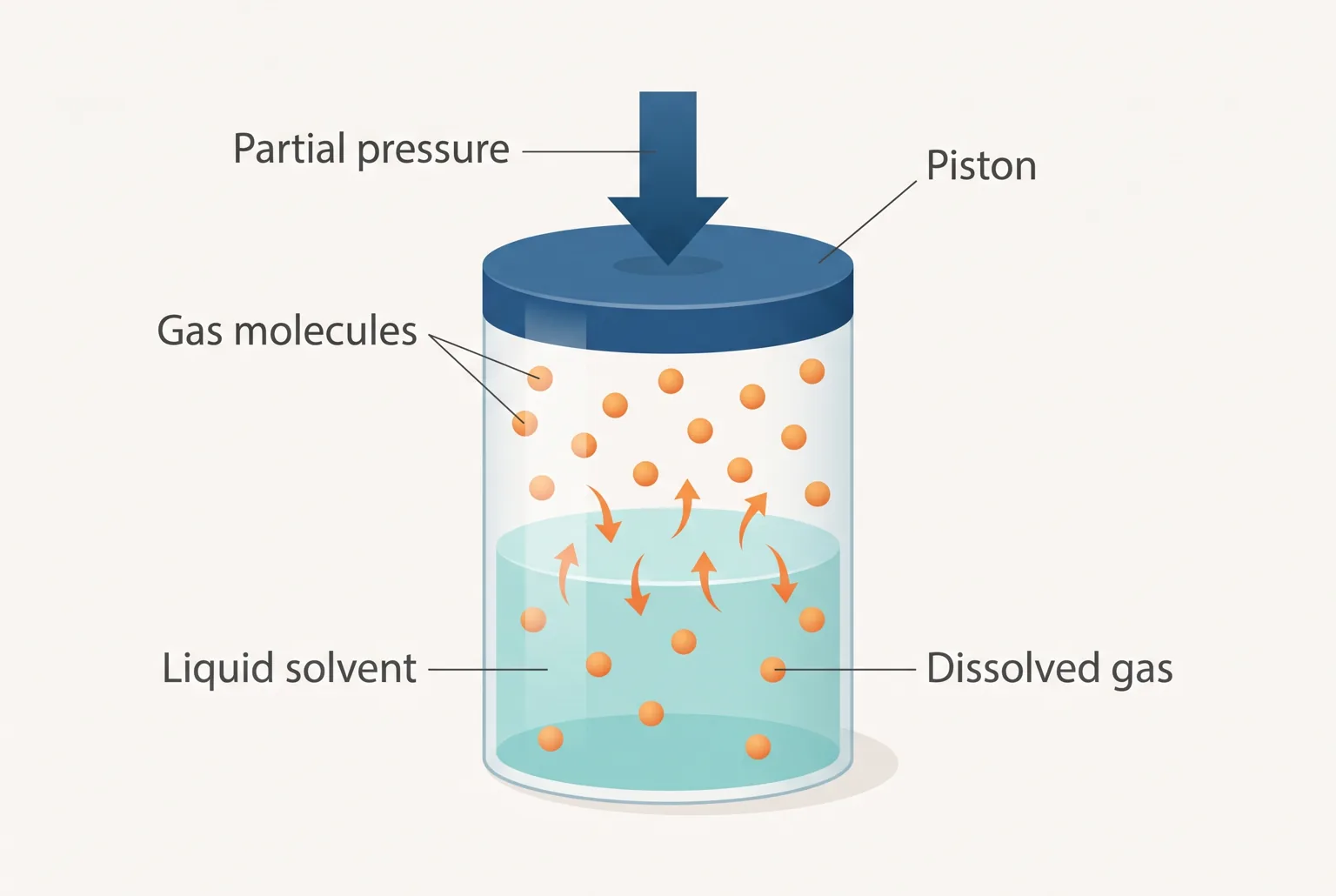
When Henry’s law applies: a gas above a liquid
For a dissolved gas at equilibrium at a fixed temperature, the chapter writes Henry’s law as . Here is the gas’s partial pressure above the liquid and is its mole fraction in the solution. Use partial pressure, not the total pressure of a gas mixture. On a graph of partial pressure against dissolved mole fraction, is the slope. At the same partial pressure, a larger gives a smaller dissolved mole fraction.
The chapter links this relationship to carbonated drinks, which are sealed under pressure to increase the solubility of carbon dioxide. It also tabulates Henry’s law constants at specified temperatures, so match the tabulated value to the conditions in the question. In the worked nitrogen example, notice how the pressure units are made consistent before the textbook uses mole fraction to determine the amount dissolved.
Read Raoult’s law through the vapour-pressure graph
For an ideal binary solution of two volatile liquids at a fixed temperature, Raoult’s law gives . The mole fraction refers to the liquid solution, and is the vapour pressure of the pure component at the same temperature. Each partial pressure is calculated separately; Dalton’s law then gives the total as their sum. The textbook graph shows how the partial pressures change with composition and why the total pressure varies linearly between the two pure-component values in the ideal case.
Both Henry’s and Raoult’s laws in the chapter relate a partial pressure to a liquid-phase mole fraction, but their proportionality constants have different meanings. Keeping that distinction clear also helps when the chapter moves from ideal behaviour to deviations from Raoult’s law.
Use the worked examples before the in-text questions
Start with the chapter’s examples on mole fraction, molarity and molality. For each, identify the denominator before tracing the arithmetic. Then use the nearby in-text questions to practise choosing the concentration measure without the example’s setup in front of you. The aqueous potassium iodide question is particularly useful for comparing measures: it gives both mass percentage and density and asks you to express the same composition in three ways. Before calculating, decide which requested measure needs solution volume and why density is relevant to that step.
The chapter’s stated scope extends beyond vapour pressure to colligative properties, including osmotic pressure. It connects measurements of these properties with solute molar mass and introduces the van’t Hoff factor when discussing abnormal colligative behaviour. Use that connection to frame the later reading: before interpreting a calculated molar mass, identify the assumptions the calculation makes about the solute in solution.
Spotted an error? Report a correction. Practise this in the app: notes, formula sheets and mind maps.















































































































































Loading comments…