NCERT Solutions for CBSE Class 12 Chemistry: Solutions
CBSEChemistrySolutions
This worked-solutions file for CBSE Class 12 Chemistry covers the NCERT in-text questions and chapter exercises on Solutions. Use it to practise choosing the right concentration scale, distinguishing gas solubility from vapour pressure, and checking the assumptions behind colligative-property calculations.
Find the right question across editions
The file separates 12 in-text questions from 41 exercise questions. The main index lists the in-text questions and groups the exercises by topic. A separate exercise index gives each question a short description and a page number, so you can find a specific problem without scanning the worked pages.
The uploaded textbook edition labels Solutions Chapter 2, while the file uses Chapter 1 numbering. Match the question by its wording or index description, not by its number alone. Keep the two question lists distinct as well: an in-text question and an exercise question can carry the same number while asking about different concepts. The in-text list is a direct route to topics such as dilution and liquid–vapour composition; the exercise index also points to questions on solution types, intermolecular interactions and dissociation.

Solutions | Class 12 | NCERT Solutions
In the StudentCurio app
Worked NCERT in-text and exercise solutions cover concentration conversions, solution mixing, gas solubility, Henry’s and Raoult’s laws, and colligative-property calculations. Useful for Class 12 Chemistry students practising solution numericals with step-by-step methods.
Common mistake: using the wrong denominator
A solution is a homogeneous mixture: its composition is uniform throughout. The solvent determines the physical state of the solution, but it is not always the quantity in the denominator when you describe composition. The concentration questions make that distinction explicit:
- Mass percentage compares a component’s mass with the mass of the whole solution.
- Mole fraction compares a component’s amount in moles with the total amount in moles. It has no unit, and the mole fractions in a phase add to one.
- Molality uses kilograms of solvent, whereas molarity uses litres of solution.
Compare the potassium iodide in-text question with the glucose exercise to see why the same composition can be expressed on several scales. When a mass-based description is converted to molarity using density, the density converts the mass of the whole solution to its volume, not the mass of solvent to its volume.
Mixing and dilution: identify what is conserved
In the exercise on mixing two solutions of the same solute, the percentage of each portion describes that portion only. Compare the combined solute mass with the combined solution mass. A simple average of the percentages gives each portion equal weight, so it is not the general rule when the two solution masses differ.
The dilution example instead tracks the amount of solute. When only solvent is added and no solute is lost or consumed, the initial and final amounts are equal: . Use consistent volume units on both sides, and distinguish the final solution volume from the volume of solvent added. These questions are worth comparing because both describe a change in concentration, but one combines contributions from two portions and the other follows the same solute through a change in volume.
Henry’s law: check the pressure and temperature
The gas-solubility questions use the NCERT form of Henry’s law, . Here is the gas’s equilibrium partial pressure above the liquid, and is its mole fraction in the dilute liquid solution. At fixed temperature, a higher partial pressure means a larger equilibrium dissolved mole fraction for the same gas and solvent. The soda-water example gives this relationship a familiar setting: opening the bottle lowers the carbon dioxide partial pressure, and gas escapes from the liquid.
Because mole fraction is dimensionless, has pressure units in this convention. Express the gas pressure in the same unit as the given constant before taking their ratio. Keep the pressure relationship separate from the temperature trend: the exercise explains why warming at fixed gas pressure reduces solubility when dissolution is exothermic.
Raoult’s law: keep liquid and vapour separate
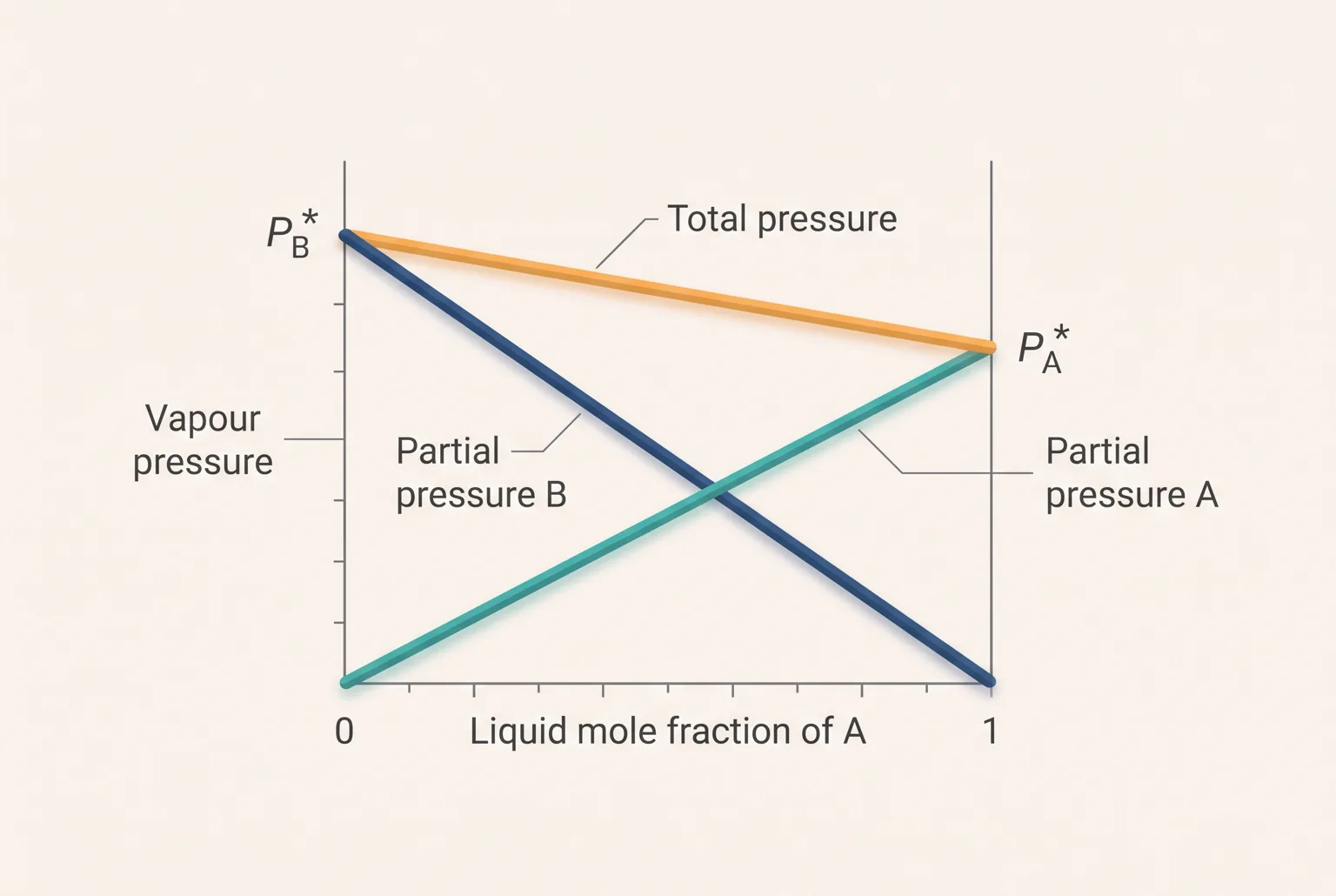
The cover graph shows how the partial pressures and total pressure vary with liquid composition for an ideal mixture of two volatile liquids at a fixed temperature. Raoult’s law gives each partial pressure as , using the component’s liquid mole fraction and its pure-liquid vapour pressure at that temperature. Add the partial pressures for the total. To describe the vapour composition, divide a component’s partial pressure by the total pressure instead. The in-text question on liquid and vapour compositions lets you practise keeping these two mole fractions separate.
The deviations exercise uses the ideal pressure as a reference at the same composition and temperature. Positive deviation means the measured pressure is above that reference; negative deviation means it is below. The comparison is with the predicted mixture pressure, not with the vapour pressure of either pure liquid alone.
Before using a colligative-property equation
First identify the measured property and the concentration it requires. For an ideal binary solution with a non-volatile solute, the solvent accounts for the vapour pressure, and the relative lowering equals the solute mole fraction. This is not the pressure model for a mixture in which both components contribute to the vapour.
The boiling-point elevation and freezing-point depression examples use molality. Read the changes as positive magnitudes: boiling-point elevation is the solution’s boiling point minus the pure solvent’s at the same pressure; freezing-point depression is the pure solvent’s freezing point minus the solution’s. The osmotic-pressure example instead uses the amount of dissolved polymer per solution volume and an absolute temperature. Before comparing these worked methods with the exercises on dissociation, check whether the solute remains as dissolved molecules or changes the effective number of particles. That distinction determines whether taking the van ’t Hoff factor as one is appropriate.
Spotted an error? Report a correction. Practise this in the app: notes, formula sheets and mind maps.















































































































































Loading comments…