Haloalkanes and Haloarenes: Class 12 NCERT Chapter Guide
CBSEChemistryHaloalkanes and Haloarenes
This CBSE Class 12 Chemistry textbook chapter connects the position of a halogen atom to how a compound is named, prepared and reacts. Use its structures, property tables and mechanism diagrams to see why compounds with similar formulas can behave differently.
Common mix-up: next to a ring is not on the ring
Start by locating the carbon directly bonded to the halogen. In a haloalkane, the halogen is attached to an -hybridised carbon of an alkyl group. In a haloarene, it is attached directly to an -hybridised carbon of an aromatic ring. A benzylic halide also contains an aromatic ring, but its halogen is bonded to an carbon attached to the ring, not to a ring carbon itself.
The same distinction applies near a carbon–carbon double bond. In an allylic halide, the halogen is on an carbon next to the double bond; in a vinylic halide, it is directly on one of the double-bond carbons. These labels describe the attachment site. By contrast, mono, di and poly tell you how many halogen atoms the compound contains.

Haloalkanes and Haloarenes | Class 12 | NCERT Textbook
In the StudentCurio app
This textbook chapter covers haloalkane and haloarene properties and reactions, with emphasis on S_N1 and S_N2 mechanisms, stereochemistry, elimination, and substitution reactions of haloarenes. It also discusses polyhalogen compounds and includes chapter review questions for Class 12 students.
Read the structure before naming the compound
To classify an alkyl halide as primary, secondary or tertiary, count the carbon atoms bonded directly to the carbon carrying the halogen. Branching elsewhere in the molecule does not determine the class. In IUPAC naming, the halogen is treated as a substituent on the hydrocarbon parent; common names of alkyl halides instead name the alkyl group followed by the halide.
For dihalobenzenes, the common prefixes ortho, meta and para correspond to the positions 1,2; 1,3; and 1,4, respectively. In dihaloalkanes, geminal means both halogens are on the same carbon, while vicinal means they are on adjacent carbons. Use the textbook’s naming table to practise reading names back into structures as well as naming structures.
When the boiling-point order applies
The carbon–halogen bond in an alkyl halide is polar: carbon carries a partial positive charge and the halogen carries a partial negative charge. In the chapter’s methyl halide table, the carbon–halogen bond length increases and the bond enthalpy decreases from the fluoride to the iodide. Those are trends in the bond itself; boiling depends on attractions between molecules.
For the same alkyl group, the boiling-point order is because van der Waals attractions increase with halogen size. When comparing isomeric haloalkanes instead, greater branching lowers the boiling point. Melting point calls for a different comparison: para-dihalobenzenes generally melt higher than their corresponding ortho and meta isomers because their greater symmetry allows better crystal packing. Bond polarity alone does not guarantee water solubility either: attractions between water and haloalkane molecules do not adequately compensate for disruption of hydrogen bonding in water.
Choose preparation routes by the bond being formed
The chapter distinguishes making a carbon–halogen bond from exchanging one halogen for another. Alcohols can give alkyl halides by replacement of the hydroxyl group. With thionyl chloride, sulfur dioxide and hydrogen chloride escape as gases, making the alkyl chloride easier to isolate. Free-radical chlorination or bromination of alkanes, by contrast, can give mixtures that are difficult to separate. In the Finkelstein reaction, dry acetone matters because the sodium chloride or sodium bromide formed precipitates, favouring the formation of the alkyl iodide.
Do not transfer the alcohol route directly to phenols to prepare haloarenes: the carbon–oxygen bond in phenols has partial double-bond character and is harder to break. The chapter instead discusses electrophilic halogenation of arenes and preparation through aromatic diazonium salts.
What the substitution mechanism explains
In nucleophilic substitution of a haloalkane, an electron-rich nucleophile attacks the partially positive carbon bonded to the halogen, which leaves as a halide ion. The substitution table distinguishes the reagent, the attacking species and the product class. That distinction matters for ambident nucleophiles, which have two possible sites of attack. Which atom bonds to carbon determines how the product is connected.
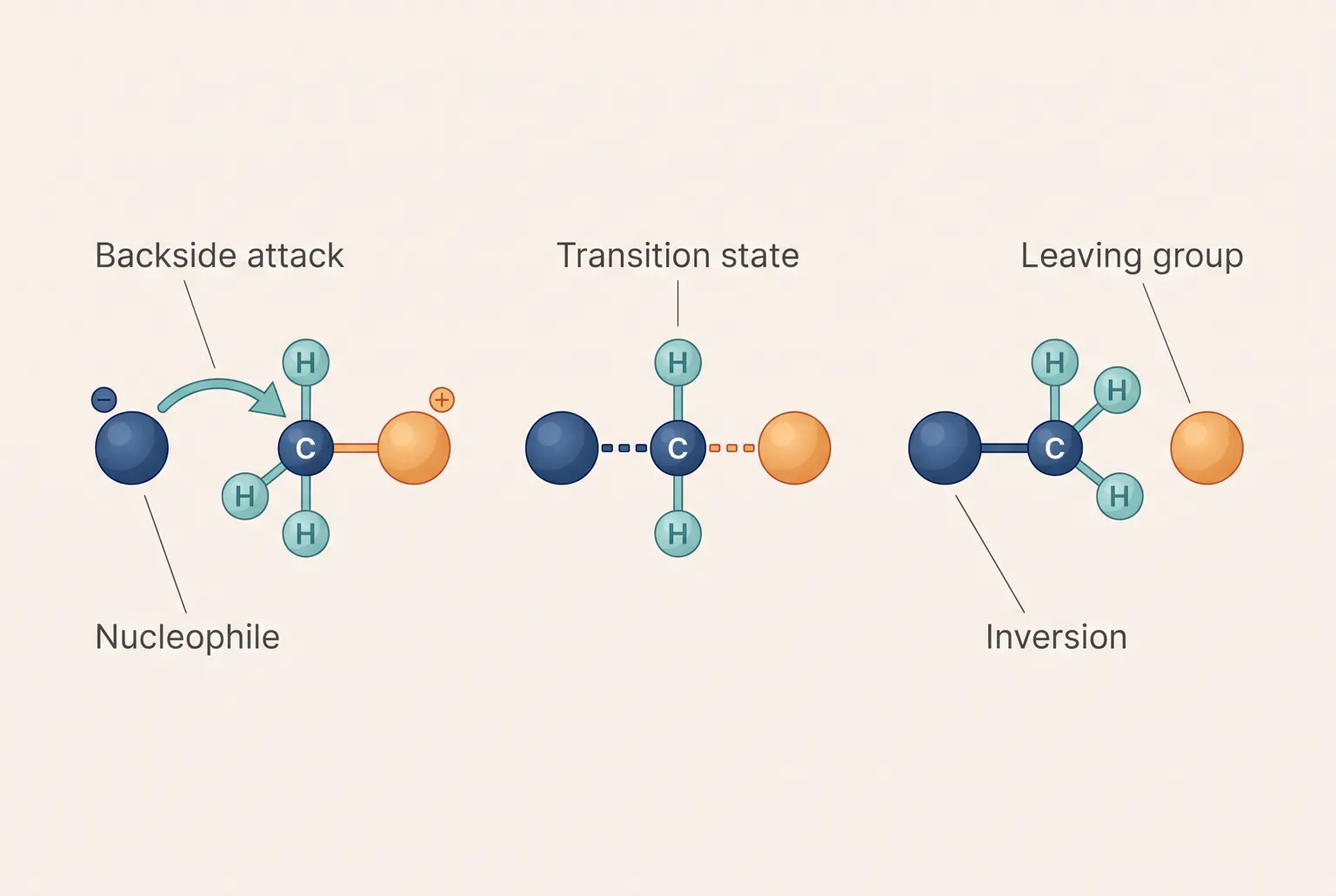
In the chapter’s mechanism, bond formation and bond breaking occur in a single step. The incoming nucleophile and departing group are both partially bonded to carbon in the transition state; this is not an isolable intermediate. Backside attack inverts the arrangement at the reacting carbon. The rate depends on both reactant concentrations, and bulky groups hinder the nucleophile’s approach. Among simple alkyl halides, methyl halides therefore react most readily by this mechanism and tertiary halides least readily. Treat that as a mechanism-specific comparison, not a ranking for every substitution reaction.
Quick self-check: can you justify the comparison?
As you read the chapter’s treatment of alongside , compare the steps, the concentrations that affect the rate and the stereochemical outcome. Keep substitution separate from elimination: track whether one group replaces another at carbon or whether a new double bond forms. The chapter also covers reactions with metals, substitution reactions of haloarenes and the uses and environmental effects of polyhalogen compounds.
Use the intext questions and chapter review to check whether you can explain a choice rather than recall a label. Before a property comparison, ask what stays fixed and what changes. Before classifying a structure, point to the exact carbon bonded to the halogen and explain why its position matters.
Spotted an error? Report a correction. Practise this in the app: notes, formula sheets and mind maps.















































































































































Loading comments…