Haloalkanes and Haloarenes: Class 12 NCERT Solutions
CBSEChemistryHaloalkanes and Haloarenes
This CBSE Class 12 Chemistry solutions file works through the NCERT in-text questions and exercises on Haloalkanes and Haloarenes. Use it to connect the position of a halogen, the structure of a molecule and the reaction conditions to the properties or products you predict.
Find the right question in your NCERT edition
The file indexes 9 in-text questions and 22 exercise questions separately. Both lists start at 6.1, so check the section as well as the question number. In-text 6.1 starts with names and asks for structures; Exercise 6.1 starts with condensed structures and asks for names and classifications. The index gives each question a short topic label and a page number, and the linked entries take you to the solutions.
The file uses Chapter 6 numbering and notes that the uploaded NCERT edition labels the chapter 10. Match the wording if the number looks unfamiliar: the file also records a difference in the compound named in Exercise 6.3(v) and shows the structures for both versions.

Haloalkanes and Haloarenes | Class 12 | NCERT Solutions
In the StudentCurio app
Worked NCERT in-text and exercise solutions cover naming and properties of halo compounds, nucleophilic substitution and elimination, reaction conversions, Grignard reagents, and coupling reactions. Useful for Class 12 students practising the chapter’s reactions and mechanisms.
Start with the carbon bonded to the halogen
Benzyl chloride and chlorobenzene both contain a benzene ring and chlorine, but they belong to different classes. In benzyl chloride, chlorine is bonded to a side-chain carbon next to the ring, so the compound is benzylic. In chlorobenzene, it is bonded directly to a ring carbon, so the compound is aryl. The same distinction applies near a double bond: a halogen directly on an alkene carbon is vinylic, while one bonded to an adjacent saturated carbon is allylic.
Where primary, secondary or tertiary classification applies, count the carbon neighbours of the carbon bearing the halogen, not those of the most highly branched carbon elsewhere. For questions about distinct substitution products, use a different check: positions related by symmetry do not produce different constitutional isomers. Mirror-image forms can differ in spatial arrangement without differing in connectivity.
Use a different explanation for each physical property
The boiling-point comparisons illustrate two influences on London dispersion forces: polarisability and molecular shape. In the halomethane comparisons, greater polarisability strengthens dispersion forces. When comparing the two chloropropane isomers, the more compact structure allows less intermolecular contact. These are different comparisons, so identify what changes between the molecules before explaining the order.
For dipole moment, draw the bond dipoles as vectors instead of counting polar bonds. Their directions determine whether they reinforce or cancel. Water solubility calls for a third explanation: a polar alkyl halide can still mix poorly with water if the attractions it forms with water do not compensate for disrupting water’s hydrogen-bond network.
Before ranking substitution rates, identify the mechanism
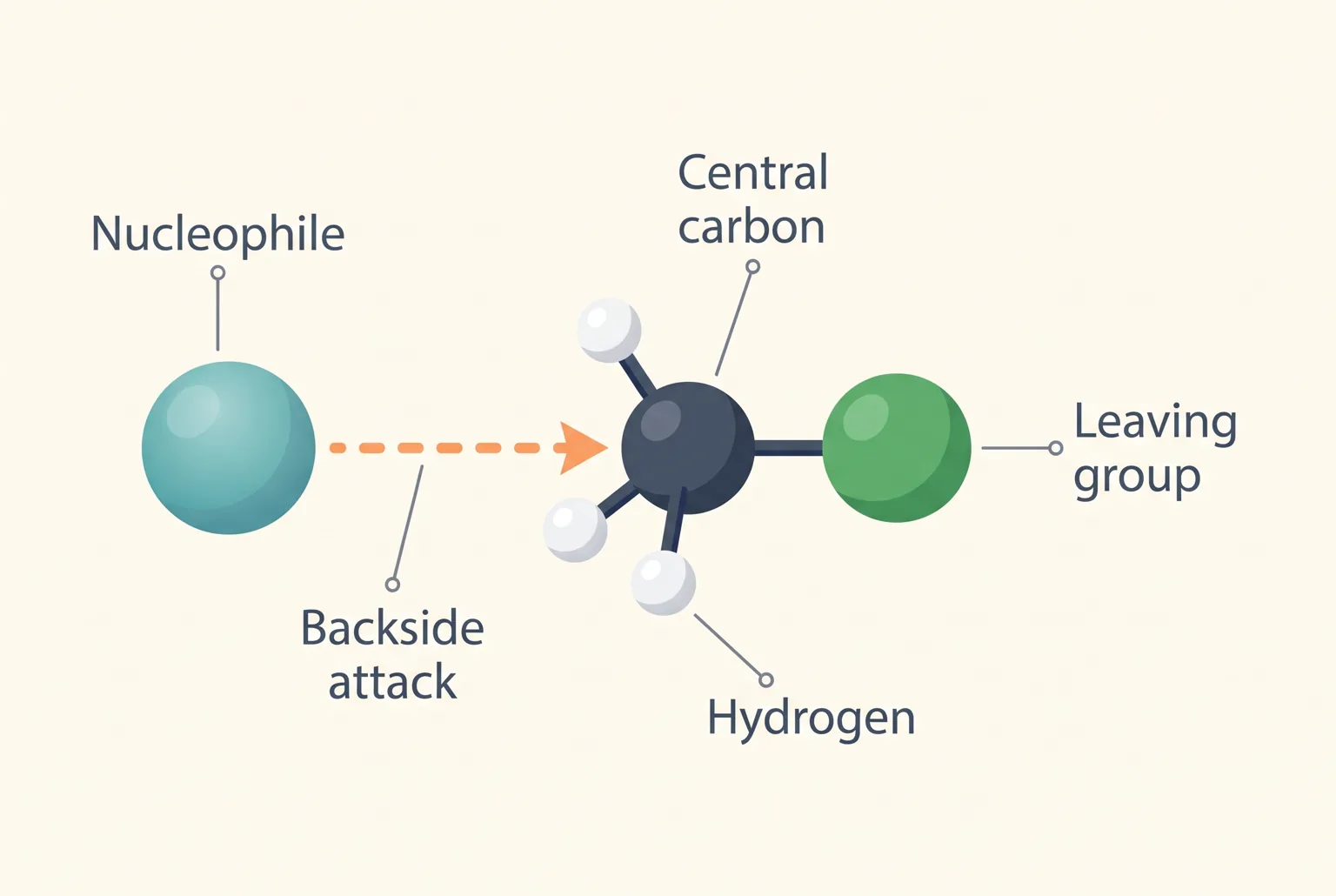
In substitution, the nucleophile approaches the carbon bearing the leaving group from the side opposite the carbon–halogen bond. Under comparable conditions, crowding near that carbon hinders the approach. A primary label is therefore not enough to settle every comparison: two primary halides can differ in how close a branch is to the reacting site. When access is comparable, as in the file’s comparison of methyl halides, leaving-group ability helps explain the rate difference.
For , reason from a different step. The bond ionises in the slow step, and the solutions compare how readily the simple alkyl chlorides in the question can form carbocations of different stability. When reviewing a rate question, ask whether your explanation concerns access for backside attack or ease of carbocation formation. An explanation for one mechanism does not automatically apply to the other.
Check for a β-hydrogen before ranking alkenes
In the sodium ethoxide and ethanol exercise, first mark the α-carbon, which bears the halogen. The adjacent carbons are β-carbons. A double bond can form between the α-carbon and a β-carbon only if that β-carbon has a hydrogen to remove. In particular, an adjacent carbon bonded to four other carbons has no hydrogen and cannot supply one for this elimination.
Once you have identified the eligible positions, check whether any are equivalent before drawing distinct alkenes. Only then apply the preference for the more substituted alkene under the ethoxide conditions used in the exercise. The preference helps rank possible products; it cannot make a product possible at a position that lacks a β-hydrogen.
Read conversion arrows as changes in bonds
The conversion solutions connect reactions that can look unrelated when studied separately. For each arrow, identify whether it changes a functional group, moves the position of a double bond through a sequence, or changes the carbon skeleton. Compare that description with the reagent and conditions in the file. In Finkelstein exchange, for example, sodium iodide in dry acetone replaces chloride or bromide with iodide; precipitation of sodium chloride or sodium bromide helps drive the exchange.
Conditions can also determine where a bond forms. The peroxide effect used for anti-Markovnikov addition in the file applies to HBr, not HI. In substitutions with an ambident nucleophile, the key distinction is instead which atom attacks: the same nucleophile can bond through different atoms, giving products with different connectivity.
A useful connection: track carbon through Grignard and coupling steps
The Grignard questions show why moisture is excluded during reagent preparation. Magnesium inserts into the carbon–halogen bond, but water consumes the resulting Grignard reagent by replacing the magnesium-containing group with hydrogen. Heavy water can supply deuterium instead, so the position of deuterium in a product can help you trace where magnesium was attached. Distinguish unwanted moisture during preparation from water added deliberately in a later step.
The coupling examples call for a different kind of tracing. Follow the two carbon fragments to the new carbon–carbon bond: the file illustrates Wurtz coupling with alkyl fragments and Fittig coupling with aryl fragments. Looking for the new bond makes it easier to see what each route builds, rather than remembering only the reaction name.
Spotted an error? Report a correction. Practise this in the app: notes, formula sheets and mind maps.















































































































































Loading comments…