Haloalkanes and Haloarenes: Class 12 NCERT Notes Guide
CBSEChemistryHaloalkanes and Haloarenes
These NCERT revision notes for CBSE Class 12 Chemistry connect the structure of the carbon–halogen bond to preparation, physical properties and reaction pathways. Use the chapter index to revisit a specific distinction, such as when substitution competes with elimination or why an aryl halide reacts differently from an alkyl halide.
First check: Which carbon carries the halogen?
Start with the atom directly bonded to the halogen, not with the most prominent part of the molecule. In a haloalkane, that carbon is ; in a haloarene, it is an aromatic carbon. The presence of a benzene ring alone does not make a compound a haloarene. A halogen on a saturated carbon next to the ring is benzylic, whereas an aryl halide has the halogen on the ring itself.
The same distinction applies around an alkene: an allylic halide has the halogen on a saturated carbon adjacent to the double bond; a vinylic halide has it directly on a double-bond carbon. For primary, secondary and tertiary alkyl halides, count the carbon groups attached to the carbon carrying the halogen.

Haloalkanes and Haloarenes | Class 12 | NCERT Notes
In the StudentCurio app
These revision notes cover preparation and physical properties of haloalkanes and haloarenes, S_N1 and S_N2 substitution, elimination and metal reactions including Grignard reagent formation, and polyhalogen compounds. They help Class 12 students review key reaction pathways and mechanisms for CBSE Chemistry.
Preparation routes: Read the conditions above the arrow
The preparation pages separate reactions by starting material. Alcohols can give haloalkanes when reagents such as phosphorus halides or thionyl chloride replace the hydroxyl group. Thionyl chloride is useful because its by-products, sulfur dioxide and hydrogen chloride, escape as gases. Alkenes instead undergo addition. The usual Markovnikov orientation for ionic hydrogen halide addition to an unsymmetrical alkene should not be applied unchanged to HBr in the presence of peroxide.
For aromatic starting materials with a benzylic side chain, compare halogenation under Lewis acid conditions with radical chlorination initiated by light. One acts on the aromatic ring; the other can act at the benzylic position. The diazonium route offers a different way to prepare aryl halides: the notes form a common intermediate from aniline at – and then distinguish the replacement steps by the halogen required.
Boiling point, melting point and solubility
Keep the comparison fixed before using the boiling-point chart. For the same alkyl group, boiling points generally rise from the fluoride to the iodide as the larger, more polarisable halogen strengthens dispersion forces. Among comparable isomeric alkyl halides, branching reduces surface contact and generally lowers the boiling point. These trends answer different questions: one changes the halogen, while the other changes the shape of the carbon skeleton.
Melting point depends on how well molecules pack in a crystal, so the boiling-point order does not establish the melting-point order. Nor does a polar bond guarantee water solubility. Haloalkanes are only slightly soluble in water because their attractions with water generally do not compensate for disrupting water’s hydrogen bonds and separating the haloalkane molecules.
Mechanism check: What determines the substitution rate?
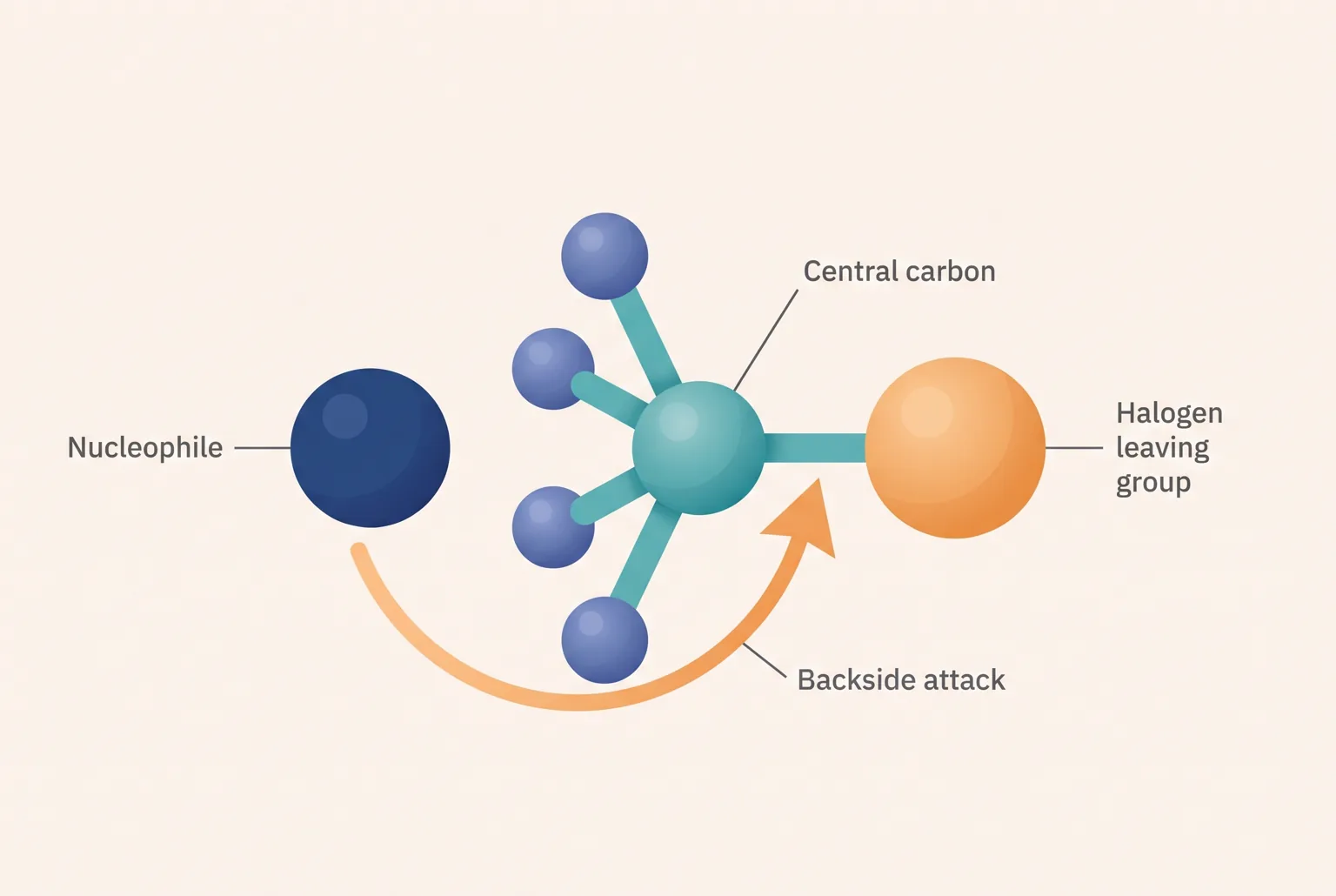
In , the nucleophile attacks from behind the leaving group. Bond formation and bond breaking occur in a single step, and the rate depends on both the substrate and nucleophile concentrations. Crowding at the reacting carbon hinders this approach. If that carbon is stereogenic, backside attack inverts its configuration.
In , slow ionisation produces a planar carbocation before the nucleophile attacks. The rate depends on the substrate concentration, and attack can occur from either face. This can lead to racemisation, but it need not give an exact equal mixture: the departing group can partly shield one face. Use the energy profiles to distinguish a transition state in the concerted mechanism from a carbocation intermediate between two barriers.
Substitution or elimination? Look beyond the reagent name
Aqueous potassium hydroxide favours substitution in many textbook cases, whereas hot alcoholic potassium hydroxide favours elimination. To follow the elimination diagram, locate the carbon bearing the halogen and then check its neighbours for a beta hydrogen. The new double bond joins the carbon that loses hydrogen to the carbon that loses halogen. If more than one alkene can form, Zaitsev’s rule usually favours the more substituted one; it does not imply that only one product forms.
For substitution, also check which atom of the nucleophile forms the new bond. Potassium cyanide mainly gives a nitrile through carbon attack, whereas silver cyanide favours an isocyanide through nitrogen attack. The distinction matters when a later conversion depends on where the new carbon is attached.
Haloarenes: Ring deactivation and direction are different
The aryl carbon–halogen bond has partial double-bond character, and the aryl carbon has greater character than a typical alkyl carbon. The bond is therefore shorter and stronger than a typical alkyl carbon–halogen bond. Ordinary alkyl substitution models do not transfer directly: formation of a phenyl cation is unfavourable, and the usual backside approach is obstructed. In activated aryl halides, a nitro group at an ortho or para position can stabilise the anionic addition intermediate by resonance; a meta nitro group cannot provide the same stabilisation.
In electrophilic substitution, halogen withdraws electron density inductively and deactivates the ring. Its lone-pair donation nevertheless stabilises the ortho and para intermediates relative to the meta intermediate. Deactivation describes reactivity; direction describes which positions are favoured.
Use the conversion maps to track carbon and work-up
Read each arrow in the conversion maps as a separate transformation. In a nitrile route, track the carbon introduced by cyanide into subsequent products. In a Grignard route, distinguish reagent formation in dry ether from the later acidic work-up. Water would destroy the organomagnesium reagent before addition; after addition, acidic work-up protonates the alkoxide or carboxylate intermediate.
The final page shifts from reaction routes to the uses and hazards of polyhalogen compounds. Read those entries as compound-specific explanations: Freon-12 is linked to ozone depletion through chlorine radicals released in the stratosphere, while DDT is noted for persistence and accumulation in food chains.
Spotted an error? Report a correction. Practise this in the app: notes, formula sheets and mind maps.















































































































































Loading comments…