Haloalkanes and Haloarenes: CBSE Class 12 Case Practice
CBSEChemistryHaloalkanes and Haloarenes
This CBSE Class 12 Chemistry assessment puts substitution, elimination, stereochemistry and haloarene reactions into case passages and reaction sequences. Use the linked solutions to check how each conclusion follows from the substrate, reagent and conditions.
How the assessment is organised
The file contains 13 case studies, 51 numbered questions and 11 OR alternatives. It includes multiple-choice, short-answer, and assertion-and-reason questions. The clickable index gives separate entry points for questions and worked solutions. Questions appear first, and each question or OR alternative has a link to its solution and a return link. The file is a case-based assessment, not a separate set of chapter-practice exercises.
The cases range from individual reactions to linked sequences. In a single-reaction question, you might need to explain what a reagent does under the stated conditions. In a sequence, the structure carried forward from one step becomes the starting point for the next. The index lets you choose between practising one concept, such as stereochemistry, and testing how several concepts work together.

Haloalkanes and Haloarenes | Class 12 Chemistry| CBSE Case-based Assessment
In the StudentCurio app
Case-based questions with worked solutions covering S_N1 and S_N2 mechanisms, substitution stereochemistry, and reactions of haloarenes. Helps Class 12 students practise and review CBSE Chemistry concepts.
What the carbon–halogen bond tells you
Start by locating the carbon bonded directly to the halogen. In a haloalkane, it is a saturated carbon; in a haloarene, the halogen is attached directly to an aromatic ring carbon. A halogen on a side chain next to a ring is therefore not the same as a halogen on the ring. This distinction matters before you try to apply any substitution rule.
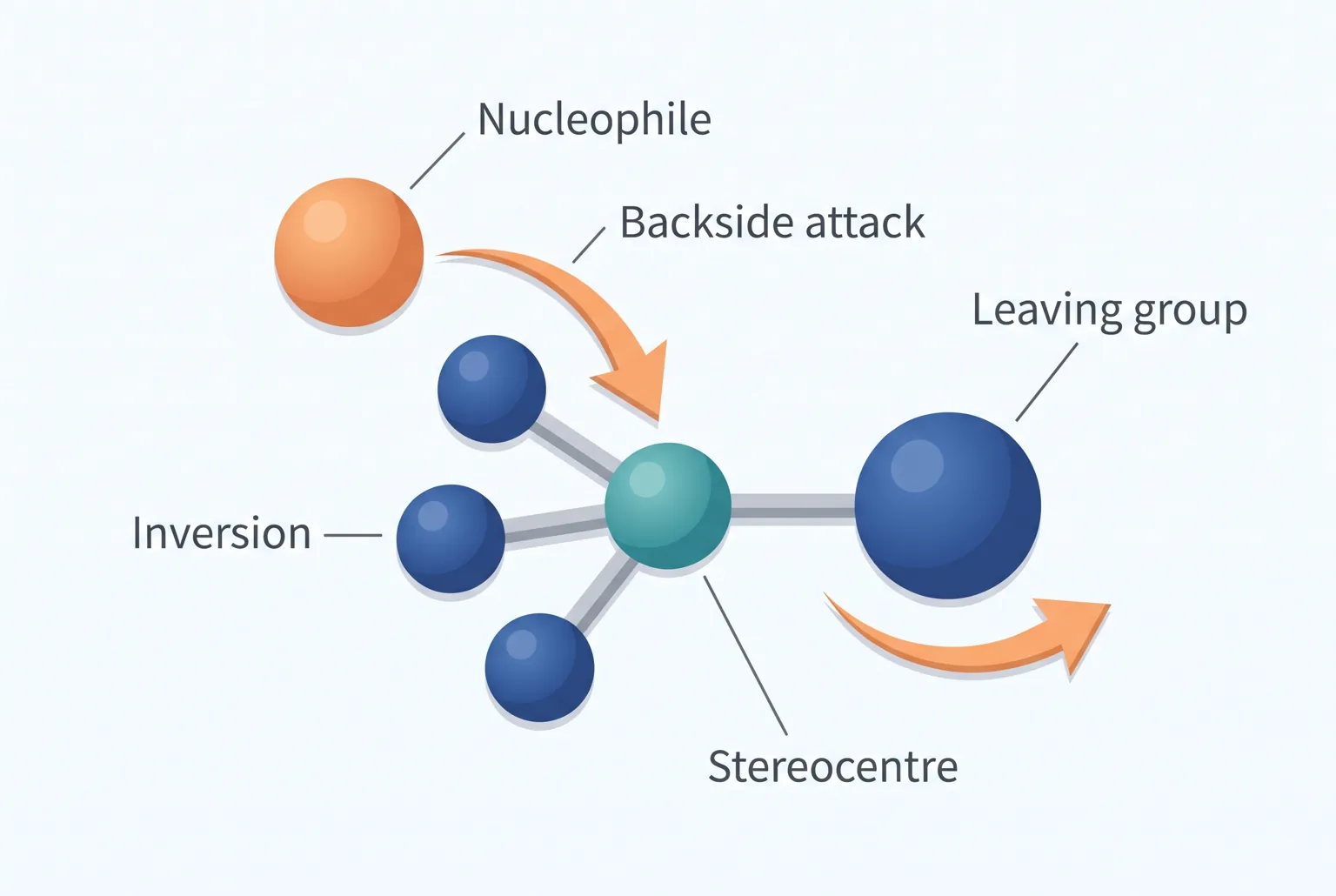
The early cases contrast homolytic cleavage, in which each fragment receives one bonding electron, with heterolytic cleavage, in which one fragment receives both. In nucleophilic substitution of a haloalkane, the nucleophile donates an electron pair to the partially positive carbon, and the halogen leaves with the carbon–halogen bonding pair. The reagent table helps separate the role of the attacking species from that of the leaving group. A nucleophile need not carry a negative charge: water, for example, can donate a lone pair.
Good to remember: primary does not always mean unhindered
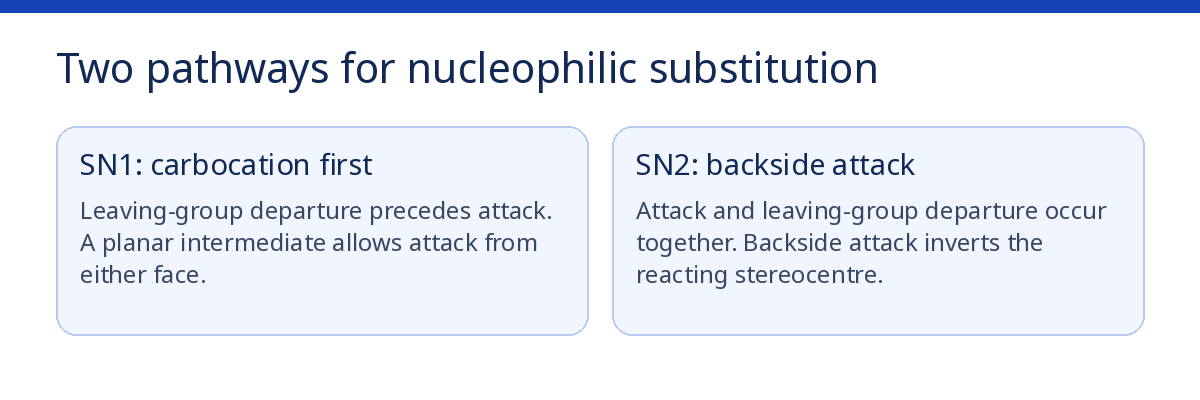
The mechanism cases ask you to distinguish carbocation stability from accessibility at the reacting carbon. In , departure of the leaving group forms a carbocation before nucleophilic attack. The rate-determining step involves the substrate, and factors that stabilise the developing ions can favour this pathway. In , the nucleophile attacks as the leaving group departs in a single step; both the substrate and nucleophile enter the rate law.
Primary substrates generally offer better access for backside attack than more substituted ones, but the label describes only the carbon carrying the halogen. Branching on the adjacent carbon can also obstruct the approach. The assessment uses neopentyl chloride to highlight this point. In comparisons, inspect the surrounding structure as well as the reacting carbon, then consider the solvent, nucleophile and leaving group rather than treating a substrate trend as universal.
Common mistake: confusing inversion with optical rotation
Backside attack in gives inversion of configuration at the reacting stereocentre. That describes a change in the spatial arrangement as substitution takes place. It does not tell you whether the product rotates plane-polarised light clockwise or anticlockwise. The sign of optical rotation is a measured property, not another way of naming the geometry at a stereocentre.
The comparison rests on a different feature: a planar carbocation can be attacked from either face. Where those approaches produce enantiomers, both can form, but access to the two faces need not be equally favourable. Do not assume an exact 50:50 mixture from planarity alone. The stereochemistry case is useful for practising how to justify a conclusion about configuration separately from any conclusion about optical activity.
When elimination competes with substitution
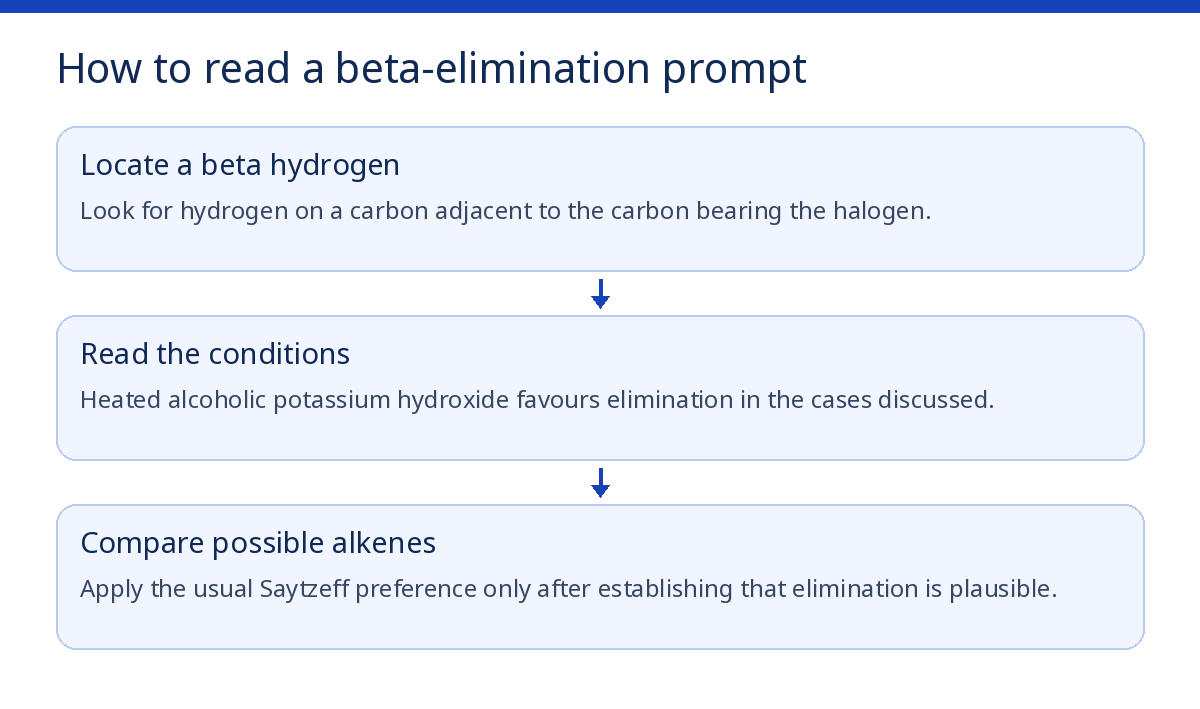
In substitution, an incoming group replaces the leaving group. In dehydrohalogenation, a base removes a hydrogen from a carbon adjacent to the one bearing the halogen, and a double bond forms between those carbons. For the beta-elimination pathway discussed in the assessment, that adjacent carbon must have a beta hydrogen. Locate it before trying to predict an alkene.
The cases contrast aqueous hydroxide, used in hydrolysis examples, with heated alcoholic potassium hydroxide, used in elimination examples. Read these as condition-dependent tendencies: a species that can act as both a nucleophile and a base may participate in competing pathways. Use Saytzeff’s rule to compare possible alkenes once elimination is established. The usual preference for the more substituted alkene does not establish that elimination occurs in the first place.
Why haloarene substitution needs a separate explanation
An aryl halide is generally less reactive than a haloalkane toward ordinary nucleophilic substitution. Resonance gives the aryl carbon–halogen bond partial double-bond character, and the halogen is bonded to an ring carbon. The phenyl cation that direct ionisation would require is also unstable, so the usual alkyl explanation does not transfer to a haloarene.
Lower reactivity does not mean no reaction. A nitro group ortho or para to the leaving group can activate an aryl halide toward nucleophilic aromatic substitution. When reading the cases on activated hydrolysis, mark that relative position rather than noting only whether a nitro group is present. In the longer haloarene sequences, also distinguish substitution at the carbon bearing the halogen from aromatic reactions such as nitration, which introduce a group at another position on the ring.
Check the first step where your reasoning changes
For a linked reaction case, annotate each arrow with the reagent, the stated conditions and the type of change you expect. Track the carbon skeleton as well as the functional group: coupling, elimination and substitution do not change a structure in the same way. For assertion-and-reason items, judge each statement separately before deciding whether the reason explains the assertion. Two true statements do not automatically form a valid explanation.
After attempting a case, open its solution and compare the reasoning at the first step where your approach differs. Use the return link to revisit the original wording or scheme, especially if the solution includes a clarification. This guide omits Case Study 1, Question 2 because the linked solution identifies an error in the printed reaction scheme.
Spotted an error? Report a correction. Practise this in the app: notes, formula sheets and mind maps.















































































































































Loading comments…