Electrochemistry: CBSE Class 12 PYQs, Key Ideas and Solutions
CBSEChemistryElectrochemistry
This guide to CBSE Class 12 Electrochemistry previous year questions explains the ideas the board papers keep testing: electrode potentials, Gibbs energy and the Nernst equation, Faraday's laws and electrolysis products, and conductivity with Kohlrausch's law. It also shows how the 170-question solved collection, labelled 2022 to 2026, is organised for topic-wise practice.
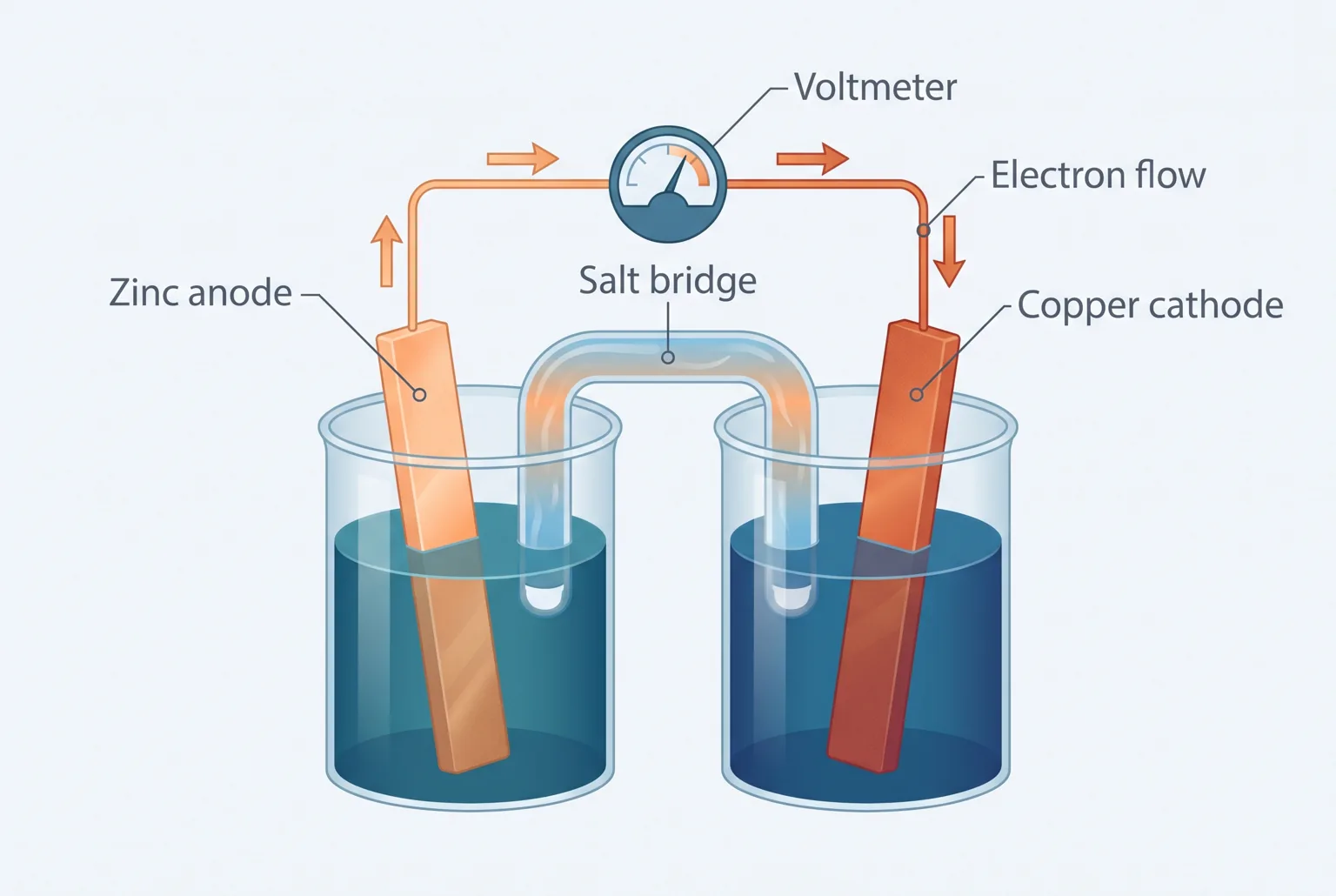
Eight Electrochemistry sub-topics the board papers test
The collection's topic finder sorts Chapter 2 questions into eight groups:
- electrochemical cells and electrode potentials
- cell thermodynamics and equilibrium
- the Nernst equation and cell emf
- electrolysis and Faraday's laws
- conductance, conductivity and molar conductivity
- Kohlrausch's law and weak electrolytes
- batteries and fuel cells
- corrosion
Many questions sit in more than one group. A single item can link a cell's emf to its Gibbs energy or to electrolysis products.
Conductivity is the longest list in the index. Nernst-equation and electrolysis questions are also heavily represented, while corrosion has only a handful.
Electrochemistry is Chapter 2 in the current CBSE sequence. Older NCERT editions number it Chapter 3.

Electrochemistry | Class 12 | Previous Year Paper
In the StudentCurio app
A comprehensive 149-page collection of solved previous year questions for CBSE Class 12 Chemistry, covering the entire Electrochemistry chapter including the Nernst equation, molar conductivity, and Faraday's laws of electrolysis.
Reading electrode potentials: polarity, reducing power and spontaneity
Standard electrode potentials here are reduction potentials measured against the hydrogen electrode, for which V.
- The couple with the more positive value is reduced at the cathode.
- The more negative couple is oxidised at the anode.
- , which is positive for a spontaneous cell.
The same values answer reducing power questions. The more negative the reduction potential, the more readily a species gives up electrons.
Some questions hide spontaneity in everyday wording. They may ask whether a metal releases hydrogen from dilute acid, or why a salt solution should not be stored in a particular metal vessel. Write both half-reactions and decide which direction the potentials favour before choosing an option.
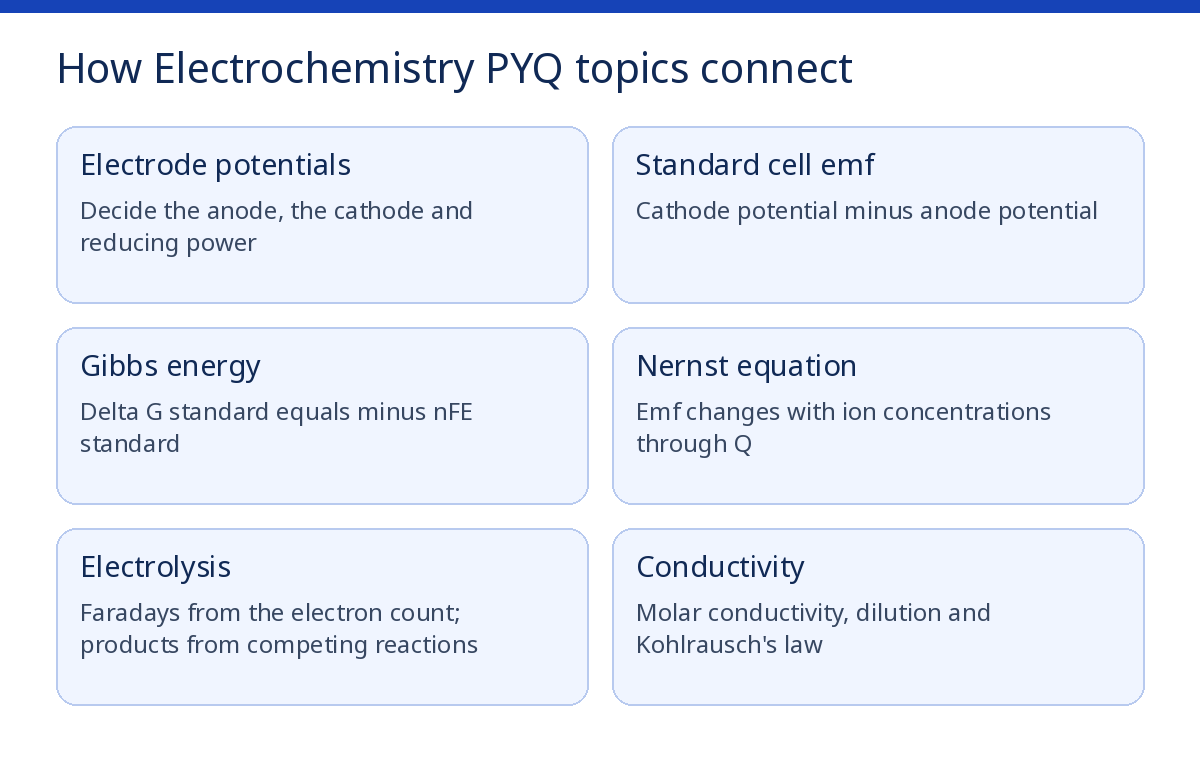
Linking cell emf, Gibbs energy and the Nernst equation
Thermodynamics questions use , with C mol supplied in the papers. A positive gives a negative , meaning the reaction is spontaneous.
- Find from the balanced cell reaction.
- Keep in volts.
- Convert J mol to kJ mol at the end.
Non-standard concentrations need the Nernst equation. At 298 K, . In , product-ion concentrations go in the numerator and reactant-ion concentrations in the denominator. Pure solids are omitted.
Recurring MCQs ask how voltage changes as a reaction proceeds, or how changing one ion's concentration raises the emf. Reason from the direction in which moves rather than memorising outcomes.
Counting Faradays and predicting electrolysis products
Faraday's-law MCQs repeatedly ask for the charge needed to reduce or oxidise one mole of a species. Examples include permanganate, dichromate, water and iron(II) oxide. The method is the same each time:
- Assign oxidation states before and after the change.
- Multiply the change by the number of atoms that change per formula unit.
- The result is the number of moles of electrons, which equals the number of Faradays.
When a current flows for a time, charge follows from .
Aqueous electrolysis is a competition at each electrode. At the cathode, the metal ion competes with the reduction of water. At the anode, the anion competes with the oxidation of water.
Papers test this with aqueous NaCl, aqueous CuCl₂ and dilute H₂SO₄ on platinum electrodes.
Conductivity, molar conductivity and Kohlrausch's law
Conductance questions start from the cell constant , so that .
With in S cm and in mol L, molar conductivity is in S cm mol.
Dilution trends appear as MCQs and as assertion–reason items. Two definitions settle them:
- Conductivity depends on the number of current-carrying ions per unit volume.
- Molar conductivity refers to the volume containing one mole of electrolyte.
Apply these separately to strong and weak electrolytes.
For strong electrolytes, Kohlrausch's relation is . The law of independent migration gives . The ion counts matter for salts such as CaCl₂ or Al₂(SO₄)₃.
For weak electrolytes, the degree of dissociation is .
How MCQ, assertion–reason and case-based items are framed
The question-type finder lists five formats: single-answer MCQs, assertion–reason, case-based, subjective, and one multiple-correct MCQ.
Assertion–reason items use the standard four options. The deciding judgement is often whether a true reason actually explains the assertion. One item pairs using an AC source to measure a solution's resistance with a reason about concentration changes under DC.
Several MCQs recur with small wording changes across sets. For example, two ask when a galvanic cell starts behaving like an electrolytic cell.
Battery questions test recall. They match the dry cell, mercury cell, lead storage cell and fuel cell with uses such as an inverter, a wrist watch, a wall clock or the Apollo space programme. Others ask you to identify a secondary cell. Conductivity-cell electrodes also appear as short factual items.
Common slips and a practice order for the 170 questions
Common mistakes
- Scaling when a half-reaction is multiplied. Electrode potential is intensive.
- Dropping the minus sign in .
- Counting electrons for one atom when two change, as with the two chromium atoms in dichromate.
- Leaving out ion counts in a Kohlrausch sum.
Practice order. The serial order is Q1–Q70 single-answer MCQs, Q71–Q169 subjective questions and Q170 multiple-correct MCQ. Use the topic finder to work through:
- Electrode-potential and Faraday MCQs
- Gibbs energy and Nernst items
- Conductivity and emf numericals
Offline "View Solution" links open worked solutions labelled "Added solution", because the supplied material had only answer keys and online links. Apparent source errors are kept in the questions and explained in the solutions.
Quick self-check
- Why are pure solids left out of ?
- Why must each be multiplied by its ion count?
Frequently asked questions
Which years do the Electrochemistry PYQs in this collection come from?
The supplied material carries exam-year labels for 2022, 2023, 2024, 2025 and 2026. Delhi, Outside Delhi and compartment sets are identified wherever those labels are printed.
Are the worked solutions from CBSE?
No. The supplied material had answer-key entries and online links but no complete written solutions. The full solutions were added for this edition and are labelled "Added solution".
Why is Electrochemistry called Chapter 2 here?
Chapter 2 follows the current CBSE Class 12 Chemistry sequence. Older NCERT editions may number Electrochemistry as Chapter 3.
Spotted an error? Report a correction. Practise this in the app: notes, formula sheets and mind maps.















































































































































Loading comments…