Electrochemistry: CBSE Class 12 NCERT Textbook Guide
CBSEChemistryElectrochemistry
The Class 12 NCERT Electrochemistry chapter connects the movement of electrons in a redox reaction to measurable cell voltage. For CBSE Chemistry, use the Daniell cell diagrams, standard potential table and intext questions to learn how cell voltage depends on the reaction and its conditions.
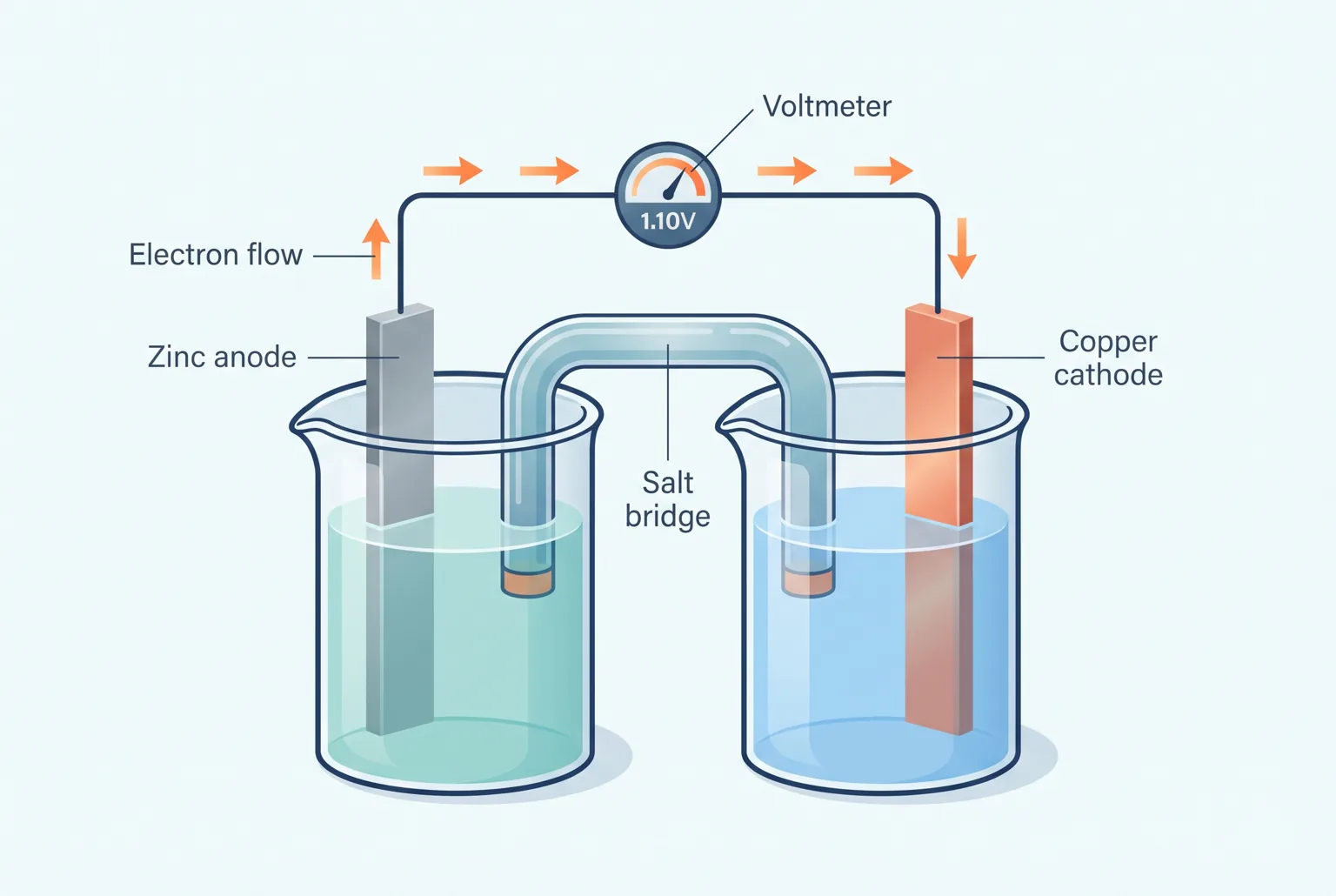
Follow the electrons in the Daniell cell
A galvanic cell converts energy released by a spontaneous redox reaction into electrical energy. In the Daniell cell, zinc is oxidised at the anode: zinc atoms enter the solution as ions and release electrons. At the cathode, copper ions gain electrons and deposit as copper metal. Electrons travel from zinc to copper through the external wire; conventional current flows in the opposite direction. The salt bridge provides a separate path for ions between the solutions. Trace both paths in Figure 2.1 rather than treating the bridge as part of the electron route.
An electrolytic cell uses electrical energy to drive a nonspontaneous reaction. Figure 2.2 shows how the Daniell setup can demonstrate both modes. As the applied opposing voltage reaches the cell emf under the stated conditions, current stops. A greater opposing voltage drives the reaction in reverse: zinc deposits and copper dissolves. The electrode roles switch, but the definitions do not: oxidation still occurs at the anode and reduction at the cathode.

Electrochemistry | Class 12 | NCERT Textbook
In the StudentCurio app
This textbook chapter covers electrochemical cells, electrode potentials and the Nernst equation, the relationship between EMF and Gibbs energy, conductivity, electrolysis, batteries, fuel cells and corrosion. It helps Class 12 Chemistry students understand electrochemical principles and practise related calculations.
Read cell notation and the potential table together
NCERT writes the anode on the left and the cathode on the right in its galvanic cell notation. A single vertical line marks a boundary between phases, such as a metal and its solution. A double line between the solutions represents the salt bridge. Reading the notation alongside the diagram helps you identify which species belong to each half-cell before you write the half-reactions.
A voltmeter measures a difference between electrode potentials, not the potential of an isolated half-cell. The standard hydrogen electrode supplies the zero reference. Table 2.1 lists standard reduction potentials at 298 K, with each half-reaction written as a reduction. When comparing two entries under standard conditions, the more positive value indicates the greater tendency for the written reduction. Calculate the standard cell emf by subtracting the anode's tabulated reduction potential from the cathode's: . The emf is the cell voltage when no current is drawn.
When the Nernst equation needs a concentration term
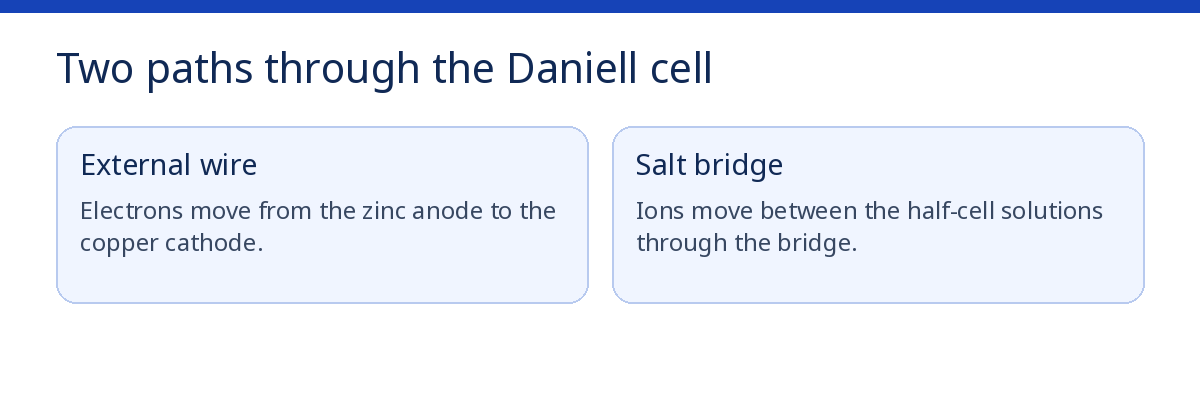
The table provides standard values; it does not tell you the cell voltage for every mixture. For the balanced reaction as written, the Nernst equation gives . Here is the temperature in kelvin, is the Faraday constant, is the gas constant and is the number of electrons transferred in the balanced reaction. Use the shortened base-ten form with the coefficient of approximately only at 298 K, and keep the divisor .
Build the reaction quotient from products over reactants, using the balanced coefficients as exponents. Pure solids have unit activity, so the zinc and copper metals do not appear in the Daniell cell quotient. NCERT uses concentrations for the dissolved ions in its treatment; strictly, the quotient uses activities. At fixed temperature, increasing the copper ion concentration while holding the zinc ion concentration fixed lowers the quotient and raises the cell potential for the reaction as written.
Separate equilibrium voltage from standard voltage
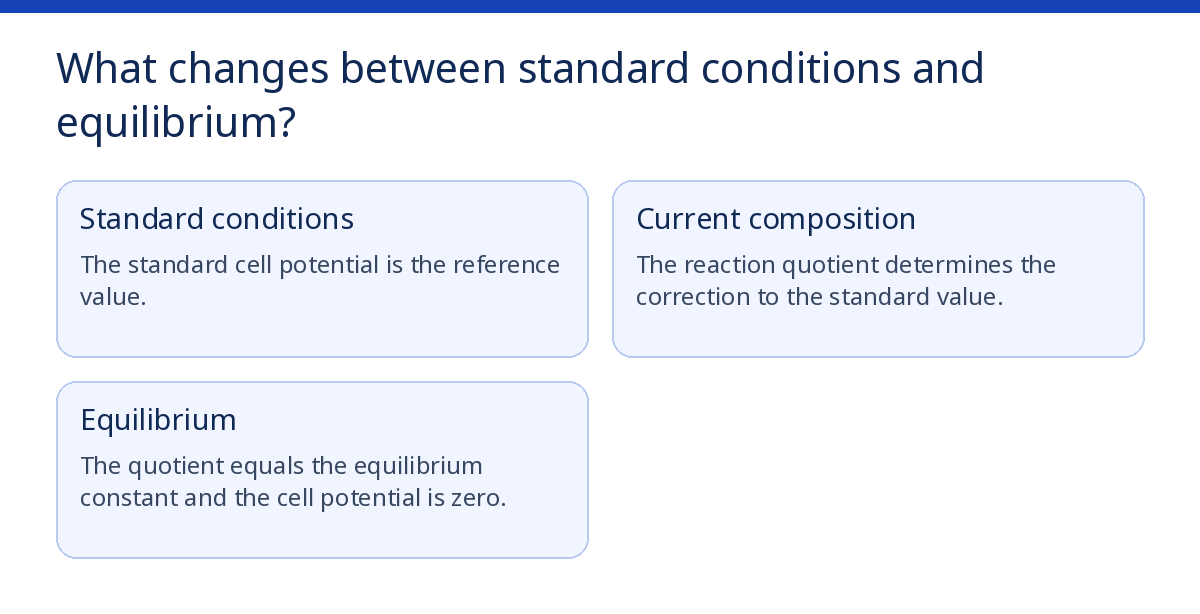
At equilibrium, and . It is the cell potential at the equilibrium composition that vanishes, not necessarily the standard cell potential. Substituting those equilibrium conditions into the Nernst equation gives . That is why a standard cell potential can tell you about where a reaction's equilibrium lies.
The Gibbs energy relation answers a different question: which direction is spontaneous at the current composition? For the reaction as written, , so a positive cell potential corresponds to a negative reaction Gibbs energy. Under standard conditions, use . The numerical result in Example 2.3 is omitted here because its printed joule and kilojoule lines disagree; the chapter states the general relations separately.
Two sign and scaling checks before you calculate
- Use the table's sign in the subtraction. The anode reaction is oxidation, but the value you take from the table is still a reduction potential. If that entry is negative, subtract the negative value rather than reversing its sign first.
- Balance electrons without multiplying voltages. Scaling the entire reaction changes the amount of charge transferred and scales the Gibbs energy change by the same factor. The potential is intensive and stays the same. If you rescale a reaction in a Nernst calculation, the exponents in its quotient and the electron count must both match the new equation.
Use the intext questions and chapter objectives as a map
The intext questions let you practise distinct skills: setting up a comparison with a reference electrode, interpreting the standard potential table and finding an emf when concentrations are supplied. Before calculating, write down whether you need a single electrode potential relative to the reference or the difference between two electrode potentials. Then decide whether the problem calls for a standard value or a value at the given composition.
The opening objectives map the later topics. They distinguish resistivity, conductivity, molar conductivity and limiting molar conductivity, the last referring to infinite dilution. Read the discussion of concentration changes with those quantities labelled separately rather than assuming conductivity and molar conductivity vary alike. The objectives also identify Kohlrausch's law, quantitative electrolysis, primary and secondary batteries, fuel cells and corrosion as later applications of the chapter's ideas.
Spotted an error? Report a correction. Practise this in the app: notes, formula sheets and mind maps.















































































































































Loading comments…