Electrochemistry NCERT Solutions for Class 12 Chemistry
CBSEChemistryElectrochemistry
This CBSE Class 12 Chemistry solutions file brings together worked NCERT in-text and exercise questions on electrochemical cells, conductivity, electrolysis and their applications. Use it to trace how a balanced reaction, a set of conditions or a unit conversion determines the next step in a calculation.
Find the right question in the solutions file
The question index separates 15 in-text questions from 18 exercise questions. Each entry gives a topic label and a page number, and selecting it takes you to the solution. The two lists reuse question numbers, so check the section as well as the number. The file labels Electrochemistry as Chapter 2 and notes that another edition labels it Chapter 3. If your textbook numbering differs, match the topic label and opening wording rather than relying on the number alone.
The index also helps you connect related problems. For example, the in-text question on conductivity during dilution pairs naturally with the exercise comparing conductivity and molar conductivity. Reading them together shows why those two quantities can change in opposite directions.

Electrochemistry | Class 12 | NCERT Solutions
In the StudentCurio app
Worked NCERT in-text and exercise solutions cover cell potentials, EMF, Gibbs energy, the Nernst equation, conductivity and Kohlrausch’s law, electrolysis, batteries, fuel cells and corrosion. Useful for Class 12 Chemistry students reviewing concepts and practising electrochemistry problems.
Read the cell before calculating its voltage
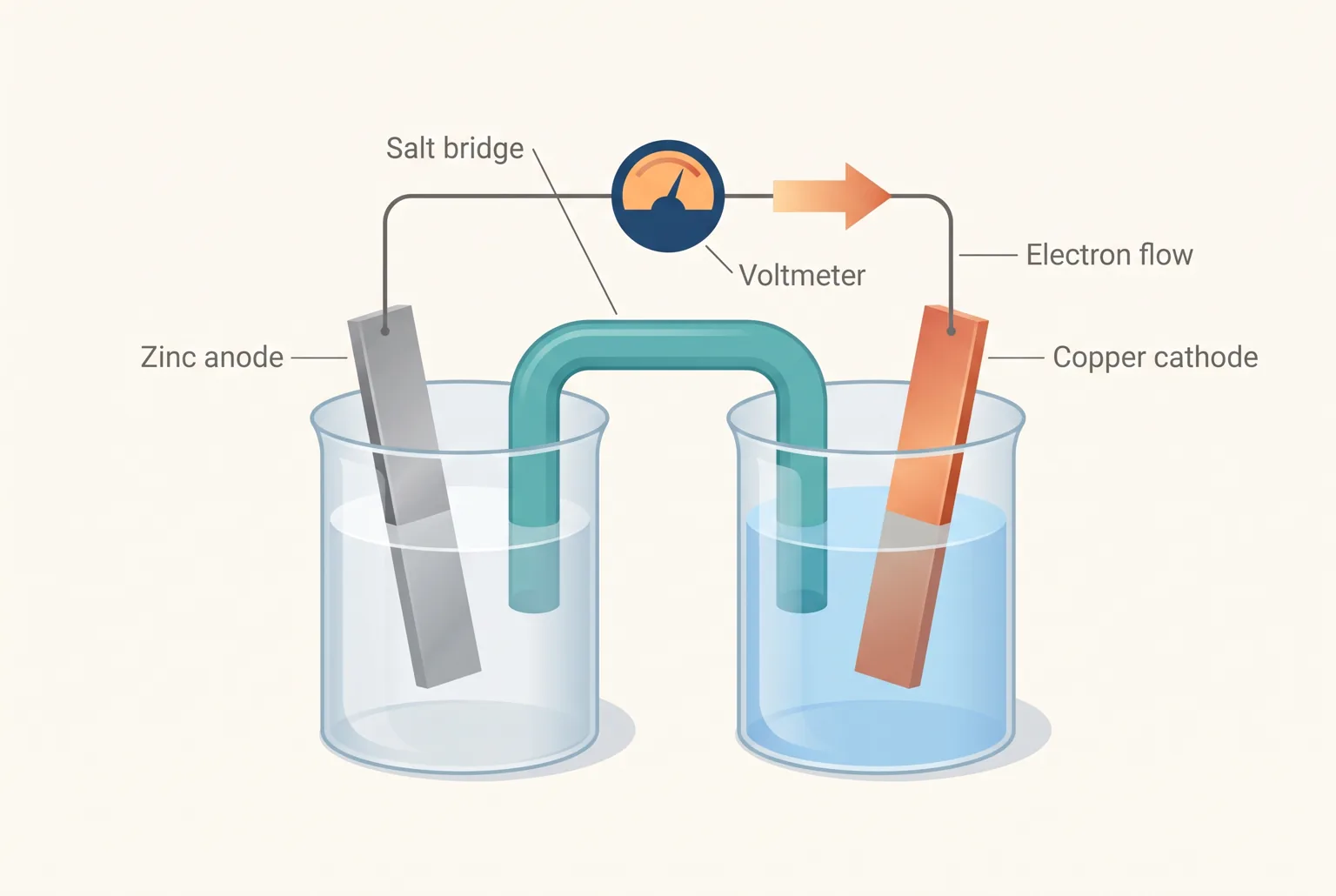
The Daniell cell diagram and the zinc–silver galvanic-cell exercise connect electrode reactions with charge movement. Oxidation takes place at the anode and reduction at the cathode. In a galvanic cell delivering current, electrons travel through the external wire from the negative anode to the positive cathode. Ions carry charge through the solutions and the salt bridge. Keeping those paths separate helps you explain how the circuit is completed without suggesting that electrons pass through the bridge.
The magnesium question introduces the standard hydrogen electrode as a zero-potential reference. When both tabulated values are written as reduction potentials, subtract the anode value from the cathode value: . Balance the half-reactions to find the electron count, but do not multiply either electrode potential by its balancing coefficient. Voltage is not an amount of charge.
When the Nernst equation needs a correction to standard EMF
The hydrogen-electrode and nickel–silver questions show how the Nernst equation adjusts standard potential for the stated conditions. Write the balanced reaction in the direction being tested before constructing the reaction quotient . The stoichiometric coefficients become exponents in , and counts the electrons transferred in that same balanced reaction. Pure solids and liquids have unit activity; for the dilute solutions in these calculations, concentrations relative to the standard concentration approximate the dissolved species’ activities. The coefficient of approximately in the base-ten form applies at .
The Gibbs energy and equilibrium questions make a related distinction: standard cell potential belongs with standard Gibbs energy change, through , and with the equilibrium constant through . To judge the written reaction under specified nonstandard conditions, use the sign of the cell potential at those conditions. A negative value favours the reverse direction.
Common mix-up: conductivity and molar conductivity
At fixed temperature, conductivity generally falls on dilution because there are fewer mobile ions per unit volume. Molar conductivity divides conductivity by the amount concentration of electrolyte, so it can rise at the same time. In a strong electrolyte, weaker interactions allow ions to move more freely on dilution. In a weak electrolyte, dilution also increases the fraction that dissociates. A greater fraction dissociating does not mean a greater number of ions per unit volume.
The KCl and cell-constant exercises show why the length units must agree. If conductivity is in siemens per metre, use concentration in moles per cubic metre to obtain molar conductivity in siemens square metres per mole. If conductivity is in siemens per centimetre and concentration is given in moles per litre, convert the concentration to moles per cubic centimetre before dividing.
Two routes to limiting molar conductivity
The sodium chloride exercise estimates limiting molar conductivity by plotting molar conductivity against the square root of concentration. The limiting value is the intercept at zero concentration, not the value of the most dilute measured point. The worked method uses the approximately linear dilute region for extrapolation because the more concentrated points deviate from that line.
The in-text question on water uses a different route. Kohlrausch’s law treats ionic contributions as independent at infinite dilution. Combining limiting values measured at the same temperature lets unwanted ionic contributions cancel. The weak-acid questions then use the ratio of measured to limiting molar conductivity to estimate the fraction dissociated before relating that fraction to the acid dissociation constant.
Use half-reactions to connect electrolysis and applications
For electrolysis, distinguish the charge supplied from the amount of substance changed. With a steady current, current multiplied by time in seconds gives charge in coulombs. Dividing that charge by the Faraday constant gives the amount of electrons in moles. The balanced electrode half-reaction then relates those electrons to the amount of product. The nickel deposition calculation assumes all the current goes towards depositing nickel; the calculated mass depends on that assumption.
The application questions keep the same focus on electron transfer. Recharging a lead storage battery requires an external source to drive the discharge reaction in reverse, but the definitions of anode and cathode do not change. In rusting, oxidation and reduction occur at different spots on the iron, with electrons moving through the metal and ions through the water film. For a quick self-check, compare these cases and ask which electrode labels can be assigned from the reaction alone, before considering polarity.
Spotted an error? Report a correction. Practise this in the app: notes, formula sheets and mind maps.















































































































































Loading comments…