CBSE Class 12 Electrochemistry: NCERT Revision Notes
CBSEChemistryElectrochemistry
These NCERT notes for CBSE Class 12 Chemistry connect redox reactions and cell potentials to conductivity, electrolysis, batteries, fuel cells and corrosion. Use the chapter index to revisit a specific topic or follow the printed pages in order to see how the ideas build on one another.
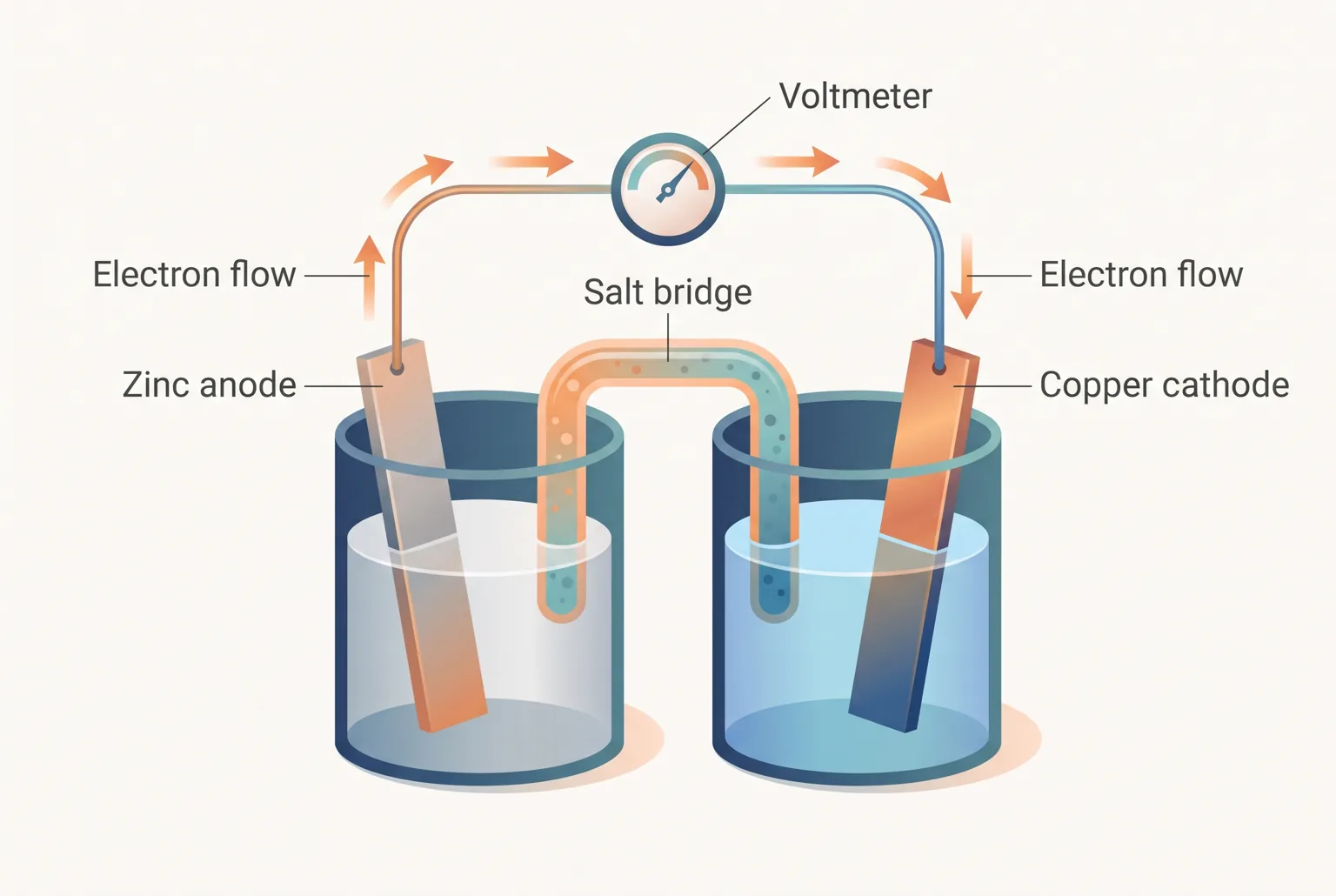
Follow the electrons and ions in a galvanic cell
The notes begin with the difference between a direct redox reaction and one whose half-reactions are separated. In a galvanic cell, a spontaneous reaction drives electrons through an external circuit. An electrolytic cell does the reverse kind of energy conversion: it uses electrical energy to drive a chemical reaction.
Use the Daniell cell diagram to follow two paths. Electrons travel from anode to cathode in the external circuit, while ions move through the salt bridge to maintain electrical neutrality and complete the circuit. The bridge does not carry electrons between the electrodes. When you move from the diagram to cell notation, a single bar marks a phase boundary and a double bar represents the salt bridge.
Good to remember: Oxidation defines the anode and reduction defines the cathode in both cell types. The signs are not part of those definitions: the anode is negative during galvanic discharge but positive in an electrolytic cell.

Electrochemistry | Class 12 | NCERT Notes
In the StudentCurio app
These revision notes cover electrochemical cells, cell notation, electrode potentials and EMF, alongside conductivity, the Nernst equation, electrolysis, batteries, fuel cells and corrosion. They help Class 12 students review core electrochemistry concepts and applications.
Read electrode potentials before calculating emf
An individual electrode potential is measured relative to a reference. The standard hydrogen electrode is assigned a standard potential of zero by convention, giving tabulated values a common reference. Standard conditions refer to unit activity for dissolved species, a gas pressure of 1 bar, and pure solids or liquids where applicable. The temperature must be specified; 298 K is commonly used.
The electrochemical series lists reduction potentials. To obtain the cell emf, subtract the anode reduction potential from the cathode reduction potential. Emf is measured in volts when no current is drawn. If you reverse a half-reaction and write it as an oxidation, its potential changes sign. If you multiply a half-reaction to balance electrons, its potential does not get multiplied. Check which convention you are using before combining the two values.
When the 298 K Nernst shortcut applies
The Nernst equation links the cell potential under the stated conditions to the standard cell potential and the reaction quotient. Build the quotient from the balanced reaction as written, using stoichiometric coefficients as powers. Pure solids and liquids have unit activity, so they contribute no concentration terms. For dilute solutions, dissolved activities can be approximated by concentrations relative to 1 M.
The base-ten logarithm form with the coefficient V applies at 298 K. At another temperature, keep the temperature-dependent factor from the general equation. The electron-transfer number must also match the balanced reaction used to write the quotient.
The Gibbs energy relation explains what the sign means: a positive cell potential corresponds to a negative Gibbs energy change for the reaction as written under those conditions. At equilibrium the cell potential is zero, and the reaction quotient equals the equilibrium constant. The zero applies to the actual cell potential, not necessarily to the standard value.
Separate conductivity from molar conductivity
The conductivity page moves from circuit measurements to solution properties. Conductance is the reciprocal of resistance for the measured arrangement. Multiplying conductance by the calibrated cell constant gives conductivity. The notes show why an alternating-current source is used: direct current can change the solution composition at the electrodes. When calculating molar conductivity, match the concentration units to the conductivity units before using either expression in the notes.
A useful dilution check: Conductivity generally falls on dilution because there are fewer ions per unit volume, while molar conductivity rises as interionic interactions weaken and, for weak electrolytes, dissociation increases. For a strong electrolyte in the dilute range, the notes extrapolate an approximately linear plot against the square root of concentration. For a weak electrolyte, they use Kohlrausch’s law instead: at infinite dilution, each ion contributes independently, with its contribution counted according to the number of those ions per formula unit.
Treat electrolysis products and quantities separately
First ask what can react at each electrode. The comparison between molten sodium chloride and concentrated aqueous brine shows why the physical medium matters: water can compete in an aqueous solution but is absent from the molten salt. Electrode material also matters because a reactive electrode can participate. Overpotential helps explain why thermodynamic feasibility alone does not determine which process proceeds at an appreciable rate.
Once the electrode process is known, Faraday’s laws connect charge to the amount produced. At constant current, charge is current multiplied by time. The conversion from charge to product then depends on the number of electrons required per formula unit. When comparing masses for the same charge, compare equivalent masses rather than molar masses alone.
Connect batteries, fuel cells and corrosion
Use the last two indexed topics to compare what sustains or reverses a redox process. The dry cell and mercury cell illustrate primary cells, which are intended for one discharge cycle. The lead storage and nickel–cadmium cells illustrate secondary cells, which can be recharged by driving the discharge reaction in reverse. The hydrogen–oxygen fuel cell instead receives reactants continuously and produces water overall.
Corrosion brings the same electrode vocabulary to a metal surface. In the presence of moisture, iron dissolves at local anodic sites while oxygen is reduced at cathodic sites. The notes distinguish oxygen reduction in acidic conditions from its form in neutral aerated water. Sacrificial protection puts that distinction between electrode roles to use: a more reactive attached metal oxidises, keeping the iron cathodic.
Spotted an error? Report a correction. Practise this in the app: notes, formula sheets and mind maps.















































































































































Loading comments…