Coordination Compounds: CBSE Class 12 PYQs and Solutions
CBSEChemistryCoordination Compounds
This guide covers CBSE Class 12 Chemistry previous-year questions on Coordination Compounds, NCERT Chapter 5. It explains Werner's primary and secondary valences, IUPAC naming, isomerism, valence bond hybridisation and crystal field splitting, including how splitting links to spin, magnetism and colour.
How the Chapter 5 questions spread across eight tested ideas
The collection gathers 164 board questions with exam-year labels from 2022 to 2026. Q1–Q84 are subjective, and Q85–Q164 are single-answer MCQs.
The question-type finder splits these into 74 subjective, 10 case-based, 73 MCQ and 7 assertion-reason questions. Case-based items sit in the first block and assertion-reason items in the second.
A topic finder groups the questions under eight headings:
- terminology and ligand types
- formulae, oxidation states and IUPAC names
- isomerism
- Werner's theory
- valence bond theory
- crystal field theory
- magnetism and spin
- colour and spectra
Many questions appear under several headings. A typical board item combines naming, structure and magnetism, often with an internal choice marked OR.

Coordination Compounds | Class 12 | Previous Year Paper
In the StudentCurio app
A comprehensive 141-page collection of solved previous year questions (PYQs) for Class 12 Chemistry, covering IUPAC nomenclature, isomerism, Valence Bond Theory, and Crystal Field Theory.
Werner's valences and the AgCl precipitation pattern
In Werner's theory, a metal shows two kinds of valency:
- Primary valences are normally ionisable.
- Secondary valences are non-ionisable. They correspond to the groups held in the coordination sphere.
The board turns this into a recurring pattern. A formula such as or is treated with excess . You are told how many moles of AgCl precipitate per mole of compound. The reasoning runs:
- Only chloride outside the square bracket precipitates, so the AgCl count gives the number of chloride counter-ions.
- The remaining chlorides are bonded to the metal.
- Together, the ligands must fill the coordination number.
The source repeats this for one, two and three moles of AgCl. It also gives cases with no precipitate, such as .
The same logic sets conductivity order: a complex that releases more ions in solution conducts better.
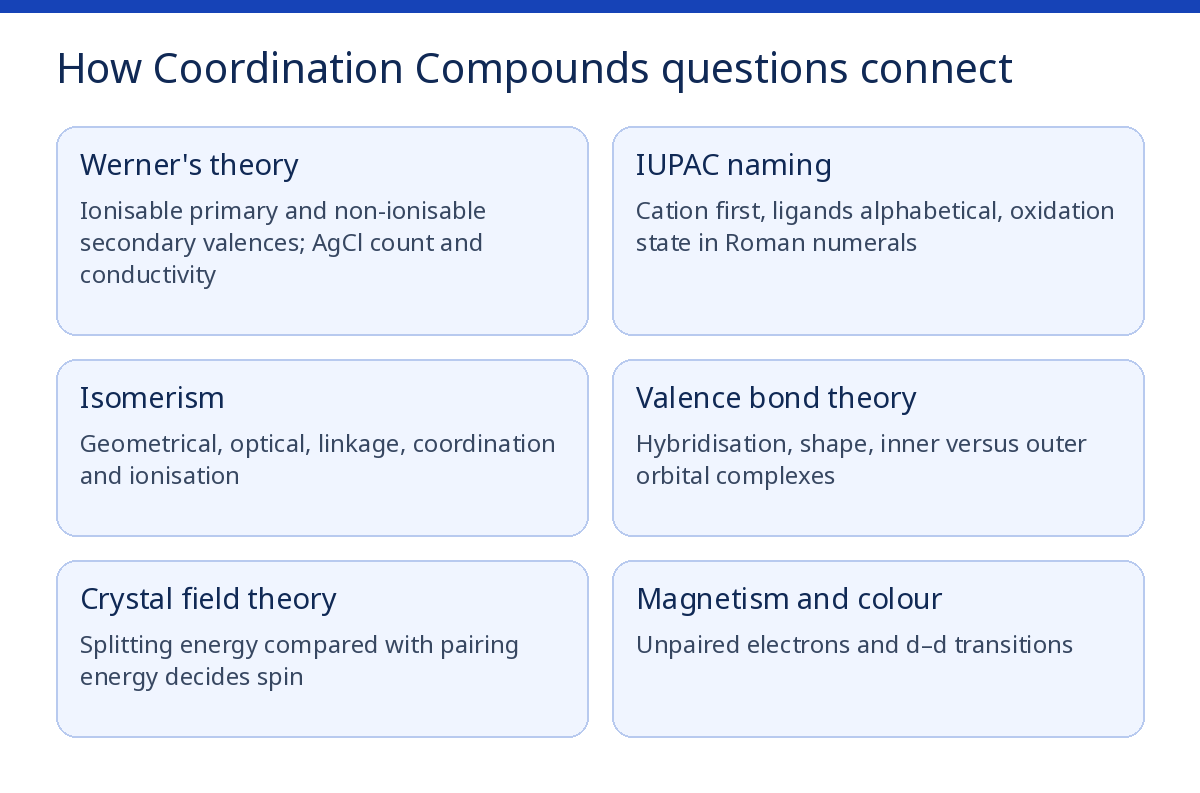
Writing IUPAC names and formulae the board way
Naming is tested in both directions: name to formula, and formula to name. Apply these conventions:
- Name the cation before the anion, even when both are complex ions, as in .
- List ligands alphabetically before the metal. Use prefixes such as bis for ligands like ethane-1,2-diamine (en).
- Give the metal's oxidation state in Roman numerals. An anionic complex takes an -ate ending, as in cobaltate.
- Mark the donor atom of an ambidentate ligand, as in tetrathiocyanato-S or O-bonded ONO.
Work out the oxidation state from the overall charge and the ligand charges before you name anything. Coordination number counts donor atoms, so a didentate ligand such as oxalate contributes two.
Deciding which isomerism a complex shows
Isomerism questions ask you to "indicate the type" or "draw the isomer". The source tests five types:
- Geometrical: the same ligands in different spatial arrangements, such as cis/trans or fac/mer.
- Optical: non-superimposable mirror images, often in complexes with chelating en.
- Linkage: an ambidentate ligand bonds through different donor atoms.
- Coordination: ligands are exchanged between cationic and anionic complex entities.
- Ionisation: an ion swaps between the coordination sphere and the counter-ion position. The isomers release different free ions, so a chemical test tells them apart.
A frequent pattern uses the type. Here you must judge which geometrical isomer is chiral. Check for a plane of symmetry before calling an isomer optically active.
Valence bond theory: inner and outer orbital complexes
VBT questions ask for hybridisation, shape and magnetic behaviour. Atomic numbers are supplied (Fe = 26, Co = 27, Ni = 28). The expected steps are:
- Find the oxidation state.
- Write the d-electron count of the ion.
- Decide whether the ligands cause pairing.
- Choose the hybrid orbitals and the geometry they give.
- Count the unpaired electrons and state whether the complex is paramagnetic or diamagnetic.
A complex that uses inner orbitals, as in , is an inner orbital complex. One that uses outer orbitals, as in , is an outer orbital complex. Four-coordinate nickel items contrast tetrahedral with square planar.
Many questions pair one metal with two different ligands. They test whether you can link ligand strength to pairing.
Crystal field theory: comparing Δo with pairing energy
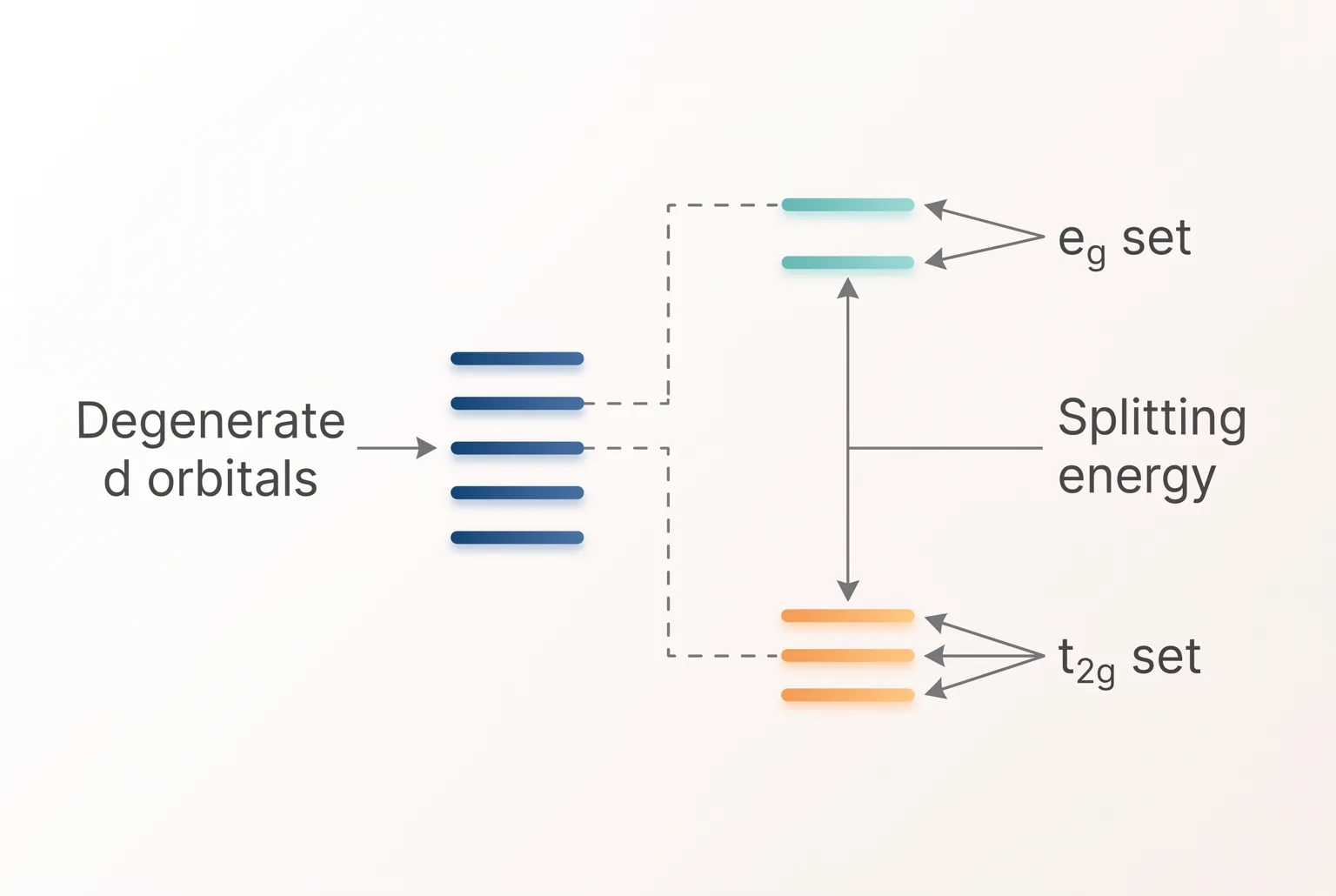
CFT treats ligands as point charges that remove the degeneracy of the d orbitals. In an octahedral field, the d orbitals split into a lower set and a higher set. The gap between them is the crystal field splitting energy, .
The board asks which orbitals rise in energy and why. The answer rests on how the orbitals point towards the approaching ligands. A case passage adds that tetrahedral splitting is smaller than octahedral splitting.
Spin follows from comparing with the pairing energy :
- When , electrons beyond the third enter singly. This is a weak field and gives high spin.
- When , electrons pair in first. This is a strong field and gives low spin.
Questions ask this for and ions, answered in form. The spectrochemical series ranks ligands by field strength.
Colour comes from d–d transitions across the gap. Before explaining a colour, first check whether such a transition is possible at all.
Common mistakes in coordination compound answers
- Treating every chloride as ionisable. Only chloride outside the coordination sphere precipitates as AgCl.
- Counting ligands instead of donor atoms. Each en or oxalate ligand contributes two donor atoms to the coordination number.
- Using the neutral atom's configuration. Take the d-electron count from the ion.
- Assuming every chelate complex is chiral. Check each geometrical isomer for symmetry.
- Dropping donor-atom markers such as -S or ONO in linkage names.
The source keeps printed slips such as "didendate" and "heterolyptic". Read these as didentate and heteroleptic.
Working through the 164 questions in topic order
Start with the terminology and naming headings in the topic finder, since later answers depend on correct formulae and oxidation states. Then work through Werner's theory, isomerism and VBT, and finish with CFT, magnetism and colour. After that, attempt the 10 case-based items, then the MCQ block. Leave the 7 assertion-reason questions for last.
The original material had only answer keys and online links, so every full solution here is labelled "Added solution". Marks appear only where they were printed. Older NCERT editions number this chapter as Chapter 9.
Quick self-check: why does a smaller tetrahedral splitting affect the comparison with ?
Frequently asked questions
Which question formats appear in this Coordination Compounds collection?
The question-type finder lists 74 subjective, 10 case-based, 73 single-answer MCQ and 7 assertion-reason questions, giving 164 questions in total.
Are the worked solutions from the original papers?
No. The supplied material had answer keys and online links but no complete written solutions. Every full solution in this edition is labelled "Added solution".
Why is this chapter called Chapter 5?
Chapter 5 follows the current CBSE Class 12 Chemistry sequence. Older NCERT editions may number it Chapter 9.
Spotted an error? Report a correction. Practise this in the app: notes, formula sheets and mind maps.















































































































































Loading comments…