Coordination Compounds: Class 12 NCERT Chemistry Notes
CBSEChemistryCoordination Compounds
These CBSE Class 12 notes connect the formula of a coordination compound to its geometry, bonding and magnetic behaviour. Use the chapter index to revisit a specific concept or follow the notes from coordination spheres to crystal-field splitting and metal carbonyls.
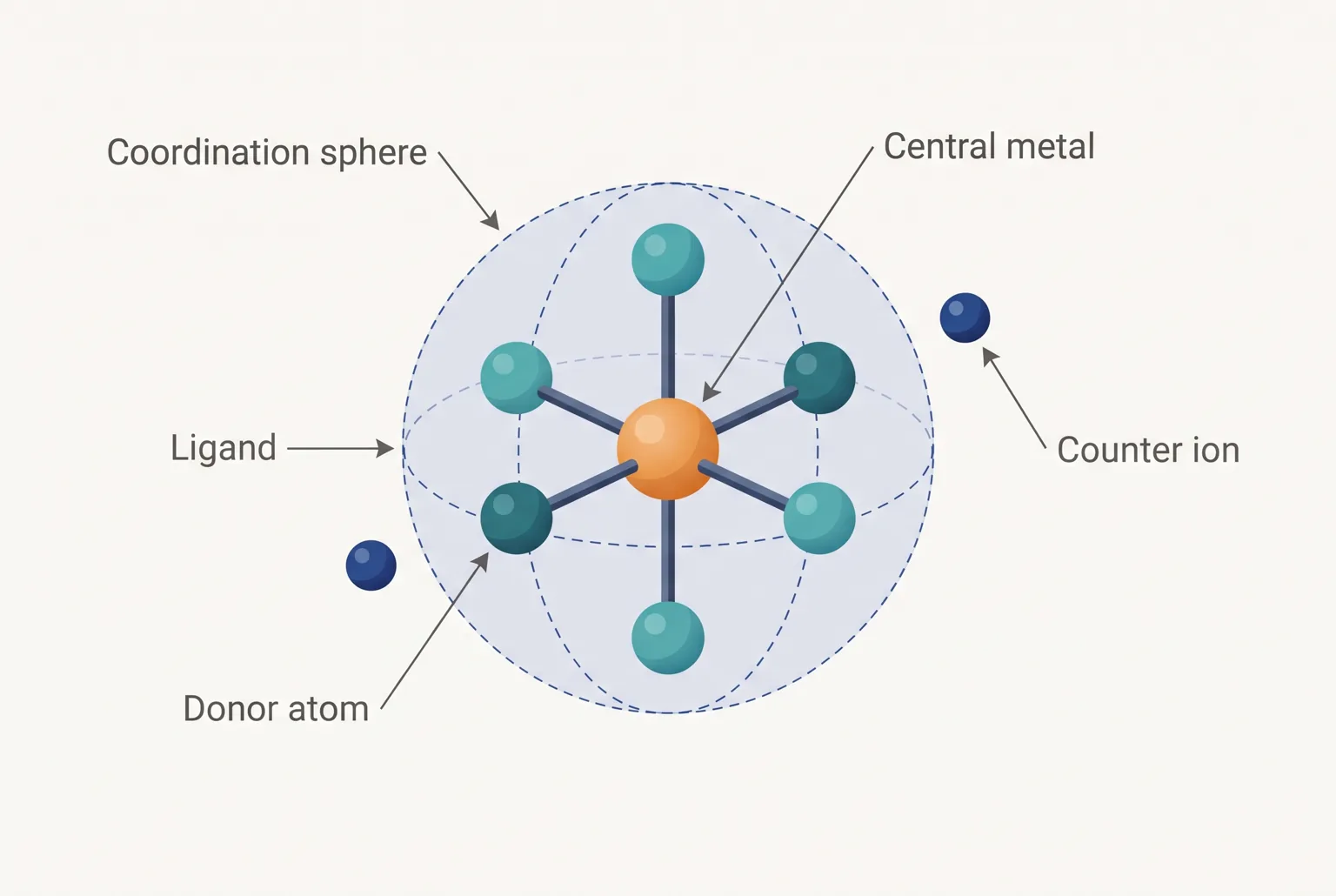
Read the coordination sphere before the rest of the formula
Start with the square brackets. In a coordination formula, they enclose the central metal and the ligands directly bonded to it. Together, these make up the coordination entity. A ligand supplies an electron pair to the metal, and the particular atom that forms the bond is its donor atom. Counter ions, when present, lie outside the brackets. They balance the charge of the entity but do not count as part of the metal’s immediate surroundings.
The notes contrast coordination compounds with double salts. A double salt gives its constituent simple ions when dissolved in water. A coordination compound with counter ions can instead release those ions while the complex ion remains intact. Read the two dissociation examples side by side to see why listing every ion separately is not the right approach for both.

Coordination Compounds | Class 12 | NCERT Notes
In the StudentCurio app
Revision notes cover coordination spheres, ligands, denticity, coordination geometry, Werner’s theory, oxidation states, isomerism and bonding, with emphasis on crystal-field splitting in octahedral and tetrahedral complexes. They also explain magnetic properties and synergic bonding in metal carbonyls, helping Class 12 students review key concepts and examples.
Common mistake: counting ligands instead of donor atoms
Denticity counts how many donor atoms from one ligand bind to the same metal centre. Coordination number counts all donor atoms directly bonded to that centre. These counts answer different questions: a bidentate ligand contributes two to the coordination number even though it is only one ligand. If binding through multiple sites closes a ring that includes the metal, the result is a chelate ring.
Do not confuse a bidentate ligand with an ambidentate one. In the linkage examples, an ambidentate ligand has two alternative donor atoms but attaches through only one at a time. Once you know which atoms are bonded, focus on their spatial arrangement. The geometry table shows why a coordination number of four does not settle the shape by itself: both tetrahedral and square planar arrangements have four donor positions.
Separate oxidation state from coordination number
Werner’s distinction between primary valence and secondary valence gives you two ways to read the same compound. Primary valence corresponds to the metal’s oxidation state. Secondary valence corresponds to its coordination number and is directed in space, which accounts for the arrangement of the groups bound to the metal. A metal’s oxidation state and coordination number need not be the same.
For charge balance, add the metal’s oxidation number to the algebraic sum of the ligand charges. The result must equal the charge of the coordination entity, not the charge of the full salt. Remember to include the charge of each ligand as many times as it occurs. By contrast, when classifying a complex as homoleptic or heteroleptic, count ligand types, not total ligands or donor atoms.
Identify what changes between two isomers
The isomerism pages are best read by comparing pairs rather than memorising names in isolation. First check whether the connectivity changes. In ionisation isomerism, a ligand and a counter ion exchange roles. In solvate isomerism, solvent molecules occupy different positions inside and outside the coordination sphere. Linkage isomerism changes the donor atom of an ambidentate ligand. Coordination isomerism changes how ligands are distributed between a complex cation and a complex anion.
In stereoisomerism, the connectivity stays the same. The square planar drawings illustrate how changing the relative positions of ligands can produce geometrical isomers without changing which atoms are bonded. Optical isomerism calls for a different test: the two structures must be mirror images that cannot be superimposed.
When the spin-only formula applies
The valence bond theory section describes ligand lone pairs overlapping with empty hybrid orbitals on the metal. Use its table to connect hybridisation with geometry and, for the octahedral cases, to distinguish the use of inner and outer d orbitals. Keep the geometry separate from the spin description: high-spin and low-spin alternatives arise only for electron configurations in which pairing and occupying higher orbitals compete.
A complex with unpaired electrons is paramagnetic; one with all electrons paired is diamagnetic. Once the number of unpaired electrons is known, the spin-only magnetic moment is . Here is the number of unpaired electrons, not the total number of d electrons, and is the Bohr magneton.
Read crystal-field diagrams from the barycentre
Crystal field theory uses an electrostatic model to explain why the five metal d orbitals no longer have the same energy in a directional ligand field. In an octahedral field, ligands approach along the axes, so the two orbitals pointing along those axes form the higher set. In a tetrahedral field, ligands approach between the axes and the order reverses: the three orbitals in the corresponding set are higher.
The barycentre is the average orbital energy in the spherical-field reference. When comparing the upward and downward shifts, account for how many orbitals are in each set: it is the average across all five that stays fixed. The splitting itself is the positive gap between the sets. The approximation compares fields with the same metal, ligands and metal–ligand distances.
Trace both directions of bonding in metal carbonyls
The final page shifts from an electrostatic model of orbital splitting to orbital interactions in metal carbonyls. In sigma donation, the carbon lone pair of carbon monoxide donates to a vacant metal orbital. In pi back-donation, a filled metal d orbital transfers electron density into a vacant antibonding orbital of carbon monoxide. The word “back” signals the reversal in direction: electron density moves from metal to ligand rather than from ligand to metal.
The notes call the effect synergic because the two interactions reinforce each other and strengthen the metal–carbon bond. When revisiting the bonding sketch, trace each arrow separately and identify its occupied starting orbital and vacant destination. That makes the distinction clearer than memorising the two labels alone.
Spotted an error? Report a correction. Practise this in the app: notes, formula sheets and mind maps.















































































































































Loading comments…