Coordination Compounds: CBSE Class 12 Case-Based Assessment
CBSEChemistryCoordination Compounds
This solved CBSE Class 12 Chemistry assessment asks you to use evidence from passages, formulas and tables to reason about coordination compounds. It covers nomenclature, isomerism, bonding models, colour and magnetism through multiple-choice, short-answer and assertion–reason questions.
What you’ll practise in this assessment
The file contains 13 numbered case studies and one unnumbered passage, with questions presented before the solutions. Some sets include OR alternatives. The clickable index lists the question and solution pages by topic, so you can select a specific case without working through the file in order. It is a case-based assessment, not a separate bank of standalone chapter exercises.
The cases ask you to work with different kinds of evidence. A nomenclature question starts with a name or formula; a Werner’s theory passage asks you to interpret observations from solution tests; a crystal-field case asks you to read absorption data. Before choosing an answer, identify which detail in the passage or formula supports it.

Coordination Compounds | Class 12 Chemistry| CBSE Case-based Assessment
In the StudentCurio app
Solved case-based and assertion–reason questions cover crystal-field theory, splitting, spin states, magnetic properties, nomenclature, isomerism, Werner’s theory, valence bond theory and chelation. Helps Class 12 CBSE Chemistry students practise applying coordination-compound concepts to exam-style cases.
Read the brackets before you name the compound
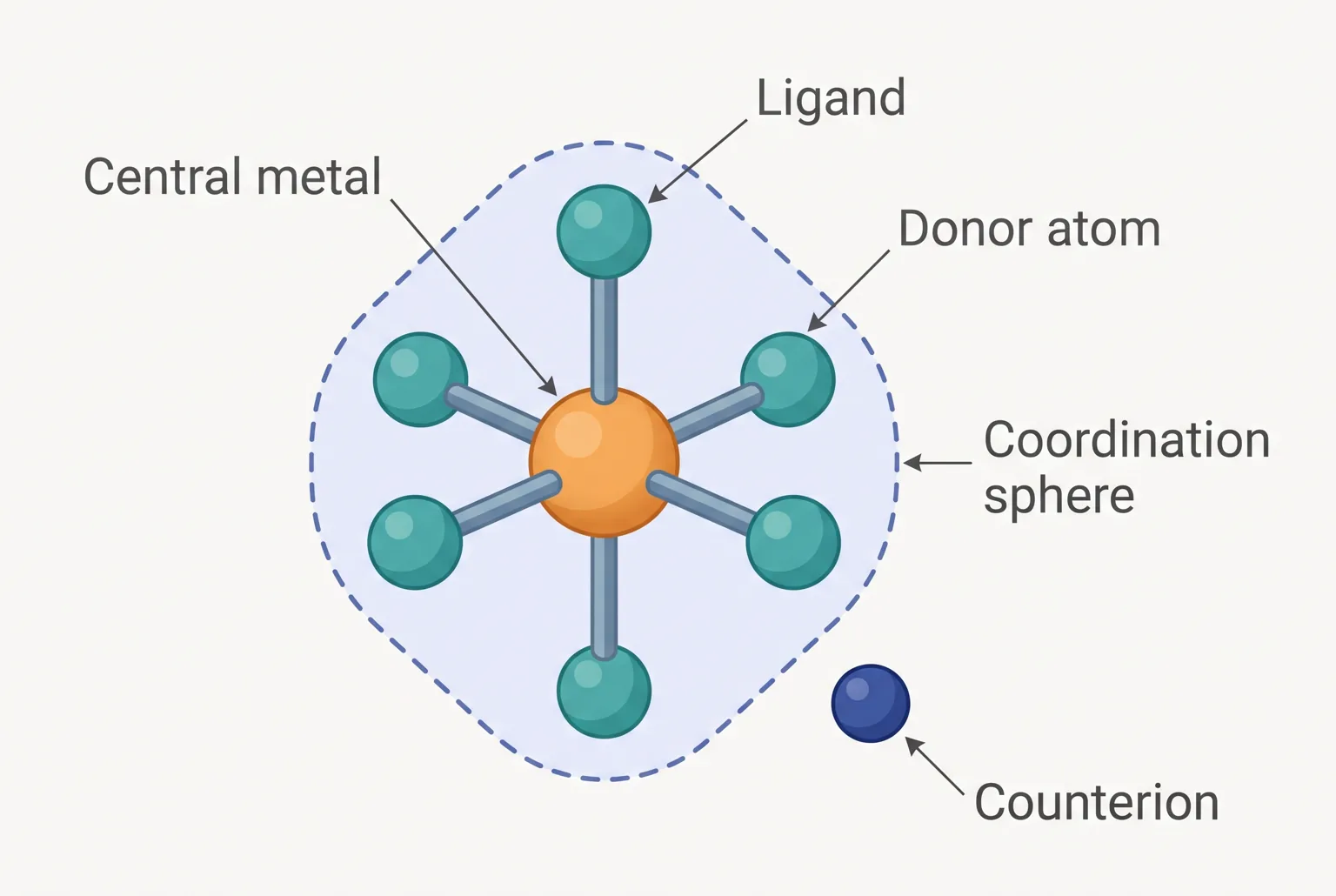
Start by separating the coordination entity from any counterions. Ligands inside the brackets are attached to the central metal; counterions outside balance the charge of the entity in an ionic compound. To find the metal’s oxidation state, use the charge of the bracketed entity: the metal’s oxidation state plus the sum of the ligand charges must equal that charge. If the formula does not show the entity’s charge explicitly, use the counterions to infer it.
For naming, separate two rules that operate at different levels. In an ionic compound, name the cation before the anion. Within the coordination entity, name the ligands before the metal and place different ligand names in alphabetical order, regardless of their charges. When going from a name to a formula, check that the ligand identities, multiplicities and charges agree with the name.
What precipitation tells you—and what it doesn’t
Werner’s distinction between primary and secondary valencies helps explain why compounds containing chloride need not release all their chloride as free ions. Secondary valency corresponds to coordination number and is associated with the arrangement of ligands around the metal. In the silver nitrate tests discussed in the cases, chloride released as free ions forms silver chloride; chloride bound to the metal is not counted as free chloride under the test conditions. Molar conductance provides a different clue about the ions furnished in solution, rather than identifying chloride specifically.
This distinction also helps with ionisation isomerism, where changing which ion is coordinated and which is outside the brackets changes the ions released. For hydrate isomerism, track whether water is coordinated or present outside the coordination sphere. For geometrical isomerism, the question is instead how the attached ligands are arranged around the metal.
Keep the two bonding models distinct
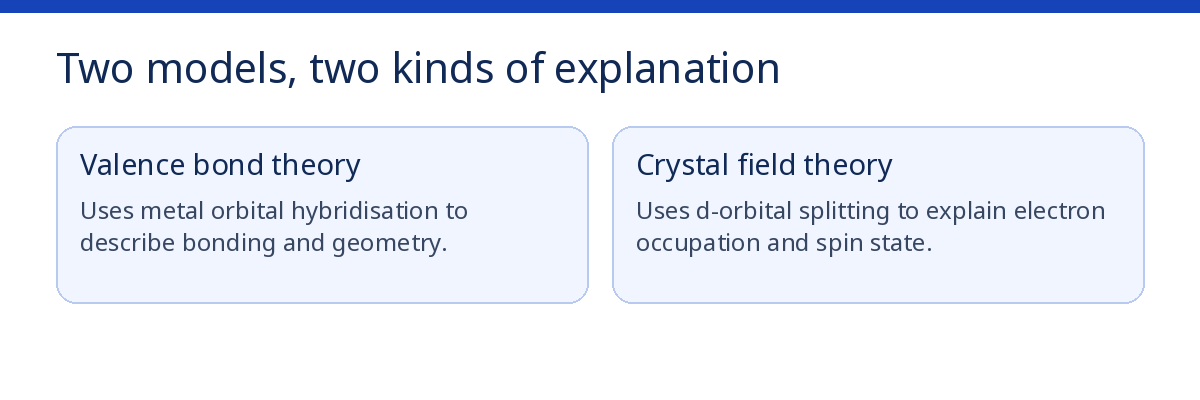
Valence bond theory uses metal orbitals and hybridisation to describe bonding and geometry. In the octahedral cases, the labels inner orbital and outer orbital distinguish whether the hybridisation uses inner or outer orbitals. Crystal field theory instead describes how the ligand environment changes the relative energies of the metal’s d orbitals. It gives you a way to reason about electron occupation and absorption that the valence bond treatment in the assessment does not provide.
The labels inner orbital and low spin are not interchangeable definitions. One identifies which metal orbitals are used in a valence bond description; the other describes electron occupation in a split set of d orbitals. When a prompt asks for both, state the basis for each description.
When splitting changes the spin state
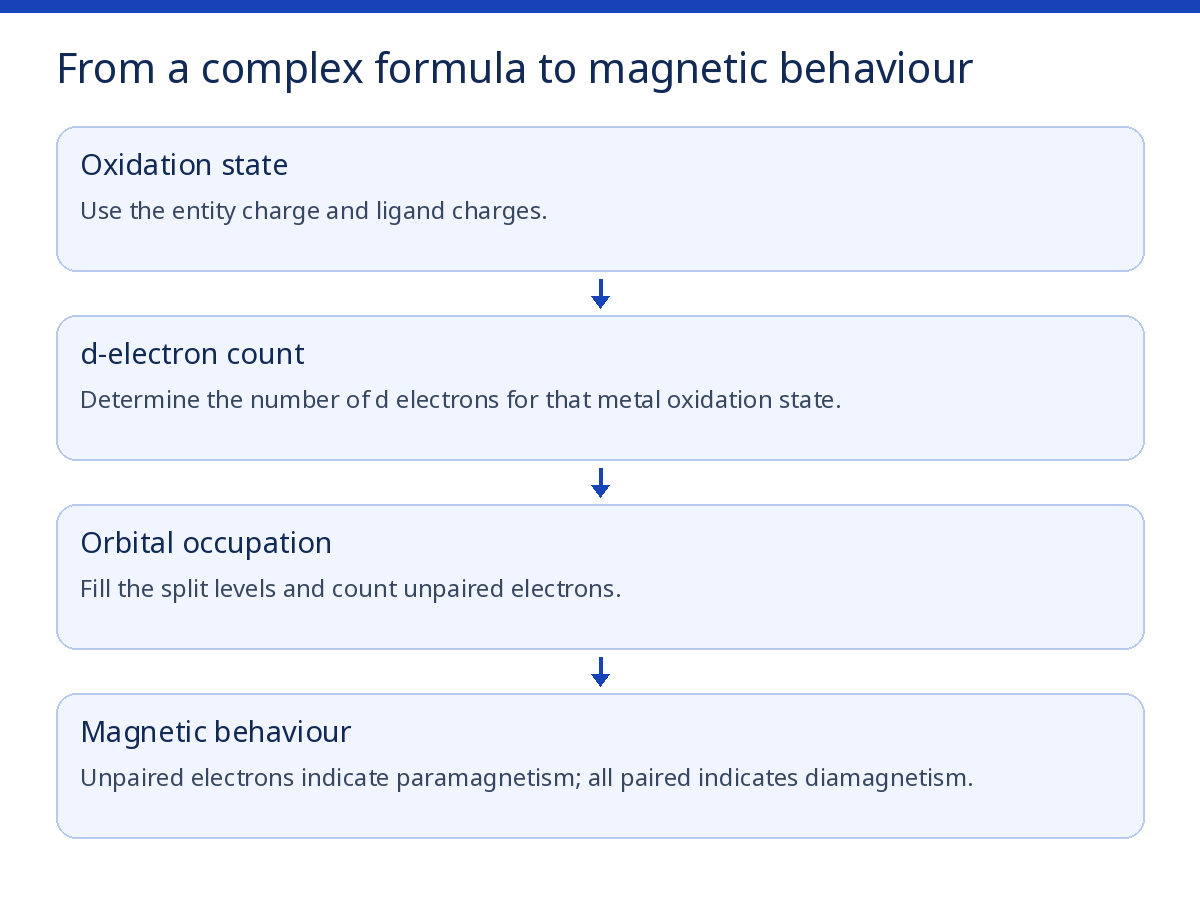
In an octahedral crystal field, the lower set is separated from the higher set by the splitting energy . Where high-spin and low-spin arrangements are possible, compare this gap with the pairing energy . If , occupying a higher orbital costs less than pairing; if , pairing in the lower set is favoured. Establish the metal ion’s d-electron count before filling the levels, then count the unpaired electrons to interpret magnetic behaviour. Unpaired electrons give rise to paramagnetism; an arrangement with all electrons paired is diamagnetic.
The chromium absorption table uses wavenumbers and molar absorbed energies to compare splitting. A higher absorption wavenumber corresponds to a higher transition energy. For the d–d absorption discussed there, distinguish the colour absorbed from the complementary colour observed. This guide omits the inconsistent formula references in Case Study 2’s third question.
Common mistake: counting ligands instead of donor atoms
The coordination number counts donor atoms directly attached to the metal, not separate ligand molecules or ions. A bidentate ligand that binds through both donor atoms contributes two to the coordination number. The dimethylglyoxime case and the later passage on denticity and chelation give you places to practise that distinction. Chelation involves a ligand binding through multiple donor atoms to the same metal and forming one or more rings.
The metal carbonyl case asks you to think about bonding in another way. Carbon monoxide can donate electron density to the metal and also accept electron density back from the metal into an empty antibonding orbital. Keep the directions of donation and back bonding distinct when explaining the metal–ligand interaction.
Quick self-check before opening a solution
Use the question-to-solution links after writing a short justification of your own. In an assertion–reason item, decide whether each statement is true separately before asking whether the reason explains the assertion. In a short-answer item on magnetism, check whether you can trace your conclusion from oxidation state through d-electron count and orbital occupation to the number of unpaired electrons.
If your conclusion differs from the solution, use the return link to revisit the first step where your reasoning diverged. In a formula question, for instance, check whether you used the charge of the bracketed entity or mistakenly treated the entire salt’s charge as the charge of the complex.
Spotted an error? Report a correction. Practise this in the app: notes, formula sheets and mind maps.















































































































































Loading comments…