CBSE Class 12 Chemistry: 2026 Supplementary Paper
CBSEChemistry2026 Previous Year Paper
Paper code: 56/7/3 · 2026Use the full 2026 CBSE Class 12 Chemistry supplementary paper, set 56/7/3, for a timed attempt. Then use the worked solutions to check the assumptions, units and chemical reasoning behind your answers.
This set is one of the year's papers. See every set from 2026, grouped by series.
Paper format and internal choices
This year-wise resource contains the English-language question paper and accompanying worked solutions. The paper allows three hours for 70 marks, and calculators are not permitted. Its 33 questions are divided into five sections: one-mark multiple-choice questions in A, two-mark very short answers in B, three-mark short answers in C, four-mark case-based questions in D, and five-mark long answers in E. Section A includes assertion–reason items as well as other multiple-choice formats.
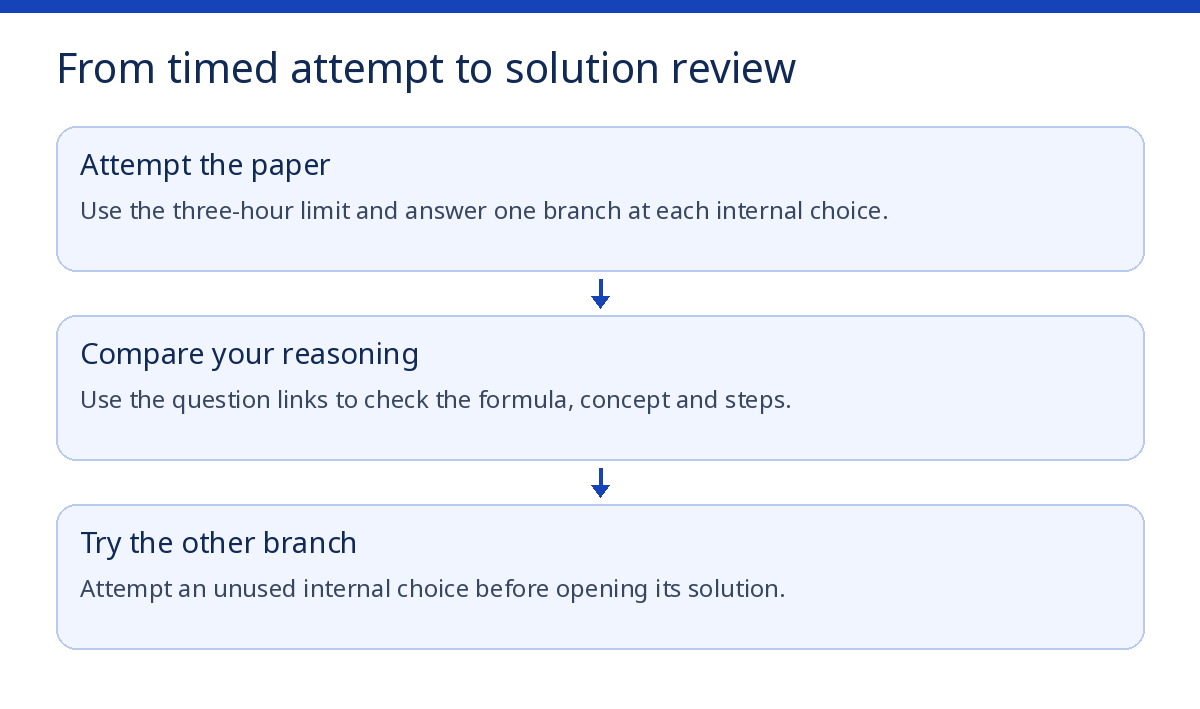
There is no overall choice. All questions are compulsory, but some questions outside Section A offer internal alternatives. For a timed attempt, answer only one branch wherever an OR appears. The resource provides worked solutions to both printed branches, so you can attempt the branch you skipped after marking your first attempt.

Chemistry Supplementary 2026 | Class 12 | Previous Year Paper | Code 56/7/3
In the StudentCurio app
A worked CBSE Class 12 Chemistry supplementary examination paper for 2026, covering questions across topics including coordination compounds, chemical kinetics, electrochemistry, solutions and organic chemistry. Helps students practise board-exam questions and review their solutions.
Solutions and electrochemistry: choose the right quantity
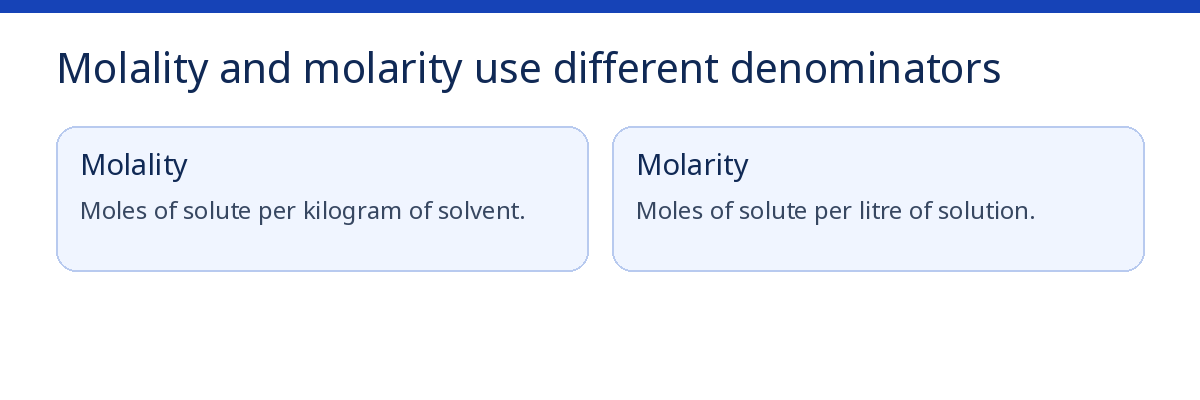
The solutions questions cover vapour pressure, freezing-point depression and other colligative properties. Start by identifying the property being measured and the concentration measure it requires. Molality is moles of solute per kilogram of solvent; molarity is moles of solute per litre of solution. When a question explicitly assumes complete dissociation, account for the ions produced rather than treating each dissolved formula unit as one particle. Complete dissociation is an assumption to check, not a rule to apply to every dissolved substance.
Electrochemistry ranges from electrode processes and cell operation to conductivity and dissociation. Distinguish measured conductivity, in , from molar conductivity, in . The paper also supplies limiting ionic molar conductivities for a weak acid. These refer to ions at infinite dilution, not to the conductivity measured at the stated concentration. For battery questions, check the operating condition too: a lead storage battery in use is discharging, not charging.
Kinetics: separate rate from time elapsed
A short kinetics question changes the concentration of the reactant in a second-order reaction and asks what happens to the rate. A long question uses reaction progress and elapsed time and also asks you to interpret a graph involving the natural logarithm of reactant concentration. A rate law relates the rate to concentration at a given moment. An integrated rate law relates concentration to time. Identifying which relationship the prompt calls for is more useful than reaching for a formula as soon as you see the reaction order.
Before using a completion percentage: distinguish the fraction that has reacted from the fraction still present. An integrated concentration–time expression uses the concentration remaining relative to the initial concentration, not the fraction consumed. When reviewing the graph part, read both axis labels before interpreting the straight line.
From transition-metal trends to coordination structure
The transition-metal case links atomic radius to the competing effects of increasing nuclear charge and shielding across a series. It also relates the similarity in size between the second and third transition series to lanthanoid contraction. Use the case to practise separating an observation from its explanation: describing the limited change in radius across much of a series does not explain what keeps the change small.
The coordination questions move from Werner’s terminology to naming, formula writing, isomerism and magnetic behaviour. Count donor atoms, not ligands, when determining coordination number: a single ligand can bind through more than one donor atom. In an orbital or magnetism explanation, establish the metal ion’s electron configuration before discussing the effect of the ligands. That intermediate step lets you explain the predicted property rather than simply naming it.
Organic chemistry: check structure and reaction conditions
The organic questions go beyond product recall. They include distinguishing aldehydes from ketones, explaining differences in acidity and solubility, comparing substitution in haloarenes and haloalkanes, and writing amine conversions. The amines section also specifies the gas phase for a basicity comparison. Keep that qualifier in view rather than assuming that an order learned for aqueous solution applies unchanged. Biomolecules questions switch to shorter structural and descriptive tasks involving nucleic acids, starch, proteins and vitamins.
Check the carbon next to the carbonyl. In the carbonyl case, the presence of an alpha hydrogen matters for aldol chemistry under dilute alkali. The Cannizzaro reaction instead applies to aldehydes without an alpha hydrogen under concentrated alkali. Keep both the compound class and reaction conditions in view: the absence of an alpha hydrogen does not put every carbonyl compound in the second category.
Use the worked solutions to find where your reasoning changed
Keep the solutions closed for your first attempt and use the printed mark allocations to gauge how much each response needs to show. In assertion–reason items, judge each statement independently before deciding whether the reason explains the assertion. In the case-based questions, read the passage, then identify which subparts ask you to apply a condition and which ask you to explain a trend or observation.
Afterwards, use the question-number links to compare your work with the file’s Formula used, Concept used and Explanation in steps entries where applicable. For a calculation, trace the first difference in setup, such as the concentration basis or a dissociation assumption, before checking the arithmetic. For a written response, check that you supplied a chemical reason rather than restating the observation. This guide leaves out the ether-cleavage option labels and the specific complex-stability comparison.
Spotted an error? Report a correction. Practise this in the app: notes, formula sheets and mind maps.















































































































































Loading comments…