CBSE Class 12 Chemistry Supplementary Paper 2025
CBSEChemistry2025 Previous Year Paper
Paper code: 56(B)/S · 2025Practise with the full 2025 CBSE Class 12 Chemistry supplementary paper, adapted for visually impaired candidates. Use the worked solutions to check not just your final answers but also whether you chose the right principle, used it under the right conditions and explained your reasoning.
This set is one of the year's papers. See every set from 2025, grouped by series.
Know the format of this adapted paper
This English-version theory paper, code 56(B)/S, has 33 questions for 70 marks. The title page gives a writing time of three hours and specifies a separate 15-minute reading period during which candidates do not write answers. Calculators are not allowed. These details are for this adapted supplementary paper.
Section A has sixteen one-mark questions, including assertion–reason items. Sections B and C have five two-mark and seven three-mark questions, respectively. Section D has two four-mark case-based questions, and Section E has three five-mark long-answer questions. All question numbers are compulsory, but some questions outside Section A offer internal choices. When taking the paper under timed conditions, answer only one branch of a printed OR. Save the unused branch for revision.

Chemistry Supplementary 2025 | Class 12 | Previous Year Paper | Code 56(B)/S
In the StudentCurio app
Complete 2025 CBSE Class 12 Chemistry supplementary examination paper, adapted for visually impaired candidates, with worked solutions. It includes questions across physical, inorganic and organic chemistry, supporting board-exam practice and revision.
Physical chemistry: identify what the data describe
The solutions questions move between vapour pressure, colligative properties and departures from Raoult’s law. In a vapour-pressure calculation, distinguish the pressure of the pure solvent from that of the solution at the same temperature. When applying the ideal-solution relation for a non-volatile solute, it is the solvent that contributes to the vapour pressure. And when discussing azeotropes, keep the condition specific: the liquid and equilibrium vapour have the same composition at the azeotropic composition and a fixed pressure.
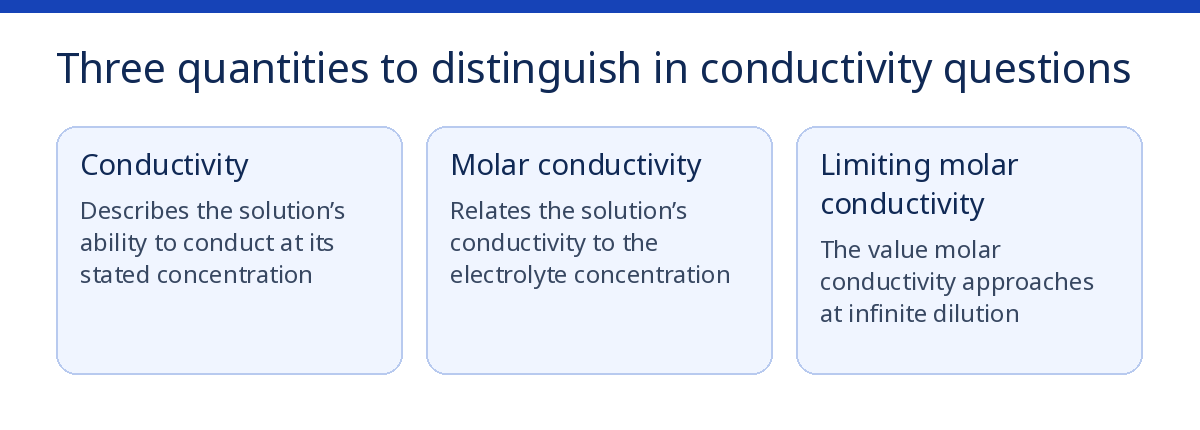
The electrochemistry questions ask you to work with both cell potentials and conductivity. For an emf calculation, check whether the stated conditions are standard before treating a tabulated standard potential as the value under those conditions. For conductivity, distinguish the measured conductivity of a solution from its molar conductivity and from the limiting value at infinite dilution. This guide omits the numerical dilution comparison in Q22.

Quick self-check: which kind of rate are you using?
Kinetics appears in both short items and a case-based passage. The paper asks you to work with species concentration changes, a stated rate law, first-order completion times and the temperature dependence of a rate constant. These tasks call for different starting points. Stoichiometric coefficients relate the rates of appearance and disappearance of species; the powers in a rate law tell you how the reaction rate depends on concentrations. Do not read those powers from the balanced equation for an overall reaction.
Before writing an equation, ask yourself: am I comparing the rates of two species, finding a time for a specified extent of reaction, or considering how the rate constant changes? Use a first-order integrated rate equation only when first-order kinetics applies. In an Arrhenius discussion, distinguish changing the temperature from changing the reaction pathway through catalysis.
Inorganic chemistry: build the explanation from the ion
The coordination questions test several properties that can be confused if you start from the formula alone. Oxidation state is a formal charge assignment; coordination number counts donor atoms directly attached to the metal. For a magnetic comparison, work from the metal ion’s electron count and consider how the ligands affect electron pairing. Comparing two complexes of the same metal is useful precisely because a shared metal does not guarantee the same magnetic behaviour.
For crystal field splitting, keep the geometry attached to the symbol: refers to tetrahedral splitting and to octahedral splitting. The latter subscript is the letter o, not zero. Transition-element questions also ask for explanations of redox behaviour and contraction trends, so practise giving a reason for a comparison rather than just naming the trend.
Organic chemistry: keep the conditions with the reaction
The organic questions cover halo compounds, alcohols, phenols, ethers, amines and carbonyl compounds. They require different kinds of responses: predicting what happens under stated conditions, planning a conversion, explaining a named reaction or distinguishing two compounds. A conversion asks for a route to a target structure; a chemical test asks for an observation that lets you tell the starting compounds apart.
When reviewing a reaction, keep the substrate, reagent and conditions together. The paper explicitly distinguishes conditions such as dry ether and aqueous alkali; the medium is part of the question, not a detail to ignore. In the amines case, basic strength and water solubility are separate comparisons. An explanation about the availability of nitrogen’s lone pair addresses basicity, but it is not by itself an explanation of solubility.
A useful distinction: biomolecule structure versus properties
The biomolecules questions move from short definitions to comparisons. Protein questions distinguish how a chain is linked, how it is folded and what changes during denaturation. When you review these together, ask whether your explanation concerns the bonds that build the chain or the interactions that help maintain a particular shape. That distinction prevents you from using a description of one structural level to answer a question about another.
For paired terms, compare both members on the same basis. A comparison of nucleosides and nucleotides calls for a structural criterion, whereas a comparison of essential and non-essential amino acids calls for a nutritional one. Using the same criterion on both sides makes the difference explicit.
Use the worked solutions to locate your first error
Attempt the paper before opening the solutions. Then use the question-number navigation and the formula, concept and step-by-step labels to find where your reasoning first differed. In a calculation, that might be the choice of equation or the interpretation of a quantity. In an assertion–reason item, check the truth of the two statements separately before deciding whether the reason explains the assertion. For a written explanation, check whether you named the governing concept and connected it to the facts in the question. Finally, attempt an unused OR branch without notes to see whether you can apply the idea in a different question.
Spotted an error? Report a correction. Practise this in the app: notes, formula sheets and mind maps.















































































































































Loading comments…